
As UPSC CSE Prelims 2027 is still ahead, building a strong foundation alongside regular current affairs preparation is essential. UPSC Weekly Quiz is a current affairs–based quiz on relevant topics from the past week, curated for aspirants of competitive examinations. Attempt the weekly quiz every Saturday and review the detailed answers with explanations to strengthen conceptual clarity and exam readiness.
🚨 Click Here to read the UPSC Essentials magazine for October 2026. Share your views and suggestions in the comment box or at manas.srivastava@indianexpress.com🚨

QUESTION 1
With reference to Section 17A of the Prevention of Corruption Act, 1988, consider the following statements:
1. Public servants accused of demanding bribes are entitled to prior approval under Section 17A before an investigation can be initiated, irrespective of whether the alleged act is connected with their official duties.
2. The Supreme Court has held that Section 17A does not apply to allegations of demanding bribes that are unconnected with a public servant’s official functions or duties.
Which one of the following is correct in respect of the above statements?
(a) Both Statement 1 and Statement 2 are correct and Statement 2 is the correct explanation for Statement 1.
(b) Both Statement 1 and Statement 2 are correct and Statement 2 is not the correct explanation for Statement 1.
(c) Statement 1 is incorrect but Statement 2 is correct.
(d) Statement 1 is correct but Statement 2 is incorrect.
Why this question for UPSC Prelims 2027?
The Supreme Court’s interpretation of Section 17A of the Prevention of Corruption Act is relevant to the legal safeguards governing investigations into corruption allegations against public servants. It is relevant to the Indian Polity and Governance syllabus, particularly statutory safeguards, administrative accountability and the role of the judiciary.
Explanation
— A bench comprising Justices S V N Bhatti and N V Anjaria dismissed an appeal by a Rajasthan police constable who had challenged the framing of a bribery charge against him. The court held that the alleged demand for a bribe of Rs 1.5 lakh was not linked to any official decision or recommendation he made.
— It said, “The act of demanding a bribe is a pure criminal act, not connected with official functions and not relatable to or having any linkage with recommendation or decision of the appellant in his capacity, as public servant.”
— Section 17A does not provide blanket protection to public servants in every case. Its prior-approval requirement applies to investigations into alleged offences related to recommendations made or decisions taken in the discharge of official functions or duties. Hence, statement 1 is not correct.
— The Supreme Court held that demanding a bribe is a criminal act unrelated to official functions when it is not connected with an official decision or recommendation. Therefore, Section 17A’s prior-approval requirement does not apply in such cases. Hence, statement 2 is correct.
Therefore, option (c) is the correct answer.
QUESTION 2
With reference to the satellite NVS-03, consider the following statements:
1. It is a navigation satellite.
2. The satellite is likely to restore the functioning of India’s satellite-based positioning system – NavIC.
3. The satellite will be launched on board the PSLV-C62.
How many of the statements given above are correct?
(a) Only one
(b) Only two
(c) All three
(d) None
Why this question for UPSC Prelims 2027?
The question is relevant to UPSC Prelims 2027 under Science and Technology, particularly space technology and satellite-based navigation systems. It also links a current space mission with the broader applications of satellite technology in communication, navigation and national infrastructure.
Explanation
— The Indian Space Research Organisation (ISRO) is slated to launch the much-awaited NVS-03 on board the GSLV Mk II. Hence, statement 3 is not correct.
— The NVS-03 is the third new-generation navigation satellite, which is likely to restore the functioning of India’s satellite-based positioning system, NavIC, which had stopped providing location data after the end of life and failure of atomic clocks, and recent failed launches of its satellites. Hence, statements 1 and 2 are correct.
— The new satellite, whose launch has been in the pipeline since late 2025 but has been delayed by multiple factors, will help the NavIC system meet the minimum requirement of four operational satellites to provide positioning data again.
What is NavIC?
— NavIC, which stands for Navigation with Indian Constellation, is the operational name for the Indian Regional Navigation Satellite System (IRNSS). A seven-satellite constellation that covers the Indian subcontinent and a region up to 1,500 km around it, NavIC is a regional satellite-based navigation system similar to the US’s Global Positioning System (GPS).
— With all seven satellites functional, the system was designed to provide location accurately up to 10 metres, which would be open to the public. A more accurate restrictive service would also be available for a fee to select users, such as those undertaking massive construction projects or the military. Incidentally, the space agency started work on NavIC in 1999 after the Kargil war, where Indian defence forces could not use the US-owned GPS system to provide locational aid to its soldiers in conflict zones.
— The system, when functional, can provide better coverage over the Indian landmass compared with the GPS, whose signals are received in India at an angle that makes it difficult to access in certain areas such as valleys and forests.
— A full-fledged NavIC system can help achieve the government’s goal of real-time tracking of around 12,000 trains, with around 8,700 trains already equipped with the system.
Therefore, option (b) is the correct answer.
QUESTION 3
Recently, the places ‘Asaphila’ and ‘Taksing’ were in the news due to face-offs between Indian forces and China’s People’s Liberation Army (PLA) troops. These places are located in:
(a) Himachal Pradesh
(b) Ladakh
(c) Sikkim
(d) Arunachal Pradesh
Why this question for UPSC Prelims 2027?
The question is relevant to UPSC Prelims 2027 under Indian and World Geography and International Relations. It helps assess awareness of India’s international boundaries and strategically important locations.
Explanation
— Amid recent reports of a face-off between Chinese and Indian troops in Arunachal Pradesh, the Ministry of External Affairs (MEA) said that friction points typically occur when Chinese forces depart from established patrolling patterns in border pockets. The comments came in the wake of Indo-Tibetan Border Police (ITBP) Director General Shatrujeet Kapur confirming that Indian and Chinese troops had faced off at multiple locations in Arunachal Pradesh, and that the situation continued.
— Since late July 2026, according to reports, China’s People’s Liberation Army (PLA) troops have engaged in face-offs with Indian forces near Asaphila and Taksing in the Upper Subansiri district of Arunachal Pradesh, including pitching tents within 6-7 km of India’s perception of the Line of Actual Control (LAC).
— Beijing refers to Arunachal as Zangnan or South Tibet and claims that it belongs to China. New Delhi strongly rejects China’s territorial claims with regard to Arunachal, with the Ministry of External Affairs reiterating that Arunachal Pradesh is an “inalienable and integral part of India”.
Therefore, option (d) is the correct answer.
QUESTION 4
With reference to the Census in India, consider the following statements:
1. The Census Act, 1948, gives the central government power to appoint persons as census-officers to take, aid in or supervise the Census within a specified area.
2. A recent amendment to the Census Rules, 1990 provides for appointing Census enumerators from unaided private educational institutions’ officials.
Which of the statements given above is/are correct?
(a) 1 only
(b) 2 only
(c) Both 1 and 2
(d) Neither 1 nor 2
Why this question for UPSC Prelims 2027?
The question is relevant to UPSC Prelims 2027 under Indian Polity and Governance, particularly statutory provisions and the Census framework. It tests knowledge of the Census Act, 1948, and the Census Rules, 1990, including the roles of authorities involved in conducting the Census.
Explanation
— On October 16, the Centre amended the Census Rules, 1990 to expressly provide that teachers of government, local authority, aided as well as unaided private educational institutions may be appointed as Census enumerators. It similarly included officials of establishments such as banks, companies, institutions, societies and trusts. Hence, statement 2 is correct.
— But the amendment also retains a much wider category: “any person” whom a state government or Union Territory administration considers suitable to perform the duties of an enumerator.
— Section 4(2) of the Census Act, 1948 gives the state government power to “appoint persons as census-officers” to take, aid in or supervise the Census within a specified area. Importantly, it adds that such persons, “when so appointed, shall be bound to serve accordingly”. Hence, statement 1 is not correct.
Therefore, option (b) is the correct answer.
To read more: Census 2027: Can private teachers or citizens be forced to do Census duty?
QUESTION 5
With reference to the Legislative Councils, consider the following statements:
1. There are only four states in India having Legislative Councils.
2. The Legislative Council serves as a second layer for deliberations during the lawmaking process.
3. The origin of the Legislative Councils traces back to the Morley-Minto reforms.
4. The members of the Legislative Councils are chosen through direct elections.
How many of the statements given above are correct?
(a) Only one
(b) Only two
(c) Only three
(d) All four
Why this question for UPSC Prelims 2027?
This question is relevant to UPSC Prelims 2027 under Indian Polity, particularly the state legislature and its constitutional framework. The topic is important for examining bicameralism at the state level and the constitutional provisions governing legislative institutions.
Explanation
— Elections to 28 seats across the Legislative Councils of Uttar Pradesh, Bihar, Maharashtra and Karnataka were held, with results to be declared on October 27. There are total of six states having Legislative councils Uttar Pradesh, Bihar, Maharashtra and Karnataka, Telangana and Andhra Pradesh. Hence, statement 1 is not correct.
— The colonial history of the system traces back to the Montagu-Chelmsford reforms, which led to the formation of the Council of State at the national level in 1919. Then the Government of India Act of 1935 set up bicameral legislatures in Indian provinces. It was under this law that a Legislative Council first started functioning in Bengal in 1937. Hence, statement 3 is not correct.
— Similar to the Rajya Sabha, the Legislative Council serves as a second layer for deliberations during the lawmaking process. The two share many similarities — Bills need its approval to become law; only those aged above 30 can contest for a seat (unlike 25 for Lok Sabha and Legislative Assemblies), and their members are chosen for six-year terms through indirect elections. The two bodies also cannot be dissolved, and one-third of the members retire every two years. Hence, statement 2 is correct and statement 4 is not correct.
— Elections to the Legislative Council are seen as a political barometer by parties, indicating support among educated groups and professionals, or their overall position before key elections, like in the case of UP now.
— Article 169 of the Constitution concerns the Legislative Council. Parliament can pass a law to create or abolish a Legislative Council, “if the Legislative Assembly of the State passes a resolution to that effect by a majority of the total membership of the Assembly and by a majority of not less than two-thirds of the members of the Assembly present and voting.”
— Article 171 lays out its composition. The total number of MLCs cannot be more than one-third of the total number of MLAs in a state, and cannot be less than 40.
Therefore, option (a) is the correct answer.
QUESTION 6
With reference to the Shamonda virus, consider the following statements:
1. It is a vector-borne virus.
2. It belongs to the Flavivirus group of viruses.
3. The virus was first isolated in cattle in Brazil.
4. It spread through bites from Culicoides midges.
How many of the statements given above are correct?
(a) Only two
(b) Only three
(c) All four
(d) None
Why this question for UPSC Prelims 2027?
The question is relevant to UPSC Prelims 2027 under Science and Technology, particularly virology and emerging infectious diseases. The topic also highlights the importance of animal health surveillance, zoonotic disease risks and the One Health approach.
Explanation
— France has confirmed the first known human case of Shamonda virus in a patient who died at a Lyon hospital earlier in October. This raises questions about the risks posed by a virus that has reached Europe this year decades after first being detected in Nigeria.
— The Shamonda virus is a vector-borne virus belonging to the genus Orthobunyavirus in the family Peribunyaviridae. It is part of the Simbu group of viruses, which also includes Schmallenberg virus — which is known to cause congenital malformations and stillbirths in cattle and other domesticated species. Hence, statement 1 is correct and statement 2 is not correct.
— The virus, first isolated in cattle in Nigeria in 1965 and since identified in parts of Africa, Asia, and Europe, is understood to spread through bites from Culicoides midges (small, two-winged fly-like insects). Although recent reports have primarily concerned cattle, cases have also been reported in sheep, goats, horses, and even alpacas. Hence, statement 3 is not correct and statement 4 is correct.
— Fever, diarrhoea, reduced milk production, and reproductive disorders such as abortions and foetal malformations are some of the signs reported in animals — neurological signs are less common. Since these can often resemble other diseases, laboratory testing is needed to confirm infection.
— According to the World Organisation for Animal Health (WOAH), two different variants of the virus — Shamonda virus Europe 1 (SHAV-EU1) and Shamonda virus Europe 2 (SHAV-EU2) — have caused this year’s outbreaks in Europe. Although its long-term impact and significance in Europe is still unclear, outbreaks caused by the Simbu group tend to occur in cycles as per the seasonal patterns of midges. The behaviour of the European variants of Shamonda, especially in cattle populations that are immunologically naive, may differ from that of the virus in endemic countries, WOAH noted.
Therefore, option (a) is the correct answer.
To read more: First human case of Shamonda virus: What is it, what are the risks
QUESTION 7
With reference to the carbon capture, utilisation and storage (CCUS) technologies, consider the following statements:
1. It can prevent industrial carbon dioxide emissions from entering the atmosphere.
2. The captured CO₂ can either be stored deep underground in suitable geological formations or reused to make products such as chemicals.
3. India’s Union Budget 2026 has no mention of CCUS technologies.
4. CCUS can be used only in the power generation sector.
Which of the statements given above are correct?
(a) 1, 2, 3, and 4
(b) 2, 3 and 4 only
(c) 1 and 3 only
(d) 1 and 2 only
Why this question for UPSC Prelims 2027?
CCUS is relevant to climate change mitigation and the reduction of industrial greenhouse gas emissions. The topic links environmental technology with industrial decarbonisation, carbon storage and India’s long-term climate commitments.
Explanation
— The just-released Emissions Gap Report, an annual publication by the UN Environment Programme, acknowledges what has been evident for quite some time now — that a breach of 1.5 degree Celsius temperature target set in the Paris Agreement is unavoidable now. Global temperatures are almost certain to rise up to at least 1.8 degree Celsius from pre-industrial times, and human efforts would need to be focused to pull it back from there to the 1.5 degree Celsius level sometime in the second half of this century.
— The technologies (CCS/CCUS) are an integral part to every pathway that leads us to a climate resilient future. The net-zero pathways of countries are also dependent on these. However, successful deployment of this combination of technologies at scale has remained a big challenge.
— CCUS, short for carbon capture, utilisation and storage, refers to a range of technologies that capture carbon dioxide (CO₂) emitted by industries such as steel, cement and power generation, preventing it from entering the atmosphere. The captured CO₂ can either be stored deep underground in suitable geological formations or reused to make products such as chemicals. Hence, statements 1 and 2 are correct and statement 4 is not correct.
— These technologies are particularly relevant for industries where cutting emissions is difficult, even with a shift to cleaner energy. However, their widespread adoption remains constrained by high costs and the challenge of scaling up existing technologies.
— India’s Union Budget 2026 has rightly earmarked Rs 20,000 crore for CCUS technologies over the next five years with the goal of achieving industrial growth while meeting net-zero targets. About 20% (Rs 4,000 crore) of India’s announced CCUS budget can be invested in translational innovation, research and breakthrough projects, as well as pilot validation. This portion of the budget must be used to assess the potential of diverse solutions to avoid costly, unpredictable failures in the future. Hence, statement 3 is not correct.
Therefore, option (d) is the correct answer.
QUESTION 8
With reference to Khajuraho, consider the following statements:
1. The city is home to one of India’s largest groups of medieval temples.
2. The site rose to prominence under the Paramaras of Malwa between the 10th and 12th centuries.
3. The city of Khajuraho has temples confined to Hindu traditions only.
How many of the statements given above are correct?
(a) Only one
(b) Only two
(c) All three
(d) None
Why this question for UPSC Prelims 2027?
Khajuraho is important for understanding medieval Indian temple architecture, sculpture and cultural heritage. It is relevant to the Art and Culture syllabus, particularly temple architecture, UNESCO World Heritage Sites and the religious traditions of medieval India.
Explanation
— The well-known headless idol of Vishnu at Khajuraho’s Javari temple may soon be restored. The Archaeological Survey of India (ASI) plans to re-attach the long-lost sandstone head, which has now reportedly been found in an ASI store, by November.
— The restoration plan brings renewed attention to Khajuraho, home to one of India’s largest groups of medieval temples. Located in Madhya Pradesh, the site rose to prominence under the Chandela rulers between the 10th and 12th centuries. It is believed to have once covered 13 sq. km and contained 85 temples, of which around 20 survive today in varying states of preservation. Hence, statement 1 is correct and statement 2 is not correct.
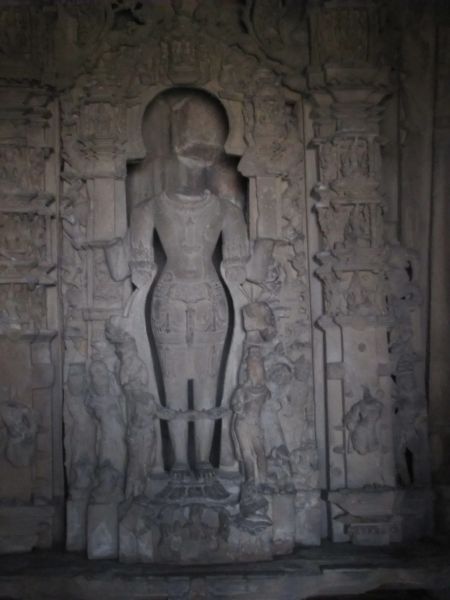 The headless Vishnu idol in Khajuraho’s Javari Temple. (Wikimedia Commons)
— The antiquity of Khajuraho can be traced to prehistoric times, with artefacts from the Middle and Late Stone Ages and the Neolithic period unearthed at the site. However, there is no evidence of a township here before 900 CE. In Khajuraho (2000), author Devangana Desai writes: “The building of the temples at Khajuraho began from AD 900 onwards, when local chieftains of the Chandella family amassed power and wealth and rose to be a major political dynasty in northern India.”
— The Chandela rulers commissioned the temples of Khajuraho as expressions of religious devotion, royal patronage, political legitimacy, and cultural accomplishment. Dedicated to Hindu and Jain traditions, these monuments reflect a period when kingship, sacred architecture, and artistic excellence were closely intertwined. Hence, statement 3 is not correct.
Therefore, option (a) is the correct answer.
QUESTION 9
The term “cryptographic key” refers to:
a) A digital certificate used to verify the identity of a website or user.
(b) A mathematical algorithm used to convert plaintext into ciphertext.
(c) A parameter used in conjunction with a cryptographic algorithm that determines its operation.
(d) A software program used to detect and remove malicious code from computer systems.
Why this question for UPSC Prelims 2027?
The topic helps distinguish cryptographic keys from encryption algorithms, digital certificates and other cybersecurity tools. It is relevant to Science and Technology, particularly cybersecurity, encryption, digital authentication and the protection of sensitive information.
Explanation
— Some of the world’s biggest Internet browser companies, including Google, Mozilla, Apple and Microsoft, have taken action to block digital certificates associated with Bengaluru-based eMudhra, after a serious security flaw was detected in the company’s systems for generating cryptographic keys. The flaw could have allowed attackers to impersonate legitimate websites and intercept supposedly secure Internet communications.
— The incident has raised concerns about the broader security of the Internet, which relies on a system of trust between browsers and certification authorities to authenticate websites and secure online communications. A lapse at even one certification authority could undermine this system, potentially allowing attackers to create fraudulent digital certificates, impersonate legitimate websites and intercept sensitive information. It also raises questions about the safeguards in place at organisations entrusted with securing large parts of the Internet’s infrastructure.
— The incident concerns eight intermediate certification authority (CA) certificates whose private keys were generated with insufficient randomness, making them potentially easy to decipher.
— Cryptographic keys are central to how digital certificates work. A private key is meant to remain secret and is used to authenticate the identity of an entity, such as a website or software publisher. Generating such keys requires sufficient randomness to prevent outsiders from predicting or reconstructing them.
— Cryptographic keys are parameters used in conjunction with a cryptographic algorithm that determines its operation.
Therefore, option (c) is the correct answer.
QUESTION 10
The term ‘Mate’, with reference to the caffeinated drink, was in the news. Consider the following statements:
1. It is known as Paraguay tea.
2. It originated in Europe and is now becoming famous in South America.
Which of the statements given above is/are correct?
(a) 1 only
(b) 2 only
(c) Both 1 and 2
(d) Neither 1 nor 2
Why this question for UPSC Prelims 2027?
Yerba mate is relevant to the study of important plant-based beverages, their geographical origins and regional cultural significance. It helps assess factual awareness of plants, their uses and their association with particular regions.
Explanation
— Mate (pronounced mah-teh), also sometimes known as Paraguay tea, has become synonymous with South American footballers and is rapidly gaining a fanbase among their European counterparts. It is made by steeping chopped and dried leaves of the South American yerba mate plant in warm water. Hence, statement 1 is correct.
— Part of its allure is the vessel in which the drink is consumed, which is traditionally carved from a calabaza gourd. The vessel’s rim is usually made of steel, while the mug features leather and wood imprints. Mate is consumed using a silver straw called bombilla.
— The drink’s origins are widely attributed to the indigenous Guaraní, a group whose origins date back to 500 CE, according to the BBC. Today, people of Guaraní descent live in parts of Paraguay, southern Brazil and Northwest Argentina. Hence, statement 2 is not correct.
— “The drink has deep cultural, social and economic roots,” said Raul Romero of the National Yerba Mate Institute in Argentina, told The New York Times. “It has its origins in aboriginal communities that populated this region of America before the colonisation process. Yerba mate consumption is extremely important to people.”
— The Guaraní people used yerba mate leaves as a beverage, a reverential object and a form of currency. They believed that the leaves provided nutrition and helped suppress appetite.
— Yerba mate consumption was popularised by the Spanish colonisers (or conquistadors) in the late 1500s-early 1600s. Years later, Jesuit missionaries popularised its cultivation.
Therefore, option (a) is the correct answer.
Previous Weekly Quiz
UPSC Weekly Current Affairs Quiz (October 11 – October 17)
UPSC Weekly Current Affairs Quiz (October 04 – October 10)
UPSC Weekly Current Affairs Quiz (September 27 – October 03)
UPSC Weekly Current Affairs Quiz (September 20 – September 26)
UPSC Weekly Current Affairs Quiz (September 13 – September 19)
UPSC Weekly Current Affairs Quiz (September 06 – September 12)
UPSC Weekly Current Affairs Quiz (August 30 – September 05)
Subscribe to our UPSC newsletter and stay updated with the news cues from the past week.
Stay updated with the latest UPSC articles by joining our Telegram channel – IndianExpress UPSC Hub, and follow us on Instagram and X.

 Share


