
As UPSC CSE Prelims 2027 is still ahead, building a strong foundation alongside regular current affairs preparation is essential. UPSC Weekly Quiz is a current affairs–based quiz on relevant topics from the past week, curated for aspirants of competitive examinations. Attempt the weekly quiz every Saturday and review the detailed answers with explanations to strengthen conceptual clarity and exam readiness.
🚨As we mark the 3rd anniversary of the UPSC Essentials magazine, we thank our readers for being part of this journey. Your trust, feedback and continued support have shaped the magazine and encouraged us to keep improving with every edition. Click Here to read the UPSC Essentials magazine for September 2026. Share your views and suggestions in the comment box or write to us at manas.srivastava@indianexpress.com.🚨

QUESTION 1
With reference to Section 163 of the BNSS, consider the following statements:
1. In 2024, Section 163 of the BNSS replaced Section 144 of the CrPC.
2. It empowers an Executive Magistrate to act where there is sufficient ground for proceeding under this section and immediate prevention or speedy remedy is desirable.
3. It is enforced through a written order.
4. Section 163 of the BNSS is the statutory provision that directly governs the suspension of Internet services in India.
How many of the statements given above are correct?
(a) Only one
(b) Only two
(c) Only three
(d) All four
Why this question for UPSC Prelims 2027?
The topic is relevant to the UPSC Prelims 2027 syllabus under Indian Polity and Governance: criminal laws, executive powers, public order and fundamental rights. The provision also highlights the distinction between imposing restrictions to prevent an imminent threat and suspending telecommunication services under a separate legal framework.
Explanation
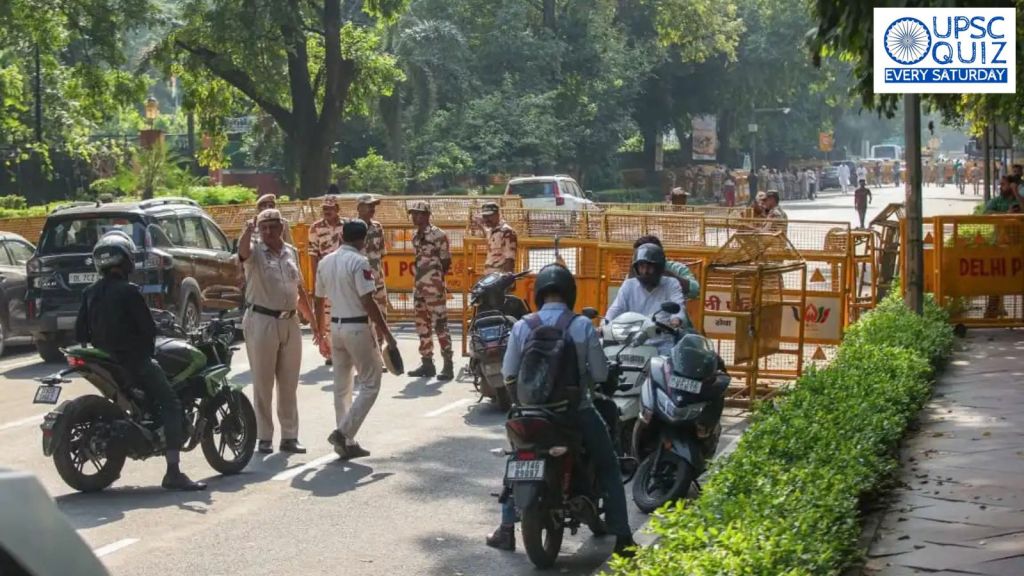
— Ahead of the Cockroach Janta Party (CJP) protests planned in Delhi this Saturday and Sunday (October 10 & 11), demanding the resignation of Chief Election Commissioner Gyanesh Kumar, Delhi Police has denied permission for the gathering.
— In 2024, with the BNSS replacing the CrPC, Section 163 of the BNSS replaced Section 144 of the CrPC, which empowers an Executive Magistrate to act where “there is sufficient ground for proceeding under this section and immediate prevention or speedy remedy is desirable”. Hence, statements 1 and 2 are correct.
— It is enforced through a written order, directing “any person to abstain from a certain act or to take certain order with respect to certain property”, where the direction is likely to prevent “obstruction, annoyance or injury to any person lawfully employed, or danger to human life, health or safety or a disturbance of the public tranquillity, or a riot, or an affray”. Hence, statement 3 is correct.
— The provision assumes that a magistrate is responding to something specific and immediate, that the order is specific to that threat, and that it lapses within two months once the threat has passed.
— Internet shutdowns in India are primarily governed by Section 20 of the Telecommunications Act, 2023 and the Telecommunications (Temporary Suspension of Services) Rules, 2024. Hence, statement 4 is not correct.
Therefore, option (c) is the correct answer.
QUESTION 2
Which sectors are required to declare embedded carbon emissions under the EU’s Carbon Border Adjustment Mechanism (CBAM)?
1. Aluminium
2. Pharmaceuticals
3. Fertiliser
4. Hydrogen
5. Food Processing
6. Iron and Steel
Select the correct answer using the codes given below:
(a) 2, 3, 5 and 6 only
(b) 1, 3, 4 and 6 only
(c) 1, 2, 3 and 6 only
(d) 1, 2, 3, 4, 5 and 6
Why this question for UPSC Prelims 2027?
The topic is relevant to the UPSC Prelims 2027 syllabus under Environment and Ecology: climate-change mitigation; and Indian Economy: international trade and trade-related measures.
Explanation
— The USTR said that CBAM is a carbon pricing mechanism that requires EU importers of covered products in the aluminium, cement, electricity, fertiliser, hydrogen, and iron and steel sectors to declare the embedded emissions of the imported goods, and the regulation intends to apply to imported goods a carbon price that is equivalent to the carbon price that EU producers pay.
— “The EU calculates the default values using country- and sector-level production and energy data to estimate the emissions intensity across countries and sectors. However, the EU adds a punitive mark-up that increases the overall values, in order to encourage the use of company-level data. CBAM requires that any company-level data provided must be verified by an EU-accredited third-party verifier,” the USTR said.
— The process of seeking public comments, which is often the first step towards retaliation, comes as India had tough negotiations with the EU on CBAM and the regulation is expected to impact a range of India’s metal exports. However, any US measure to make CBAM more flexible could help Indian exports, as Indian trade negotiators had managed to secure a ‘forward-Most Favoured Nation’ Clause (MFN) CBAM under the India-EU trade deal.
Therefore, option (b) is the correct answer.
QUESTION 3
Consider the following statements:
1. The naming or renaming of an airport in India requires approval at the Union Government level.
2. A request for naming/renaming of airport is considered by the Union Cabinet based on the recommendations of the concerned State Government supported by a resolution passed in the respective State Legislative Assembly.
Which one of the following is correct in respect of the above statements?
(a) Both Statement 1 and Statement 2 are correct and Statement 2 is the correct explanation for Statement 1.
(b) Both Statement 1 and Statement 2 are correct and Statement 2 is not the correct explanation for Statement 1.
(c) Statement 1 is correct but Statement 2 is incorrect.
(d) Statement 1 is incorrect but Statement 2 is correct.
Why this question for UPSC Prelims 2027?
The procedure for naming or renaming airports is relevant to understanding administrative decision-making and Centre–State coordination in India. It is significant for UPSC Prelims 2027 under Indian Polity and Governance: Centre–State relations and the functioning of the Union Government.
Explanation
— “The Council of Ministers of Uttar Pradesh expresses its gratitude to Prime Minister Narendra Modi for gifting the state the Noida International Airport at Jewar. The Cabinet has approved a proposal to name it Narendra Modi International Airport, Noida-Jewar,” the CM told reporters in a briefing after the Cabinet meeting. He added that the airport was set to emerge as UP’s largest airport and a major aviation hub in the country.
— In a reply to a question in Lok Sabha on March 19, 2020, then Minister of State (Independent Charge) of Civil Aviation, Hardeep Singh Puri, said: “A request for naming/renaming of airport is considered by the Union Cabinet based on the recommendations of the concerned State Government supported by a resolution passed in the respective State Legislative Assembly.” Hence, statement 2 is correct.
— On a question in Rajya Sabha seeking details about a uniform policy for naming and renaming of airports across India, then Union Minister of Civil Aviation, Jyotiraditya Scindia reiterated Puri’s statement in his response. “The final decision in the matter is taken by the Union Cabinet. This is the guiding policy for naming/renaming of airports / terminal buildings,” Scindia said in his response dated July 28, 2021. Hence, statement 1 is correct.
Therefore, option (a) is the correct answer.
QUESTION 4
With reference to the repo rate, consider the following statements:
1. It is the rate at which banks borrow from the Reserve Bank of India.
2. If the repo rate increases, it can push up the EMI cost or force the borrower to stay indebted for longer.
Which of the statements given above is/are correct?
(a) 1 only
(b) 2 only
(c) Both 1 and 2
(d) Neither 1 nor 2
Why this question for UPSC Prelims 2027?
The topic is relevant to the UPSC Prelims 2027 syllabus under Indian Economy: monetary policy, banking and inflation. Understanding its transmission to bank lending rates and its impact on EMIs and loan repayment periods is important for analysing monetary policy and household finances.
Explanation
— A 25-basis-point (bps) repo rate hike may seem insignificant on paper, but for a homebuyer, it is anything but small. On a Rs 50 lakh home loan taken for 20 years, a 25-bps increase can mean roughly Rs 780 more in monthly equated monthly installment EMI, and nearly Rs 1.88 lakh in additional interest outgo over the life of the loan, experts say. Hence, statement 2 is correct.
— The RBI’s repo rate is the price at which banks borrow from the central bank. When that rate rises, borrowing costs across the financial system tend to move up. Hence, statement 1 is correct.
— Floating-rate home-loan borrowers are particularly exposed because their interest rates are linked, directly or indirectly, to benchmark rates – the repo rate. The increase can either push up the EMI or force the borrower to stay indebted for longer.
— According to experts, banks may choose to increase the loan tenure rather than allow the EMI to jump sharply. That may soften the immediate monthly shock, but it is hardly a free lunch. A longer tenure means the borrower remains in debt for more years and can end up paying considerably more interest.
Therefore, option (c) is the correct answer.
QUESTION 5
Which of the following articles of the Constitution of India allows “reasonable restrictions” on peaceful assembly in the interest of public order?
(a) Article 19(1)(a)
(b) Article 19(1)(b)
(c) Article 19(2)
(d) Article 19(3)
Why this question for UPSC Prelims 2027?
The topic is relevant to the UPSC Prelims 2027 syllabus under Indian Polity: Fundamental Rights and constitutional provisions governing civil liberties.
Explanation
— The Delhi Police has formally denied permission to the Cockroach Janta Party (CJP) to hold a protest at Jantar Mantar on October 10, citing short notice. Police said the pressure group sought permission on October 7, three days before the march, but should have done so at least 10 days before a gathering.
— The protests are part of demonstrations demanding the resignation of Chief Election Commissioner Gyanesh Kumar over alleged irregularities in the Special Intensive Revision (SIR) exercise.
— Article 19(1)(a) of the Constitution protects the right to free speech and expression. Clause (b) guarantees the right to assemble peacefully and without arms. These provisions protect a citizen’s ability to gather and express dissent. But neither right is absolute.
— Article 19(2) permits restrictions on speech on specific grounds, including public order, while 19(3) allows “reasonable restrictions” on peaceful assembly in the interest of public order.
Therefore, option (d) is the correct answer.
QUESTION 6
With reference to the Trans-Arctic Transport Corridor (TATC), consider the following statements:
1. It aims to connect key Russian ports from St. Petersburg through Murmansk to Vladivostok and link them to Russia’s inland cities and towns.
2. It connects the key economic centres of Eurasia and forms a seamless logistics corridor.
3. India is connected to both ends (eastern and western) of the TATC.
Which one of the following conclusions based on the above statements is correct?
(a) All three statements are correct.
(b) There are two correct statements, that include statement 1.
(c) There is only one correct statement.
(d) There is no correct statement.
Why this question for UPSC Prelims 2027?
The Trans-Arctic Transport Corridor (TATC) is relevant to India’s evolving connectivity with Russia and the wider Eurasian region. It links to important themes such as Arctic shipping routes, multimodal transport networks, the International North-South Transport Corridor (INSTC) and the Chennai–Vladivostok Eastern Maritime Corridor.
Explanation
— In recent years, Russia has emerged as a critical energy partner for India. Russian oil is largely shipped from its Baltic ports via the Suez Canal — which connects the Mediterranean Sea to the Red Sea through Egypt — to Western Indian ports. As a result, even diversified supplies remain exposed to maritime chokepoints and broader geopolitical disruptions.
— The Russians have subsumed the erstwhile Northern Sea Route, which ran from Murmansk to Provideniya, into the Trans-Arctic Transport Corridor (TATC) project, which spans from St Petersburg in the west to Vladivostok in the east.
— TATC aims to connect key Russian ports from St. Petersburg through Murmansk to Vladivostok and link them to Russia’s inland cities and towns via land, rail, sea and inland waterway systems. Hence, statement 1 is correct.
— It connects the key economic centres of Eurasia and forms a seamless logistics corridor. Hence, statement 2 is correct.
— India is connected to both ends of the TATC. On the western side, it is linked via the International North-South Transport Corridor (INSTC), and on the eastern side via the Chennai-Vladivostok Maritime Corridor, also known as the Eastern Maritime Corridor (EMC). The critical internal connector in this system is Russia’s Unified Deep-Water System, which integrates inland waterways, links European Russia to Arctic ports, and carries approximately 75% of Russia’s internal cargo. Hence, statement 3 is correct.
Therefore, option (a) is the correct answer.
QUESTION 7
With reference to the Input Tax Credit (ITC), consider the following statements:
1. It is a mechanism to avoid cascading of taxes.
2. ITC can be claimed on any business-related expense.
3. Vendor payment timelines do not affect your right to retain ITC.
How many of the statements given above are correct?
(a) Only one
(b) Only two
(c) All three
(d) None
Why this question for UPSC Prelims 2027?
The topic is relevant to the UPSC Prelims 2027 syllabus under Indian Economy: taxation, GST and fiscal policy. Understanding its eligibility conditions, restrictions and supplier-payment requirements is important for assessing GST compliance and the functioning of indirect taxation in India.
Explanation
— The Goods and Services Tax (GST) Council recommended amendments to Section 54(3) of the Central Goods and Services Tax Act to provide for refund of accumulated input tax credit (ITC) on account of capital goods in case of refund pertaining to zero-rate supplies and for input services and capital goods under inverted duty structure.
— The ITC refund on capital goods, such as plant and machinery, will be spread over 60 months. While the change for capital goods will come into effect from April next year, that for input services can be availed from November 1, 2026, Finance Minister Nirmala Sitharaman said.
— ITC is a mechanism to avoid cascading of taxes. Hence, statement 1 is correct.
— Not all business-related expenses qualify for ITC. The credit is subject to several statutory requirements and restrictions, including blocked credits under Section 17(5) of the CGST Act. Hence, statement 2 is not correct.
— Section 16(2) of the CGST Act states that if the recipient fails to pay the supplier the value of the supply plus tax within 180 days of the invoice date, the associated ITC shall be reversed or paid back, along with any applicable interest. It can be returned when payment is received, according to the appropriate conditions. Hence, statement 3 is not correct.
Therefore, option (a) is the correct answer.
QUESTION 8
With reference to the Nobel Prize, consider the following:
1. 2026 Literature Nobel Prize – Anne Carson – for creating new forms for contemporary literature.
2. 2026 Nobel Peace Prize – Navi Pillay – for her efforts to promote peace and international law.
Which of the pairs given above is/are correct?
(a) 1 only
(b) 2 only
(c) Both 1 and 2
(d) Neither 1 nor 2
Why this question for UPSC Prelims 2027?
The Nobel Prizes are important international current-affairs topics for UPSC Prelims, particularly for tracking achievements in literature, peace and other fields. It is relevant to the UPSC Prelims 2027 syllabus under Current Events of National and International Importance, with a focus on major international awards and personalities.
Explanation
— The 2026 Nobel Peace Prize was awarded to South African jurist Navanethem “Navi” Pillay, 85, whose work — from the apartheid regime in her home country to the ongoing humanitarian crisis in Gaza — has helped shape legal precedents on key global issues. The Norwegian Nobel Committee has decided to award the Nobel Peace Prize for 2026 to Navi Pillay “for her efforts to promote peace and international law.”
— Her Indian Tamil grandparents reached Africa as indentured labourers, and she grew up at a time when racial discrimination was systemically ingrained into the law. Pillay went on to become the first South African to earn a doctorate in law from Harvard University and would later defend compatriot Nelson Mandela, the 1993 Nobel Peace Prize laureate, in court during apartheid.
— The Nobel Prize in Literature for 2026 is awarded to the Canadian author Anne Carson.
— Poet, classicist, essayist and translator for more than four decades, the 76-year-old has used the past to clarify her thoughts about the contemporary. She has drawn on the literature of ancient Greece while refusing to be confined by forms, by the boundaries between poetry, fiction, criticism and memoir. This year’s Nobel Prize in Literature acknowledges her “for her bold and inventive oeuvre that, in playful dialogue with the classical tradition, has created new forms for contemporary literature”.
Therefore, option (c) is the correct answer.
QUESTION 9
The Permanent Labour Certification Programme is a:
(a) US government programme that provides permanent residency to foreign workers without requiring employer sponsorship.
(b) first step for US employers to obtain an employment-based green card for foreign national employees who are in the US via temporary H-1B visas.
(c) Programme that allows foreign workers to obtain US citizenship directly after completing a specified period of employment.
(d) Temporary work visa scheme that permits US employers to hire foreign workers for seasonal and short-term jobs without labour certification.
Why this question for UPSC Prelims 2027?
The topic is significant for UPSC Prelims 2027 in the context of India–US relations, skilled migration and the impact of US visa and immigration policies on Indian professionals.
Explanation
— The US has suspended a host of major global IT companies, including Indian players, from the Permanent Labour Certification Programme (PERM). This was, in theory, expected to disrupt the operations of Indian IT companies that provide services to US-based companies.
— Permanent Labour Certification Programme is basically the first step for US employers to obtain an employment-based green card for foreign national employees who are in the US via temporary H-1B visas.
— A large portion of US-based companies depend on Indian IT firms to service their software systems, help implement AI, and handle maintenance owing to the lower wage costs for Indian employees, which helps provide a more affordable deal for the clients. In turn, Indian IT companies derive 50-60% of their revenues from the US.
Therefore, option (b) is the correct answer.
QUESTION 10
The term ‘kibbutzim’ refers to:
(a) Religious schools in Israel that focus on the study of Jewish scriptures and traditions.
(b) Military settlements established by Israel exclusively for retired defence personnel.
(c) Government-controlled industrial zones established to promote high-technology manufacturing in Israel.
(d) Collective communities in Israel traditionally based on shared ownership of property, cooperative production and communal living.
Why this question for UPSC Prelims 2027?
The topic is relevant to the UPSC Prelims 2027 syllabus under World Geography and Current Events of National and International Importance.
Explanation
— UN investigations detail that the complex attack comprised an assault from the “land, sea, and air in conjunction with the launch of a large-scale rocket and mortar attack towards cities, towns and villages and military bases in southern and central Israel.”
— Executed across the day, the October 7 operation also saw attacks on several Israeli kibbutzim and the Nova music festival, assaults on Israeli beaches and arterial roads, and triggered the evacuation of nearly 150,000 people from their homes.
— A kibbutz is an intended, cooperative community in Israel that is based on agriculture, common property, and socialist-Zionist ideas.
Therefore, option (d) is the correct answer.
Previous Weekly Quiz
UPSC Weekly Current Affairs Quiz (September 27 – October 03)
UPSC Weekly Current Affairs Quiz (September 20 – September 26)
UPSC Weekly Current Affairs Quiz (September 13 – September 19)
UPSC Weekly Current Affairs Quiz (September 06 – September 12)
UPSC Weekly Current Affairs Quiz (August 30 – September 05)
Subscribe to our UPSC newsletter and stay updated with the news cues from the past week.
Stay updated with the latest UPSC articles by joining our Telegram channel – IndianExpress UPSC Hub, and follow us on Instagram and X.

 Share


