
UPSC daily subject quiz | History (Week 165) : From freedom struggle to cultural heritage, test your knowledge
Think you know Indian History and Culture? Put your UPSC Prelims 2027 preparation to the test with questions covering lesser-known historical events, social reform, cultural heritage and important personalities.
 Can you crack these questions on India’s past? (AI generated image)
UPSC Essentials brings to you its initiative of daily subject-wise quizzes. These quizzes are designed to help you revise some of the most important topics from the static part of the syllabus. Attempt today’s subject quiz on History and Culture to check your progress. Find links to previous quizzes for UPSC towards the end of the article.
🚨As we mark the 3rd anniversary of the UPSC Essentials magazine, we thank our readers for being part of this journey. Your trust, feedback and continued support have shaped the magazine and encouraged us to keep improving with every edition. Click Here to read the UPSC Essentials magazine for September 2026. Share your views and suggestions in the comment box or write to us at manas.srivastava@indianexpress.com.🚨

QUESTION 1
With reference to the history of North-East India, consider the following statements:
1. The Meitei kingdom was ruled by an unbroken line of kings of the Ningthouja dynasty from the Mangang clan until the 1950s.
2. Hijam Irabot, along with Longjam Bimol, formed the Praja Sangh political party to demand an independent Assam with its own Parliament, Constitution and Cabinet.
Which of the statements given above is/are correct?
(a) 1 only
(b) 2 only
(c) Both 1 and 2
(d) Neither 1 nor 2
Relevance:
Some aspects of Indian history, particularly those of less-discussed regions, often receive limited attention in mainstream preparation. UPSC can use such overlooked areas to frame questions that test both factual knowledge and the ability to distinguish between closely related historical claims.
Explanation:
It is often forgotten that Manipuri ‘nationalist’ consciousness predates the time when it merged with India. For when British paramountcy ended in 1947, the Manipur State Constitution Act was enacted, giving the state its constitution and a representative government. There was also a deeply entrenched nationalist desire to restore the past glory of the Meitei kingdom as it existed before 1891 when it became a princely state, governed only symbolically by the crown whereas the administrative power was vested in the hands of the British resident.
Sociologist A Bimal Akoijam in an article written for the Economic and Political Weekly in 2001 notes that “the identity of the Manipuris as a ‘nation’ evolved against the backdrop of the Meiteis and its kingdom since the first century of the Christian era.” The Cheitharol Kumbaba, which are the royal chronicles of Manipur, trace the origins of the Meitei kingdom of Kangleipak to 33 CE.
The Meiteis divide themselves into seven clans — Mangang, Luwang, Khuman, Angom, Moirang Kha, Ngangba, and Sarang Leishangthem. The Meitei kingdom was ruled by an unbroken line of kings of the Ningthouja dynasty from the Mangang clan till 1955. The dynasty traced its descent to Pakhama, the serpent king, who continues to be revered as the presiding deity of Manipur. The symbol of Pakhamba, a snake with its tail in the mouth can be seen in homes, streets and temples all across Imphal. (Hence, statement 1 is correct)
From what was, in essence, a small principality consisting of present-day Imphal, the empire expanded over a vast area incorporating other principalities and people across the length and breadth of the valley and the hills that came under the region. By the 15th century, the kingdom had spread out into regions far beyond what is present-day Manipur. “As the kingdom grew, it also acquired the consciousness of being a ‘people’,” writes Akoijam. “Their ‘peopleness’ was shaped not only by the fact that they were under the rule or suzerainty of the same ruler but also by other historical forces like the confrontations with the Burmese in the earlier times and later with the British with whom they had entered into a formal relation in the 18th century,” he adds. The Manipuri identity developed against this historical context.
Akoijam explains that their identity was further consolidated in the early decades of the 20th century through the struggle with the British and the autocratic rule of the Maharaja, which manifested itself in the struggle for a representative government and statehood. Hijam Irabot, a Communist Party leader and a socialist revolutionary emerged during this period as one of the forerunners for the mobilisation of people. In 1946, he along with Longjam Bimol formed the Praja Sangh political party, to demand an independent Manipur with its parliament, constitution, and cabinet. “Instead of the monarchical system, he wanted the representatives of the people to administer the state on socialistic principles,” writes Professor Thongkholal Haokip in his article Political Integration of Northeast India: A Historical Analysis.
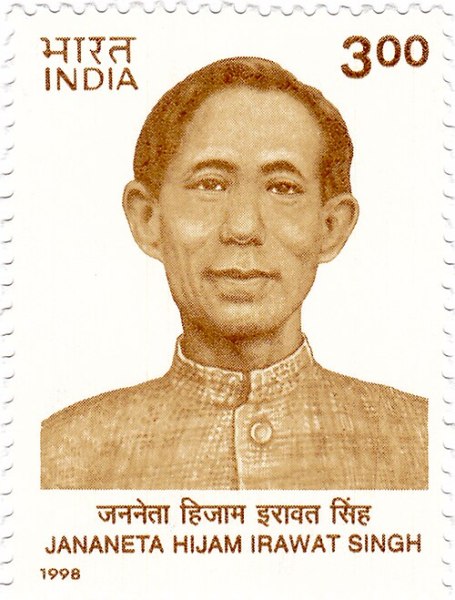 The Communist Party leader and socialist revolutionary, Hijam Irabot. (Wikimedia Commons)
Consequently, the Manipur State Constitution Act was enacted on June 27, 1947. It came into effect soon after British paramountcy ended. Under the provisions of the act, assembly elections were held in 1948. “This was the first-ever election held in India based on adult franchise,” notes Haokip, adding that a coalition government was formed with parties other than the Congress. The Maharaja was made the constitutional head of the state. A State Council of Ministers consisting of six members was elected by the State Assembly and a chief minister was appointed in consultation with the Maharaja. Further, the State Assembly was to be elected based on adult franchise and based on a joint electorate. The assembly was to have a three-year term and the constitution provided for a 36 per cent reservation to the hill tribes in the assembly. (Hence, statement 2 is not correct)
Therefore, option (a) is the correct answer.
QUESTION 2
The Cheranmadevi Gurukulam controversy revolved around which of the following?
(a) The issue of caste-based discrimination
(b) The question of women’s participation in public life
(c) The rights of agricultural labourers
(d) The demand for linguistic reorganisation
Relevance:
This topic highlights lesser-known aspects of India’s social and political history, where UPSC can draw questions from regional movements and debates that are often overlooked. It also helps aspirants connect social issues with the broader history of the national movement. The above question is closely related to the life of Periyar.
Explanation:
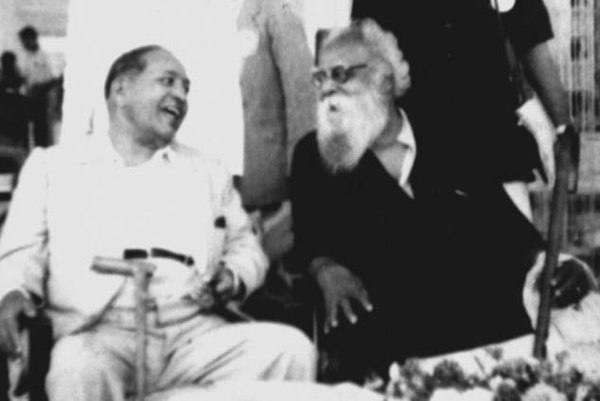 Dr. Ambedkar with Periyar (Wikimedia Commons)
Periyar was born in Erode in western Tamil Nadu to a Balija Naidu family, a Kannada-speaking, upwardly mobile community engaged in trade in the region. He married at 19. “Along with caste and religion, marriage would also be an institution that Periyar relentlessly attacked in his public life, criticizing it for the enslavement of women and distracting individuals from pursuing the common good,” write Venkatachalapathy and Manoharan.
He developed an early interest in municipal politics before turning to the Indian National Congress. He began observing the party in 1907 and attending its meetings. After the First World War, he joined the Non-Cooperation Movement and, following Gandhi’s call, actively promoted khadi. His campaigns for prohibition led to his arrest in 1922.
In 1924, Periyar became president of the Tamil Nadu Congress Committee. Yet even as a Congress activist, he demanded proportional representation for different communities in political offices and pressed the party to take a stronger stand against caste.
That year, he also took a leadership role in the Vaikom Satyagraha, which sought to secure the rights of lower castes to use public roads around the Sri Mahadeva Temple in the princely state of Travancore. Venkatachalapathy and Manoharan write, “This was the first major political protest in Periyar’s life where he confronted caste-based injustices.”
Around the same time, he clashed with fellow Congressmen over the Cheranmadevi Gurukulam controversy. At the traditional school founded by Congressman V V S Aiyar, Brahmin students received preferential treatment, while others faced discrimination. “The Cheranmadevi experience greatly coloured his views about the hypocrisy of the Congress and its Brahmin leaders towards caste,” the authors note.
Periyar continued to demand proportional representation in political bodies. Frustrated by the Congress’s lack of action on these demands, he quit the party in late 1925 and soon after launched the Self-Respect Movement (SRM).
Therefore, option (a) is the correct answer.
QUESTION 3
Recently, the longest temple corridor in the world was in the news. It is associated with which of the following temples of India?
(a) Meenakshi Amman Temple
(b) Ramanathaswamy Temple
(c) Sri Ranganathaswamy Temple
(d) Brihadisvara Temple
Relevance:
Current affairs can sometimes provide an indirect link to India’s history and culture, creating questions that test both contemporary developments and static knowledge. Such questions require aspirants to connect a recent event with its historical and cultural context. This question is also connected to the recently concluded BRICS 2026 Summit.
Explanation:
The Ramanathaswamy Temple at Rameswaram, Tamil Nadu is known for its exceptionally long pillared corridors, with the famous outer corridor having 1,212 pillars and a combined corridor length commonly cited at around 1.17 km.
At the 2026 BRICS Summit, Prime Minister Narendra Modi and Chinese President Xi Jinping were seen shaking hands in front of a high-quality projection of the pillar corridor from Tamil Nadu’s Ramanathswamy temple in Ramanathapuram district.
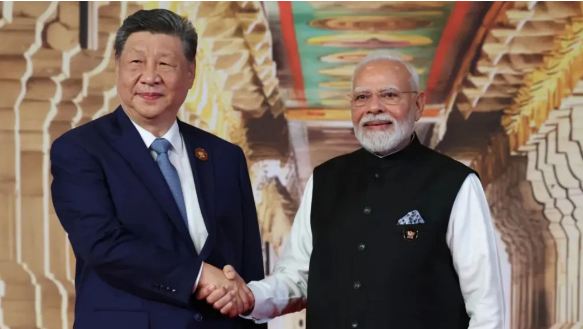 Prime Minister Narendra Modi greets Chinese President Xi Jinping upon his arrival for the BRICS summit in New Delhi, India, on Saturday, September 12, 2026. (Foreign Ministry via AP)
Tamil Nadu is also the state where Modi and Xi last met in India in October 2019. In one of their photographs from September 12, Modi appears to be describing the corridor to Xi.
The temple’s famous outer corridor is largely credited to the 18th-century ruler Muthuramalinga Sethupathi — the zamindar of the Ramnad estate.
The Ramanathaswamy Temple is not famous merely because it has 1,212 pillars. It represents the culmination of centuries of temple-building traditions.
Its religious association with Rama and Shiva gives the site its sacred importance while its corridors demonstrate how the sacred space was transformed into monumental architecture.
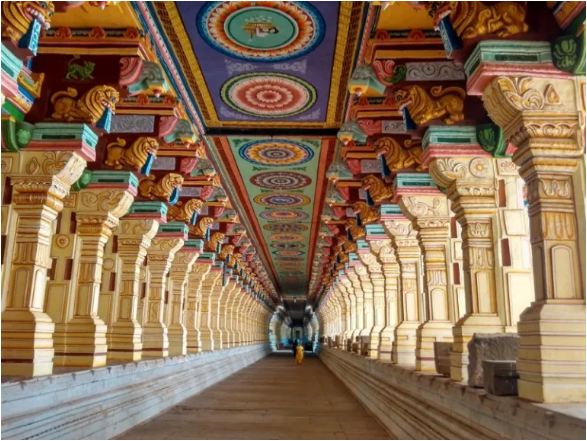 The third corridor of the Ramnathswamy temple, the longest temple corridor in the world (Wikimedia Commons)
The Ramanthswamy temple is located in the town of Rameswaram on Pamban Island. Henry Hardy Cole (1843-1916), a superintendent for the Archaeological Survey of India, noted in an 1885 report that the temple in its current form was rebuilt in the 17th century after repeated sackings over the centuries before.
Traditionally, the temple is an important religious site and is counted among the 12 jyotirlingas — a series of shrines across the country dedicated to Shiva.
The temple’s history, however, is said to span back much farther than the 17th century.
Lord Ram is believed to have worshipped Lord Shiva at the site upon his return from Lanka. The Sethupathi rulers of Ramanathapuram were particularly important in shaping its present form.
In the image of Modi and Xi, the corridor consequently places a diplomatic encounter against an architectural tradition in which scale, symmetry, repetition, and movement were used to turn stone into an experience of space.
Therefore, option (b) is the correct answer.
QUESTION 4
Who among the following is associated with the field of numismatics?
(a) Parmeshwari Lal Gupta
(b) Birbal Sahni
(c) Nandalal Bose
(d) Salim Ali
Relevance:
Questions based on personalities and their areas of expertise can test an aspirant’s ability to connect individuals with specialised fields. UPSC often uses such associations to assess factual awareness beyond commonly studied personalities.
Explanation:
Parmeshwari Lal Gupta (P. L. Gupta) was an Indian numismatist who collated previous research on Indian Numismatics in the post-Independence era. His collated work was published as ‘COINS’, a book by the National Book Trust in 1969.
Numismatics is the study of coins and money, of coins and coin-like objects.
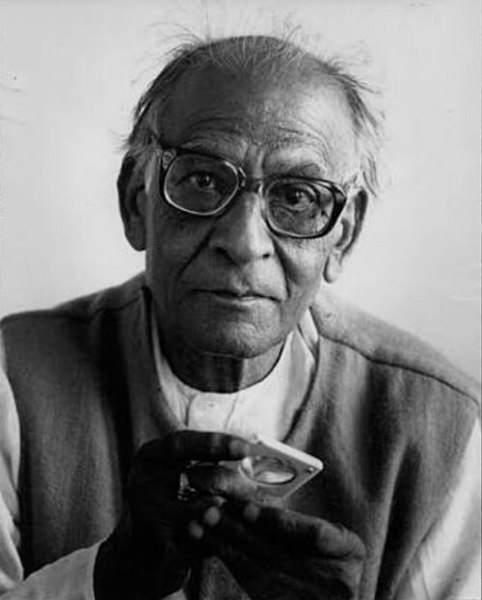 Parmeshwari Lal Gupta, an eminent numismatics. (wikimedia commons)
Therefore, option (a) is the correct answer.
QUESTION 5
In the context of modern Indian history, the phrase “cancer in the belly of India”, used by Sardar Vallabhbhai Patel, referred to which of the following?
(a) Travancore
(b) Junagadh
(c) Jammu and Kashmir
(d) Hyderabad
Relevance:
Important events of modern Indian history can be tested through lesser-known references, statements and associations linked to them. Such questions require aspirants to go beyond familiar events and understand their wider historical context.
Explanation:
September 17 marks the anniversary of the accession of Hyderabad to independent India. This day in 1948 brought to a close a year-long saga that threatened to make the rich Deccan province a “cancer in the belly of India”, in the words of Sardar Vallabhbhai Patel.
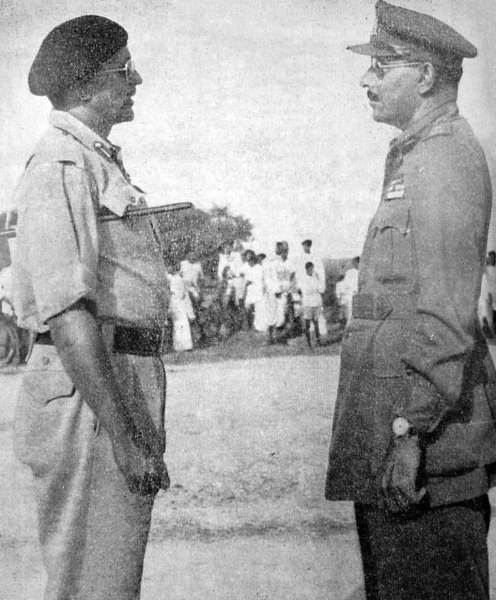 Major General El Edroos (right) offers surrender of the Hyderabad State Forces to Major General (later General and Army Chief) Jayanto Nath Chaudhuri at Secunderabad. (Photo: Wikimedia Commons)
While the state actors — KM Munshi from India’s side and dewan Mir Laik Ali from Hyderabad — were negotiating, a revolt against the Nizam’s rule had been brewing within the province. As early as on August 7, 1947, as Bipan Chandra and others write in the book India Since Independence, the Hyderabad State Congress had launched a satyagraha for democracy in the province. In the rural areas, a Communist-led peasant movement, against large landholdings, forced labour and excessive tax collection, was gaining strength.
In the midst of this, an outfit meant to cement the Nizam’s position was getting more violent.
The Ittehad-ul-Muslimeen had started off as a political outfit to demand greater say for Muslims, but after Qasim Razvi, a close aide of the Nizam, took over, it gained a communal and extremist tinge. Razvi also set up, with state support, a paramilitary called ‘razakars’, who began brutally attacking opponents of the Nizam.
Sardar Patel was fast losing patience. In June 1948, he wrote to Nehru: “I feel very strongly that a stage has come when we should tell them quite frankly that nothing short of unqualified acceptance of accession and of introduction of undiluted responsible government would be acceptable to us.”
The government still tried to make the accession happen peacefully through talks. Meanwhile, more and more arms were being brought into Hyderabad.
Operation Polo
Eventually, on September 13, 1948, the Indian Army was sent to Hyderabad under Operation Polo. In three days, the Nizam’s forces surrendered. On the night of September 17, the Nizam made a public address on the radio, banning the razakars. Six days later, he made another address, in which Guha quotes him as saying that Razvi and his men had taken “possession of the state through Hitlerite methods while he had been “anxious to come to an honourable settlement with India”.
For India, the accession of Hyderabad was not just a huge problem solved, but also a triumph of the secularism the Indian state stood for. Indian Muslims had backed the government fully, and the picture Jinnah had painted had not even come close to materialising. Sardar Patel shared this view.
Therefore, option (d) is the correct answer.
Previous Daily Subject-Wise-Quiz
Daily Subject-wise quiz — History, Culture, and Social Issues (Week 163)
Daily subject-wise quiz — Polity and Governance (Week 180)
Daily subject-wise quiz — Science and Technology (Week 180)
Daily subject-wise quiz — Economy (Week 180)
Daily subject-wise quiz — Environment and Geography (Week 180)
Daily subject-wise quiz – International Relations (Week 179)
Subscribe to our UPSC newsletter and stay updated with the news cues from the past week.
Stay updated with the latest UPSC articles by joining our Telegram channel – IndianExpress UPSC Hub, and follow us on Instagram and X

Manas Srivastava is an Assistant Editor at The Indian Express Read More
 Share


