
UPSC Prelims 2027 Polity Quiz (Week 179): MCQs on right to vote, enforcement of decrees and orders of the Supreme Court and more
Are you preparing for UPSC CSE 2027 Prelims? Check your progress and revise your topics through this quiz on Polity and Governance.
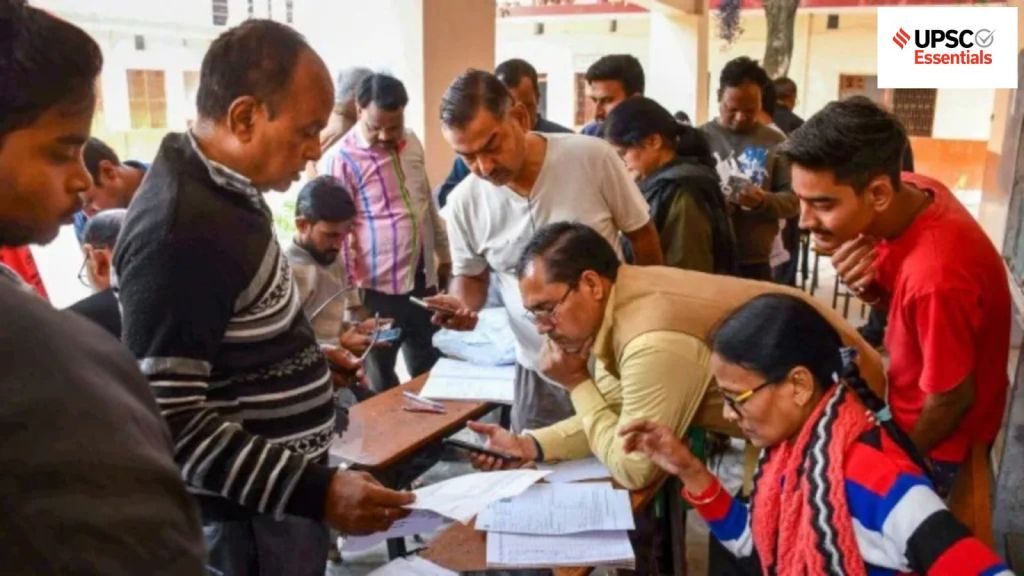 Practice and solve questions on Polity and Governance. Find a question on the right to vote in today's quiz. (File Image)
UPSC Essentials brings to you its initiative of daily subject-wise quizzes. These quizzes are designed to help you revise some of the most important topics from the static part of the syllabus. Attempt today’s subject quiz on Polity and Governance to check your progress.
🚨 Click Here to read the UPSC Essentials magazine for August 2026. Share your views and suggestions in the comment box or at manas.srivastava@indianexpress.com🚨

QUESTION 1
With reference to the enforcement of decrees and orders of the Supreme Court, consider the following statements:
A decree passed or order made by the Supreme Court in the exercise of its jurisdiction is enforceable throughout the territory of India.
2. The Supreme Court may make orders for securing the attendance of any person, the discovery or production of documents, and the investigation or punishment of contempt of itself, subject to laws made by Parliament.
3. Until Parliament makes a law prescribing the manner of enforcement of a Supreme Court decree or order, the manner of such enforcement is prescribed by the Chief Justice of India.
Which of the statements given above are correct?
(a) 1 and 2 only
(b) 1 and 3 only
(c) 2 and 3 only
(d) 3 only
Relevance: This question is relevant for UPSC Prelims because it tests the scope of Article 142, particularly the Supreme Court’s power to ensure complete justice and enforce its decrees and orders. UPSC can test this area by substituting the authority empowered to prescribe enforcement procedures or altering the scope of the Supreme Court’s powers under Article 142.
Explanation
— Article 142 of the Constitution of India provides for the enforcement of decrees and orders of the Supreme Court and orders as to discovery, etc.
— The Supreme Court in the exercise of its jurisdiction may pass such decree or make such order as is necessary for doing complete justice in any cause or matter pending before it, and any decree so passed or order so made shall be enforceable throughout the territory of India in such manner as may be prescribed by or under any law made by Parliament and, until provision in that behalf is so made, in such manner as the President may by order1 prescribe. Hence, statement 1 is correct.
— Subject to the provisions of any law made in this behalf by Parliament, the Supreme Court shall, as respects the whole of the territory of India, have all and every power to make any order for the purpose of securing the attendance of any person, the discovery or production of any documents, or the investigation or punishment of any contempt of itself. Hence, statement 2 is correct.
— Article 142(1) specifies that until Parliament makes provision regarding the manner of enforcement, the President may prescribe it by order, not the Chief Justice of India. Hence, statement 3 is not correct.
Therefore, option (a) is the correct answer.
(Other Source: Constitution of India)
QUESTION 2
With reference to the right to vote, consider the following statements:
1. The Supreme Court has historically interpreted the right to vote as a statutory right.
2. It is governed by the Representation of the People Act, 1950.
Which of the statements given above is/are correct?
(a) 1 only
(b) 2 only
(c) Both 1 and 2
(d) Neither 1 nor 2
Relevance: This question is relevant for UPSC Prelims because it tests the constitutional and statutory basis of the right to vote, an important aspect of the electoral system. UPSC can test this theme by changing the nature of the right, the governing legislation, or the constitutional provisions associated with elections.
Explanation
— The Constitution of India guarantees elections based on universal adult suffrage through Article 326. This was a notable commitment for a newly independent country, especially at a time when some established democracies still imposed restrictions on voting rights, including on the basis of gender.
— But Article 326 is not part of Part III of the Constitution, which lists the Fundamental Rights. The Supreme Court has historically interpreted the right to vote as a statutory right, calling it a ‘creature of statute’ or special law governed by the Representation of the People Act, 1950, rather than an absolute fundamental guarantee. Hence, statements 1 and 2 are correct.
— However, later judgement recognised the right to vote as a constitutional right under Article 326. For instance, in the People’s Union for Civil Liberties case (2003), Justice P V Reddy observed that the right to vote, if not a fundamental right, is certainly a ‘constitutional right’.
— The right to vote in India is thus enforceable through ordinary legal processes. In relation to disputes relating to voting rights, voters generally seek relief before high courts, election tribunals, or through procedures prescribed in the Representation of the People Act, 1950.
Therefore, option (c) is the correct answer.
QUESTION 3
With reference to the Council of Ministers, which of the following statements is/are not correct?
1. The Council of Ministers shall be collectively responsible to the President.
2. The total number of Ministers, including the Prime Minister, in the Council of Ministers shall not exceed ten per cent.
3. The advice tendered by Ministers to the President shall not be inquired into in any court.
Select the correct answer using the codes given below:
(a) 1 only
(b) 2 only
(c) 2 and 3 only
(d) 1 and 2 only
Relevance: This question is relevant for UPSC Prelims because it tests key constitutional provisions relating to the Council of Ministers under Articles 74 and 75. The question is particularly useful for testing constitutional percentages and institutional relationships, where UPSC often creates close factual traps.
Explanation
— There shall be a Council of Ministers with the Prime Minister at the head to aid and advise the President who shall, in the exercise of his functions, act in accordance with such advice.
— The question whether any, and if so what, advice was tendered by Ministers to the President shall not be inquired into in any court. Hence, statement 3 is correct.
— The Prime Minister shall be appointed by the President and the other Ministers shall be appointed by the President on the advice of the Prime Minister. The total number of Ministers, including the Prime Minister, in the Council of Ministers shall not exceed fifteen per cent. of the total number of members of the House of the People. Hence, statement 2 is not correct.
— The Ministers shall hold office during the pleasure of the President. The Council of Ministers shall be collectively responsible to the House of the People. Hence, statement 1 is not correct.
Therefore, option (d) is the correct answer.
(Source: Constitution of India)
QUESTION 4
With reference to the reservation of seats at Panchayats, consider the following statements:
1. Not less than one-third of the total number of seats reserved shall be reserved for women belonging to the Scheduled Castes or, as the case may be, the Scheduled Tribes.
2. Not less than one-third of the total number of seats to be filled by direct election in every Panchayat shall be reserved for women.
3. The offices of the Chairpersons in the Panchayats at the village or any other level shall be reserved for the Scheduled Castes, the Scheduled Tribes and women in such manner as the Legislature of a State may, by law, provide.
How many of the statements given above are correct?
(a) Only one
(b) Only two
(c) All three
(d) None
Relevance: This question is relevant for UPSC Prelims because it tests the constitutional framework governing reservation in Panchayats under Article 243D. It is useful for Prelims because UPSC can frame statements by altering the beneficiary category, level of Panchayat, or authority empowered to prescribe the manner of reservation.
Explanation
— Article 243-D of the Constitution of India provides for the Reservation of seats at Panchayats.
— Seats shall be reserved for — (a) the Scheduled Castes; and (b) the Scheduled Tribes, in every Panchayat and the number of seats so reserved shall bear, as nearly as may be, the same proportion to the total number of seats to be filled by direct election in that Panchayat as the population of the Scheduled Castes in that Panchayat area or of the Scheduled Tribes in that Panchayat area bears to the total population of that area and such seats may be allotted by rotation to different constituencies in a Panchayat.
— Not less than one-third of the total number of seats reserved under clause (1) shall be reserved for women belonging to the Scheduled Castes or, as the case may be, the Scheduled Tribes. Hence, statement 1 is correct.
— Not less than one-third (including the number of seats reserved for women belonging to the Scheduled Castes and the Scheduled Tribes) of the total number of seats to be filled by direct election in every Panchayat shall be reserved for women and such seats may be allotted by rotation to different constituencies in a Panchayat. Hence, statement 2 is correct.
— The offices of the Chairpersons in the Panchayats at the village or any other level shall be reserved for the Scheduled Castes, the Scheduled Tribes and women in such manner as the Legislature of a State may, by law, provide. Hence, statement 3 is correct.
Therefore, option (c) is the correct answer.
(Source: Constitution of India)
QUESTION 5
Which of the following statements are correct about the States Reorganisation Commission (SRC)?
1. It was headed by K. M. Panikkar.
2. The commission examined demands for linguistic states.
3. Its recommendations led to the Seventh Constitutional Amendment.
Select the correct answer using the codes given below:
(a) 1 and 3 only
(b) 2 and 3 only
(c) 1, 2 and 3
(d) 1 and 2 only
Relevance: This question is relevant for UPSC Prelims because it covers the States Reorganisation Commission (SRC), a significant milestone in the evolution of India’s territorial and administrative structure. UPSC may frame questions by altering the members of the Commission, its objectives, or the constitutional and legislative measures that followed its recommendations.
Explanation
— India’s decision to reorganise states largely along linguistic lines, beginning with the creation of Andhra State in 1953, was initially seen by many national leaders as a potential threat to national unity. The death of Potti Sriramulu after a 58-day fast for a Telugu-speaking state triggered widespread protests and pushed the Union government to act.
— The subsequent States Reorganisation Commission (SRC), headed by Justice Fazl Ali, examined demands for linguistic states while also considering administrative, economic and minority-protection concerns. Its recommendations led to the States Reorganisation Act, 1956 and the Seventh Constitutional Amendment, creating 14 states and six Union Territories. Hence, statement 1 is not correct and statements 2 and 3 are correct.
— When the States Reorganisation Act and the Constitution’s Seventh Amendment came into force on November 1, 1956, India had 14 states and six UTs. Marathi- and Gujarati-speaking regions were placed together in an enlarged bilingual Bombay state.
Therefore, option (b) is the correct answer.
Previous Daily Subject-Wise-Quiz
Daily Subject-wise quiz — History, Culture, and Social Issues (Week 163)
Daily subject-wise quiz — Polity and Governance (Week 178)
Daily subject-wise quiz — Science and Technology (Week 178)
Daily subject-wise quiz — Economy (Week 178)
Daily subject-wise quiz — Environment and Geography (Week 178)
Daily subject-wise quiz – International Relations (Week 178)
Subscribe to our UPSC newsletter and stay updated with the news cues from the past week.
Stay updated with the latest UPSC articles by joining our Telegram channel – IndianExpress UPSC Hub, and follow us on Instagram and X

 Share


