
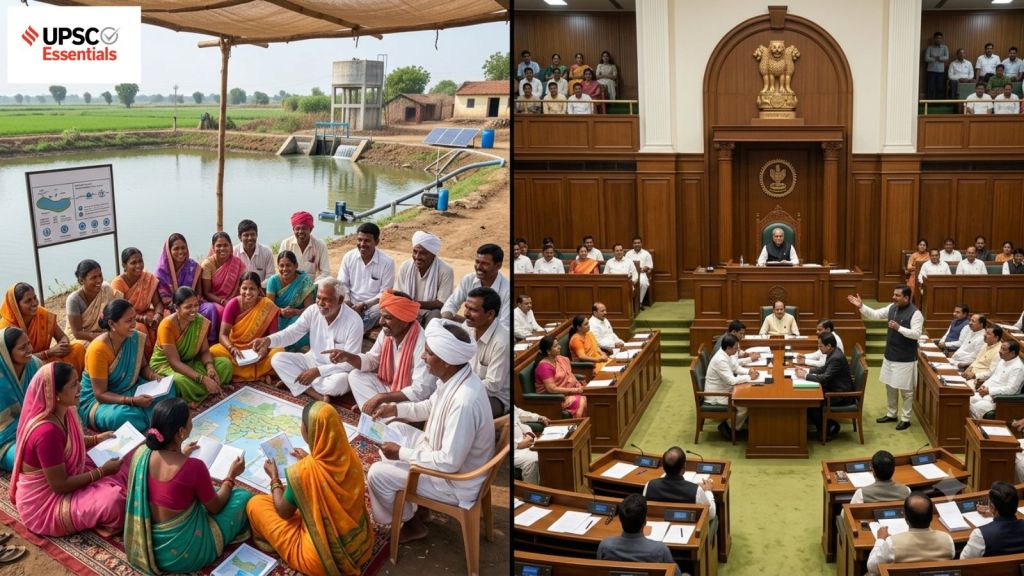
UPSC Essentials brings to you its initiative for the practice of Mains answer writing. It covers essential topics of static and dynamic parts of the UPSC Civil Services syllabus covered under various GS papers. This answer-writing practice is designed to help you as a value addition to your UPSC CSE Mains. Attempt today’s answer writing on questions related to topics of GS-2 to check your progress.
🚨As we mark the 3rd anniversary of the UPSC Essentials magazine, we thank our readers for being part of this journey. Your trust, feedback and continued support have shaped the magazine and encouraged us to keep improving with every edition. Click Here to read the UPSC Essentials magazine for September 2026. Share your views and suggestions in the comment box or write to us at manas.srivastava@indianexpress.com.🚨

QUESTION 1
How can decentralisation and community participation improve the effectiveness and sustainability of water governance in India?
QUESTION 2
“Legislative privileges are intended to secure the effective functioning of legislatures, not to insulate them from public scrutiny.” Discuss.
QUESTION 1: How can decentralisation and community participation improve the effectiveness and sustainability of water governance in India?
Relevance: The question links with GS Paper 2: Governance, decentralisation, local self-government and participatory governance. It also provides scope to discuss cooperative federalism and multi-level governance in addressing water challenges.
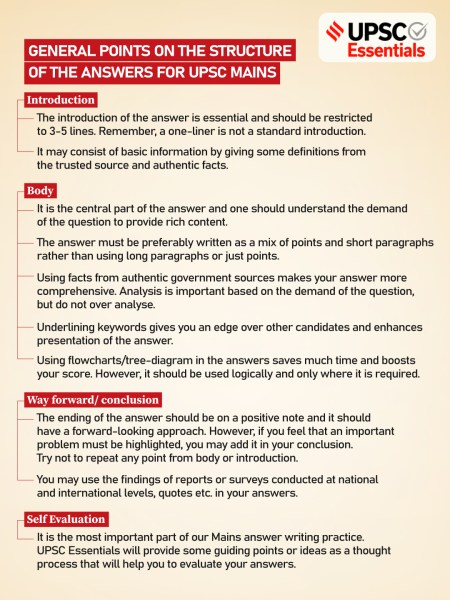
Note: This is not a model UPSC answer. It only provides you with a thought process which you may incorporate into the answers.
Introduction:
— India’s water challenge is multifaceted, encompassing not only infrastructure development but also governance, institutional capacity, and sustainable service delivery.
— The Gujarat example demonstrates that water security improves when governance, infrastructure, and community ownership are pursued simultaneously.
Body:
You may incorporate some of the following points in your answer:
Role of decentralisation and community participation
— Water-related decisions can be decentralised to reflect local variables such as availability, quality, location, and household requirements. The notion of subsidiarity states that functions should be carried out at the lowest appropriate level. This strategy is used by Gujarat’s WASMO and other similar initiatives.
— Institutions like Pani Samitis can help communities become active participants rather than passive beneficiaries. The Gujarat model demonstrates how local water governance institutions, with suitable infrastructure and external aid, may improve water conservation, harvesting, and recharge.
— Decentralisation can improve operation and maintenance since local institutions are directly involved in water system management. This is especially critical as the task switches from simply providing tap connections to guaranteeing consistent, adequate, and dependable water service.
— Community participation can assist ensure that taps are accompanied by steps to protect the underlying water source. Groundwater recharging, rainwater collection, and water supply must all be addressed simultaneously, rather than considering water provision as a standalone engineering project.
— When local communities participate in planning and implementation, they can check service quality and continuity, as well as file grievances. This can help close the gap between administrative claims of infrastructure coverage and real service delivery on the ground.
— Water availability and infrastructure requirements vary greatly by region. Local institutions can tailor responses to local hydrological and socioeconomic conditions rather than depending solely on centrally designed techniques.
Conclusion:
— Effective water administration necessitates a shift from a centralized, infrastructure-centric strategy to participatory and decentralized service governance. India’s experience, particularly the Gujarat model and the developing Jal Jeevan Mission strategy, illustrates that infrastructure becomes more sustainable when people play an active role in planning, managing, and monitoring water systems.
— Thus, decentralization can transform water governance from a government-provided function to a shared institutional and community duty.
(Sources: From India to Global South, a Gujarat water-governance model, Many challenges of Jal Jeevan Mission: Decentralisation is the only way ahead, Centre asks district collectors to regularly review Jal Jeevan Mission works, address gaps)
Points to Ponder
What institutional mechanisms can facilitate effective participation in water management?
What are the major challenges to decentralised water governance in India?
Related Previous Year Question
What are environmental pressure groups? Discuss their role in raising awareness, influencing policies and advocating for environmental protection in India. (2025)
QUESTION 2: “Legislative privileges are intended to secure the effective functioning of legislatures, not to insulate them from public scrutiny.” Discuss.
Relevance: The question directly relates to GS Paper 2: Parliament and State Legislatures, constitutional provisions and legislative privileges. It helps to analyse the role of legislative privileges in preserving parliamentary functioning while protecting democratic scrutiny.
Note: This is not a model UPSC answer. It only provides you with a thought process which you may incorporate into the answers.
Introduction:
— Legislative privileges are constitutional provisions designed to ensure that Parliament and state legislatures may carry out their tasks independently and effectively.
— Articles 105 and 194 provide privileges and immunities to Parliament and State Legislatures respectively. However, these privileges are meant to facilitate legislative functioning, not create an unrestricted sphere of immunity from constitutional scrutiny or legitimate public criticism.
Body:
You may incorporate some of the following points in your answer:
Why are legislative privileges necessary?
— Privileges protect legislators from external interference and enable them to participate freely in legislative proceedings. Article 105(1) provides freedom of speech in Parliament, subject to the Constitution and parliamentary rules; corresponding protection exists under Article 194 for State Legislatures.
— Collective privileges allow Houses to govern their proceedings and deal with conduct that disrupts their operation.
— Immunities enable lawmakers to carry out their constitutional duties without fear of legal ramifications from valid legislative speech or voting.
Why can’t privileges be used as a barrier against scrutiny?
— The Supreme Court must decide whether privileges under Articles 105 and 194 can supersede fundamental rights like free speech and expression under Article 19(1)(a). The position made before the Court is that privileges exist to defend the House’s operation rather than the reputations of MPs, governments, or ruling parties.
— India adheres to constitutional supremacy rather than the model of unrestrained parliamentary authority. As a result, legislative privileges function within the constitutional framework and cannot automatically take precedence over fundamental rights.
— The Supreme Court’s jurisprudence has gradually acknowledged limits to legislative privilege. In Raja Ram Pal (2007), the Court determined that the exercise of parliamentary privilege is subject to judicial review. In Amarinder Singh (2010), it was determined that privilege could not be utilised to punish conduct unrelated to the operation of the House.
— When privilege proceedings culminate in the arrest or imprisonment of citizens or journalists, Articles 14 and 21 are invoked alongside Article 19. The exercise of legislative power over personal liberty creates issues of fairness, due process, and arbitrariness.
— A free press allows individuals to monitor legislative activity. The 2003 Tamil Nadu Assembly privilege event, which involved actions against journalists from The Hindu and Murasoli, exemplifies the conflict between legislative privilege and press freedom. The Supreme Court suspended the arrest warrants and referred serious constitutional matters related to Articles 194(3) and 19(1)(a) for review.
Conclusion:
— Legislative privilege is a tool for protecting legislative democracy, not an end in itself. Its credibility is ultimately tied to the legislature’s ability to function effectively.
— A constitutional balance must consequently protect legislative authority while ensuring that privilege is not used to repress valid criticism, journalistic freedom, or fundamental rights. Such a balance strengthens, not diminishes, the authority of democratic institutions.
(Sources: Legislative privileges vs free speech: The question before Supreme Court, JMM bribes for votes ruling: How Supreme Court interpreted privilege for lawmakers, Article 105 of Constitution: The limits to free speech in Parliament, and what Supreme Court has ruled)
Points to Ponder
How do Articles 105 and 194 protect the functioning of Parliament and State Legislatures?
Related Previous Year Question
The ‘Powers, Privileges and Immunities of Parliament and its Members’ as envisaged in Article 105 of the Constitution leave room for a large number of un-codified and un-enumerated privileges to continue. Assess the reasons for the absence of legal codification of the ‘parliamentary privileges’. How can this problem be addressed? (2014)
Previous Mains Answer Practice
UPSC Essentials: Mains answer practice — GS 3 (Week 174)
UPSC Essentials: Mains answer practice — GS 3 (Week 175)
UPSC Essentials: Mains answer practice — GS 2 (Week 174)
UPSC Essentials: Mains answer practice — GS 2 (Week 173)
UPSC Essentials: Mains answer practice — GS 1 (Week 174)
UPSC Essentials: Mains answer practice — GS 1 (Week 173)
Subscribe to our UPSC newsletter and stay updated with the news cues from the past week.
Stay updated with the latest UPSC articles by joining our Telegram channel – IndianExpress UPSC Hub, and follow us on Instagram and X.

 Share


