


Journalism of Courage
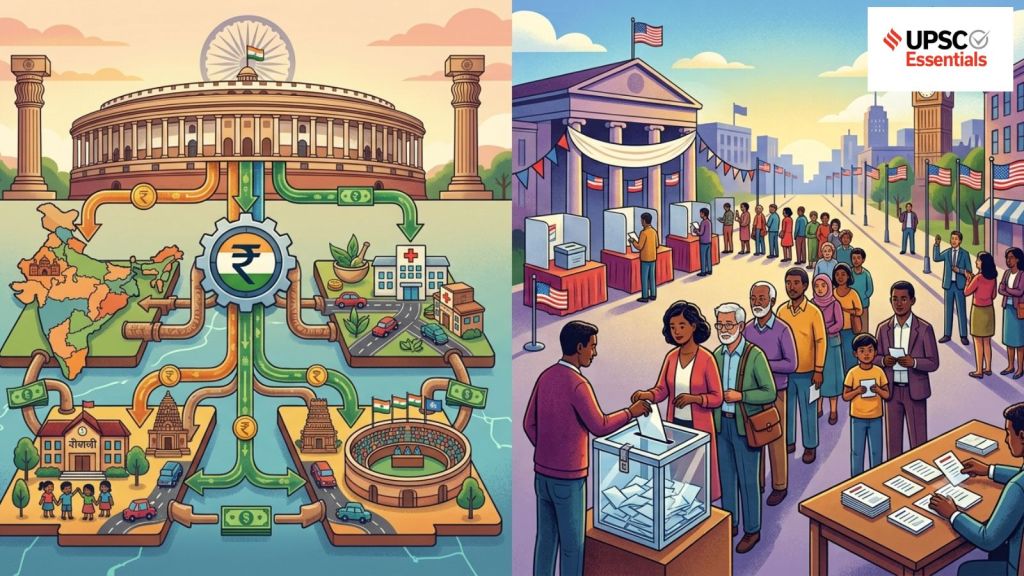 Are you preparing for Civil Services Mains Exam 2027? Attempt a question on Fiscal Federalism and the credibility of electoral democracy in today's answer-writing practice. (AI-generated Image)
UPSC Essentials brings to you its initiative for the practice of Mains answer writing. It covers essential topics of static and dynamic parts of the UPSC Civil Services syllabus covered under various GS papers. This answer-writing practice is designed to help you as a value addition to your UPSC CSE Mains. Attempt today’s answer writing on questions related to topics of GS-2 to check your progress.
🚨As we mark the 3rd anniversary of the UPSC Essentials magazine, we thank our readers for being part of this journey. Your trust, feedback and continued support have shaped the magazine and encouraged us to keep improving with every edition. Click Here to read the UPSC Essentials magazine for September 2026. Share your views and suggestions in the comment box or write to us at manas.srivastava@indianexpress.com.🚨
The distribution of taxing powers between the Union and the States is central to the functioning of India’s federal system. Discuss in the context of the recent changes to the legal framework governing taxation of mineral rights and mineral-bearing lands.
The credibility of electoral democracy depends significantly on the accuracy, inclusiveness and transparency of electoral rolls. Discuss the institutional mechanisms for maintaining electoral rolls in India.
QUESTION 1: The distribution of taxing powers between the Union and the States is central to the functioning of India’s federal system. Discuss in the context of the recent changes to the legal framework governing taxation of mineral rights and mineral-bearing lands.
Relevance: The question is relevant to GS Paper 2 – Federalism. It examines the constitutional distribution of legislative and taxing powers between the Union and States. The recent changes to the legal framework governing taxation of mineral rights and mineral-bearing lands provide a contemporary case study of Centre–State tensions.
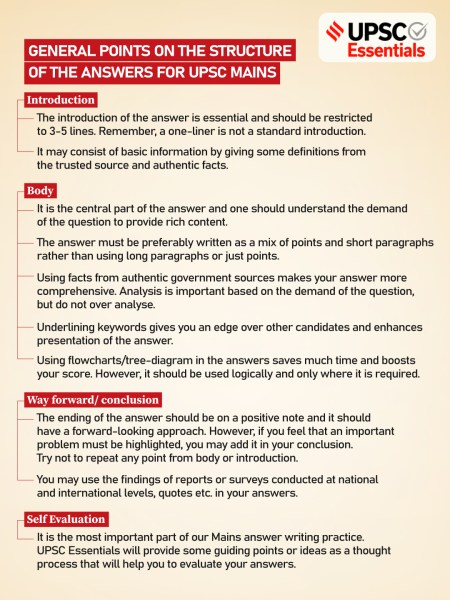
Note: This is not a model UPSC answer. It only provides you with a thought process which you may incorporate into the answers.
Introduction:
— The distribution of taxing powers between the Union and the States is an important component of India’s federal structure.
— The recent Mines and Minerals (Development and Regulation) Amendment Act, 2026, which prohibits states from placing specific levies on mineral rights and mineral-bearing areas, has reignited debate about state fiscal autonomy, resource management, and the need for a consistent national framework.
Body:
You may incorporate some of the following points in your answer:
| Constitutional framework: India’s Constitution distributes legislative and taxing powers between the Union and States through the Seventh Schedule. This division seeks to provide States with adequate revenue-raising capacity while allowing the Union to address matters having wider national implications. |
Why do the 2026 changes matter for federalism?
— The 2026 changes seek to limit states’ ability to impose specified levies on mineral rights and mineral-bearing areas, subject to the Centre’s conditions or restrictions. This may limit the area available for mineral-rich states to mobilize their own resources.
— Mineral revenues are very vital to states like Odisha, Jharkhand, and Chhattisgarh. According to estimates, mining and petroleum earnings accounted for 23% of Odisha’s, 13% of Jharkhand’s, and 5% of Chhattisgarh’s revenue in 2024-25. Thus, reducing additional levies may have a disproportionate impact on states whose economies rely heavily on mineral resources.
— The Union government has stated that high and disparate State-level taxes can raise the cost of minerals, contribute to infrastructure expenditures, and cause disparities in mineral prices across states. It has also claimed that a more predictable taxation regime can boost mining investment. The issue thus entails a genuine policy tension between state income autonomy and the goal of establishing a predictable national resource market.
— Many of the local effects of mining, including environmental damage and strains on infrastructure and communities, fall on the states. At the same time, mineral resources are strategically important to the national economy and meet vital mineral requirements. As a result, the argument has expanded beyond taxation to include the broader topic of how the economic advantages and expenses of natural resources should be allocated among various levels of government.
— The 2024 Supreme Court decision strengthened states’ authority to raise revenue from mineral resources, although following legislation aimed to limit specific state levies. This creates concerns about striking a proper balance between parliamentary competence, judicial interpretation, and budgetary federalism.
Conclusion:
— The mining taxation controversy highlights the ongoing evolution of Indian fiscal federalism. While national consistency and investment certainty may justify reducing mineral-related levies, such reforms must also maintain considerable state fiscal authority.
— A long-term framework would therefore necessitate certainty for industry, enough revenues for resource-rich states, and increased Centre-State consultation, aligning resource governance with cooperative federalism ideals.
(Sources: What does the Centre’s new mining law say and why are states opposing it?, How a new mining Bill threatens to reignite Centre vs state tensions, Parliament passes Mines and Minerals Amendment Bill, Kishan Reddy says states won’t lose mineral revenue, New minerals law infringes on Odisha’s rights, Naveen Patnaik says)
Points to Ponder
How can the Centre balance national economic interests with the fiscal autonomy of resource-rich States?
Related Previous Year Questions
How far has the Indian federal framework been successful in accommodating regional and cultural diversities? Highlight the role of asymmetric federalism and suggest measures to make dispute resolution mechanisms more effective (2026)
Examine the evolving pattern of Centre-State financial relations in the context of planned development in India. How far have the recent reforms impacted the fiscal federalism in India? (2025)
QUESTION 2: The credibility of electoral democracy depends significantly on the accuracy, inclusiveness and transparency of electoral rolls. Discuss the institutional mechanisms for maintaining electoral rolls in India.
Relevance: The question is relevant to UPSC GS Paper 2 – Election and Representation. It covers the institutional and legal framework for preparation, revision and maintenance of electoral rolls. The use of digital platforms such as ERONET and ECINET highlights the role of technology, transparency and accountability in electoral-roll management.
Note: This is not a model UPSC answer. It only provides you with a thought process which you may incorporate into the answers.
Introduction:
— The credibility of elections is determined not only by polling results, but also by whether the electoral roll is accurate, inclusive, transparent, and maintained in accordance with clearly specified statutory standards. Recent developments including SIR, ERONET, and ECINET have brought these institutional difficulties to light.
— The electoral roll is the foundation of the electoral process because only those whose names appear on it have the right to vote. In India, the Representation of the People Act, 1950, and the Registration of Electors Rules, 1960, oversee the production and revision of electoral rolls, with the Election Commission of India (ECI) exerting constitutional oversight over elections.
Body:
You may incorporate some of the following points in your answer:
Institutional mechanisms for maintaining electoral rolls
— According to Article 324, the ECI is constitutionally responsible for supervising, directing, and controlling elections. It directs the production and revision of electoral rolls, and it has the authority to order a Special Intensive Revision (SIR) under Section 21(3) of the Representation of the People Act of 1950.
— The ERO is the statutory authority in charge of preparing and modifying the electoral roll for an Assembly seat. The ERO hears claims and objections and makes decisions on the inclusion, deletion, and correction of names.
— Booth Level Officers (BLOs) work at the grassroots level, helping to verify and update election information. During the ongoing SIR, the ECI asked BLOs to visit voters’ houses who had received notices, collect documents, and upload them to ECINET for the ERO’s decision. This may make the revision process more accessible to voters.
| ERONET was developed as a centralised form-processing system for voter registration, migration and deletion and as a decision-support system for EROs.
ECINET, launched in January 2026, brought together more than 40 election-related applications and portals, including electoral-roll functions previously handled through ERONET. |
— Electoral-roll revision provides procedures for citizens to make claims and complaints. Intensive revision includes creating a new roll, whereas summary revision entails making changes to an existing roll. In its 2026 verdict on SIR, the Supreme Court underlined the significance of notice and hearing safeguards while preserving the exercise’s legality.
— An effective revision must identify duplicate, shifted, or otherwise ineligible entries while not rejecting legitimate voters. The large number of deletions during recent SIR exercises has prompted worries about establishing proper procedural safeguards.
Conclusion:
— A legitimate electoral roll demands more than just technological efficiency. It calls for statutory accountability, decentralised decision-making, procedural safeguards, and openness.
— The growing experience with SIR, ERONET, and ECINET shows that digital transformation can increase institutional safeguards and boost public trust in the election process.
(Sources: ECINET, ERONET: How the Election Commission’s roll systems work, and why they matter, Election Commissioners knocked on Cabinet Secretary’s door over voter software integrity, ECI eases SIR notice process after Maharashtra CEO’s request, Disquiet within, all three Election Commissioners meet, take first steps, Only ERO, not micro observers, can accept or reject eligibility of electors: Election Commission)
Points to Ponder
How can transparency, grievance redressal and independent oversight strengthen public confidence in electoral rolls?
Related Previous Year Questions
Is the right to vote a fundamental right? Discuss the position of the Election Commission of India while undertaking the revision of electoral rolls. Can it also examine the question of citizenship of voters (2026)
Discuss the ‘corrupt practices’ for the purpose of the Representation of the People Act, 1951. Analyze whether the increase in the assets of the legislators and/or their associates, disproportionate to their known sources of income, would constitute ‘undue influence’ and consequently a corrupt practice. (2025)
UPSC Essentials: Mains answer practice — GS 3 (Week 174)
UPSC Essentials: Mains answer practice — GS 3 (Week 173)
UPSC Essentials: Mains answer practice — GS 2 (Week 172)
UPSC Essentials: Mains answer practice — GS 2 (Week 173)
UPSC Essentials: Mains answer practice — GS 1 (Week 172)
UPSC Essentials: Mains answer practice — GS 1 (Week 173)
Subscribe to our UPSC newsletter and stay updated with the news cues from the past week.
Stay updated with the latest UPSC articles by joining our Telegram channel – IndianExpress UPSC Hub, and follow us on Instagram and X.

Read UPSC Magazine


