
QUESTION 1
Ancient Indian ports were not merely centres of commercial exchange but also nodes of cultural interaction. Discuss with reference to Poompuhar.
QUESTION 2
The evolution of Gandhian thought was shaped not only by Indian intellectual traditions but also by engagement with ideas from the wider world. Discuss with reference to Gandhi’s correspondence with Leo Tolstoy.
QUESTION 1: Ancient Indian ports were not merely centres of commercial exchange but also nodes of cultural interaction. Discuss with reference to Poompuhar.
Relevance: The question is relevant to GS1 – Indian Culture and Ancient History. It links ancient Tamilakam with maritime trade, port-city culture and overseas cultural interactions. It helps examine how archaeological and literary evidence, including Sangam sources, reconstruct India’s ancient maritime networks and cultural exchanges.
Note: This is not a model UPSC answer. It only provides you with a thought process which you may incorporate into the answers.
Introduction:
— Ancient Indian ports were not just commercial centres, but also hubs for the exchange of people, cultures, and ideas.
— Poompuhar, also known as Kaveripoompattinam, is located near the mouth of the Cauvery and serves as vital proof of this interwoven maritime environment.
Body:
You may incorporate some of the following points in your answer:
Poompuhar as a centre for commercial exchange
— Its location at the mouth of the Cauvery River connected the riverine hinterland to the Bay of Bengal, making it easier to transport commodities between inland regions and international markets.
— According to Sangam and post-Sangam accounts, Poompuhar is a thriving port that attracts traders from all over India and Southeast Asia.
— The port purportedly sold goods from the Ganges region, Sri Lankan food products, and Javanese spices, suggesting its inclusion into larger Indian Ocean networks.
— The recent finding of a fragment of a West Asian torpedo jar, which was historically used to transport liquids like wine and olive oil, gives archeological evidence of ties between West Asia and the Mediterranean.
— Indian marine networks linked Tamilakam to territories to the west via Arabia and the Red Sea, as well as Southeast Asia and China.
Poompuhar as a node of cultural interaction
— Ports brought together merchants, sailors, and people from other places, allowing for contact beyond the sale of commodities.
— Maritime networks encouraged the flow of cultural practices, technology, religious concepts, and material culture, in addition to goods. Evidence from various Indian Ocean locales shows that Indian cultural influences exist beyond of India.
— Works like Pattinappalai and Manimekalai shed light on Poompuhar’s vibrant maritime and urban life, demonstrating how ports became imprinted in the cultural imagination of ancient Tamilakam.
— The flow of merchants and commodities across the Bay of Bengal resulted in ongoing interaction between Tamilakam and the rest of the Indian Ocean world.
Conclusion:
— Poompuhar demonstrates how ancient Indian ports served as a link between inland economy and the larger Indian Ocean civilisation. Their value lay not only in facilitating commodity movement, but also in permitting long-term human, cultural, and technological exchanges, making marine networks a significant part of India’s ancient past.
(Sources: Tamil links to West Asia: What underwater excavations in Chola capital reveal, How Indians and their boats fared in the deep sea: Clues from a little-known past, Poompuhar: Scientists to digitally recreate Tamil Nadu port city swallowed by sea 1,000 years ago)
Points to Ponder
How do Sangam texts complement archaeological evidence?
How did maritime trade influence ancient Tamil society?
Related Previous Year Questions
The ancient civilization in Indian sub-continent differed from those of Egypt, Mesopotamia and Greece in that its culture and traditions have been preserved without a breakdown to the present day. Comment. (2015)
Though not very useful from the point of view of a connected political history of South India, the Sangam literature portrays the social and economic conditions of its time with remarkable vividness. Comment. (2013)
QUESTION 2: The evolution of Gandhian thought was shaped not only by Indian intellectual traditions but also by engagement with ideas from the wider world. Discuss with reference to Gandhi’s correspondence with Leo Tolstoy.
Relevance: The question is relevant to GS1 – Modern Indian History. It helps understand the evolution of Gandhian thought, particularly non-violence, morality and resistance to injustice. It also highlights the role of global intellectual influences in shaping the ideological foundations of India’s national movement.
Note: This is not a model UPSC answer. It only provides you with a thought process which you may incorporate into the answers.
Introduction:
— Gandhian thinking evolved through a synthesis process in which Indian ethical traditions interacted with ideas met by Gandhi in South Africa, as well as his contact with philosophers such as Leo Tolstoy, John Ruskin, and Henry David Thoreau.
— The correspondence with Tolstoy from 1909-10 is very important in understanding this intellectual evolution.
Body:
You may incorporate some of the following points in your answer:
Gandhi–Tolstoy intellectual engagement
— Tolstoy’s teachings, particularly The Kingdom of God is Within You, strengthened Gandhi’s belief that love and nonviolence might serve as the foundation for combating injustice. Gandhi praised Tolstoy’s teachings while explaining Indians’ nonviolent resistance in Transvaal.
— Gandhi’s letter with Tolstoy demonstrates that resistance was more than just a political strategy; it was also a moral struggle requiring truth, conscience, and the courage to suffer.
— Tolstoy’s condemnation of violence and Gandhi’s experiments with passive resistance both revolved around the premise that evil should not be combated by the replication of violence. Gandhi then transformed this into the more distinct notion of Satyagraha.
— By 1909, Gandhi’s Hind Swaraj had already established truth and nonviolence as the foundations of his political and moral philosophy. His interaction with Tolstoy emphasised this ethical dimension.
Conclusion:
— Thus, Gandhi’s ideas arose through communication, not isolation—between Indian traditions and global intellectual currents, and between ethical ideals and political experience.
— His interaction with Tolstoy helped Gandhi establish the relationship between truth, love, nonviolence, and resistance, which became crucial to his unique approach to the independence movement.
(Sources: When Mahatma Gandhi wrote to Russian writer Leo Tolstoy on non-violence and morality, How Gandhi’s writings continue to reshape global politics and everyday life, The two 9/11s: Gandhi’s Satyagraha vs the illusion of violent power, When Gandhi met Tolstoy for the first time in Jaipur)
Points to Ponder
How did Gandhi reinterpret these ideas in the Indian context?
What was the role of morality and non-violence in Gandhian thought?
Related Previous Year Questions
The significance of the Gandhian movements lay in the masses they mobilized. Elucidate (2026)
What was the difference between Mahatma Gandhi and Rabindranath Tagore in their approach towards education and nationalism? (2023)
Previous Mains Answer Practice
UPSC Essentials: Mains answer practice — GS 3 (Week 174)
UPSC Essentials: Mains answer practice — GS 3 (Week 173)
UPSC Essentials: Mains answer practice — GS 2 (Week 174)
UPSC Essentials: Mains answer practice — GS 2 (Week 173)
UPSC Essentials: Mains answer practice — GS 1 (Week 172)
UPSC Essentials: Mains answer practice — GS 1 (Week 173)
Subscribe to our UPSC newsletter and stay updated with the news cues from the past week.
Stay updated with the latest UPSC articles by joining our Telegram channel – IndianExpress UPSC Hub, and follow us on Instagram and X.

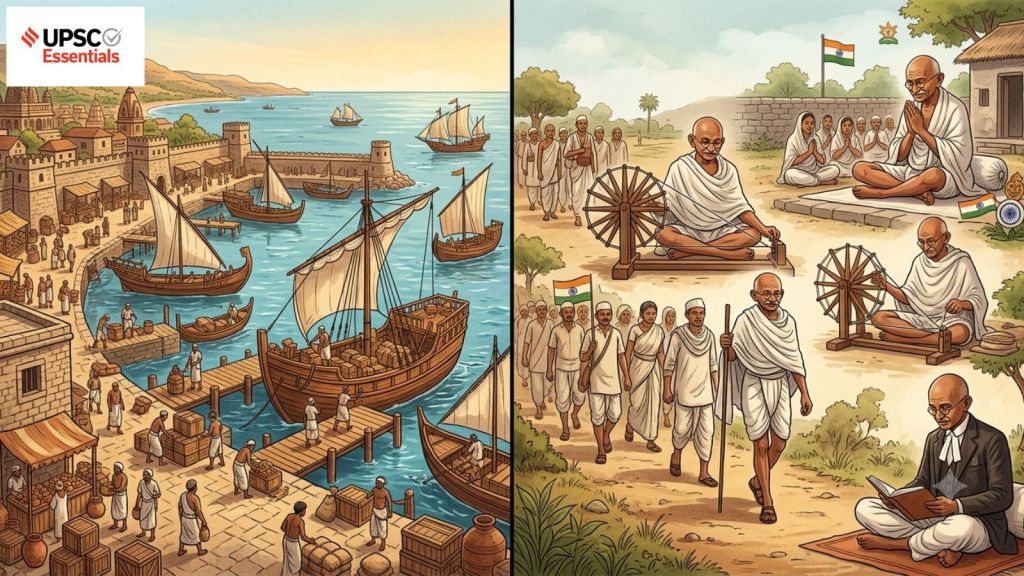 Are you preparing for Civil Services Mains Exam 2027? Attempt a question on Poompuhar Port and the evolution of Gandhian thought in today's answer-writing practice. (AI-generated Image)


 Share


