
But what happens when compassion, awareness and attention are missing from the way we build our lives and institutions?
The tragedy at Delhi’s Satya Niketan brings this question sharply into focus. Behind the incident are not merely damaged structures or failed regulations, but young aspirants who came to the city with a simple aspiration: to build a better future for themselves.
What happens when aspirations meet vulnerability?
Satya Niketan is therefore not an isolated tragedy; it raises a larger question about the conditions in which our aspirations are allowed to exist. How many people must accept unsafe spaces simply because they cannot afford safer alternatives? How long can the vulnerability of aspirants remain invisible until a tragedy makes it visible?
For many young people, especially those preparing for competitive examinations, affordable accommodation is not a luxury but a necessity. Their choices are shaped by limited resources, location, safety and the availability of alternatives. The tragedy makes us look beyond the individual and towards the social and institutional conditions that shape such choices.
It also reminds us that the executive is not merely responsible for making rules. The State is responsible for ensuring that rules actually protect people. When people live in vulnerable conditions, the ethical responsibility of institutions becomes greater, not smaller.
Where does the ethical responsibility lie when rules fail to protect life?
The ethical dilemma here is not merely about a failure to follow rules. It is about what happens when individual interests, institutional convenience and economic considerations come into conflict with the larger public good. When a person’s choices are shaped by limited alternatives, and when institutions that have the power to prevent harm fail to act, where does responsibility lie? At what point does the duty to protect human life become greater than the convenience of following the minimum required rules?
In the case of Satya Niketan, the question is not simply who violated a rule, but who had a duty to prevent the violation from becoming a threat to human life. This brings in the ethical values of responsibility, accountability, duty and sensitivity. Public administration cannot be reduced to the mechanical enforcement of rules. It must also recognise the human consequences of administrative inaction.
Can ethical values remain meaningful if they are not translated into action?
The tragedy also makes us confront the gap between values and conduct. We may speak of compassion, responsibility, integrity and concern for human life, but ethics cannot merely remain an idea or a value we speak about. They have to be translated into conduct. Compassion must become sensitivity, responsibility must become accountability, and concern for human life must become action.
Every year, incidents caused by fire, rain, structural failures and administrative lapses remind us of this gap. Officials failed, and so did all of us. The failure is not always a dramatic act of wrongdoing. Sometimes, it lies in what was not done, what was ignored, or what was allowed to continue despite the possibility of harm.
Rescue operation underway after two female students were found dead after the basement of Rau’s IAS, a UPSC coaching centre in Rajendra Nagar, was flooded following a nearby drain burst on July 27, 2024 (Express Photo/Gajendra Yadav)
In Satya Niketan, this translation should have happened before the tragedy, not after it.
Ultimately, the ethics of the sovereign good lead us to the ethics of the service of goods. The ethics of the sovereign good is concerned with identifying and pursuing what is ultimately good for human beings and society, providing principles against which our actions and choices can be judged. In public life, this means looking beyond individual or institutional interests towards the larger welfare of society. In the context of Satya Niketan, the sovereign good cannot simply be the efficient functioning of a locality or institution; it must include the safety, dignity and well-being of the people living and working there.
The ethics of the service of goods, on the other hand, is mainly associated with the servicing of goods, promoting values primarily related to efficiency and maximising output from input. Three aspects are crucial when it comes to the servicing of goods: the logic of mutual exchange, the collective approach, and the criteria for decision-making. But the larger question is whether efficiency and the delivery of goods and services remain connected to the ethical purpose they are ultimately meant to serve. If an institution functions efficiently but people remain unsafe, can that efficiency truly be called a public good?
Who is accountable when responsibility is shared by many?
When responsibility is spread across several stakeholders, accountability can easily become diluted. But public service demands that responsibility be clearly owned. In the case of Satya Niketan, accountability cannot end with identifying one immediate failure. It requires examining the chain of decisions, oversight, enforcement and inaction that allowed vulnerability to persist.
The tragedy makes this dilution of responsibility particularly troubling: the more people involved in a system, the easier it becomes for each person to believe that someone else was responsible. Ethical governance, therefore, requires not only rules but also ownership, answerability and a willingness to act before harm occurs.
And those stakeholders with unending insensitivity have forgotten something fundamental: human life cannot be treated as an externality of governance.
Is a choice really a choice when there is no safe alternative?
For an aspirant in Satya Niketan, the choice may appear to be between accepting the available accommodation and continuing the struggle for an uncertain alternative. But when every realistic alternative carries risk, how meaningful is that choice?
This is the ethical problem of the Hobson’s choice: a situation in which a person appears to have a choice, but in reality has little or no meaningful alternative. The larger ethical question is: can we call something a choice when a person has no safe alternative?
The tragedy therefore forces us to look at vulnerability not simply as an individual condition but as something that can be created or deepened by social and economic structures. When people are compelled to accept unsafe conditions because they lack alternatives, the responsibility of institutions to protect them becomes greater.
What does compassion mean in public service?
In public service, compassion means recognising the vulnerability of citizens and allowing that awareness to shape decisions and conduct. It is not merely sympathy after a tragedy, but sensitivity before one occurs. It means seeing the person behind the file, the rule, the building and the statistic.
This is where George Saunders’ understanding of compassion becomes relevant. Compassion begins with awareness and attention. It asks us to quiet the self-centred “monkey mind” and consider another person’s vulnerability with greater seriousness.
What happened at Satya Niketan therefore cannot be reduced to an unfortunate accident. It reflects a failure to recognise vulnerability, a failure to assume responsibility, and perhaps most importantly, a failure to see another person’s life as having the same value as our own.
Perhaps this is what ethics ultimately asks of us: not merely to know what is right, but to recognise another human being’s right to safety, dignity and a life lived without preventable fear.
HOW UPSC CAN ASK THIS?
1. “Compassion in public administration is meaningful only when it is translated into preventive action.” Discuss with reference to the ethical responsibilities of public officials.
2. “When citizens have no safe alternatives, can their choices truly be considered free choices?” Discuss in the context of ethical governance.
(The writer is the author of ‘Being Good’, ‘Aaiye, Insaan Banaen’, ‘Kyon’ and ‘Ethikos: Stories Searching Happiness’. He teaches courses on and offers training in ethics, values and behaviour. He has been the expert/consultant to SAARC countries, UPSC, Central Bureau of Investigation( CBI),National Judicial Academy, ATI, RAKNPA, Haryana Institute of Public Administration, ISA MountAbu, National Centre for Good Governance,Competition Commission of India (CCI), etc. He has PhD in two disciplines and has been a Doctoral Fellow in Gandhian Studies from ICSSR. His second PhD is from IIT Delhi on Ethical Decision Making among Indian Bureaucrats. He writes for the UPSC Ethics Simplified (concepts and caselets) weekly.)
Subscribe to our UPSC newsletter and stay updated with the news cues from the past week.
Stay updated with the latest UPSC articles by joining our Telegram channel – Indian Express UPSC Hub, and follow us on UPSC section of The Indian Express on Instagram and X.
For your queries and suggestions write at manas.srivastava@indianexpress.com
PREVIOUS ARTICLES ON UPSC ETHICS SIMPLIFIED:
Gen Z and the ethics of communication
IAS Tukaram Mundhe | Beyond the officer, study the ethical issues
As Divya Mittal resigns from IAS, 3 ethical questions on public service
Can fear of punishment create an ethical society?
CJP protest: Why responses to protests are an ethics case study
Railway linen theft : A Case Study in everyday ethics
Can ethics stop the next fire tragedy?
How can India’s civil services and governance rebuild Gen Z’s trust?

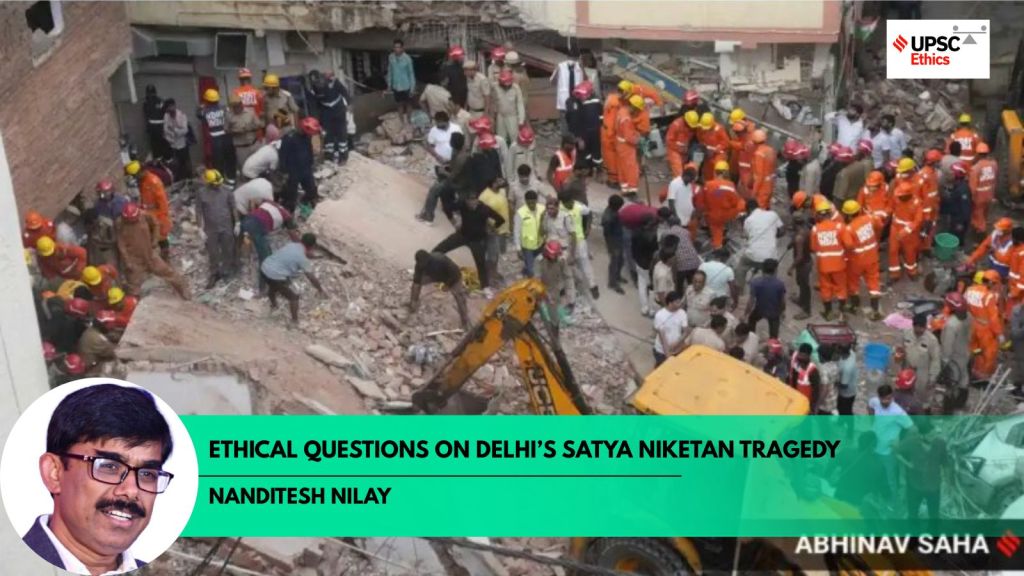 For an aspirant in Satya Niketan, the choice may appear to be between accepting the available accommodation and continuing the struggle for an uncertain alternative. But when every realistic alternative carries risk, how meaningful is that choice?

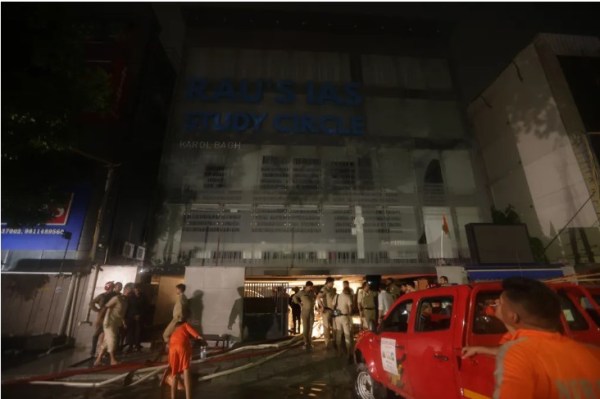 Rescue operation underway after two female students were found dead after the basement of Rau’s IAS, a UPSC coaching centre in Rajendra Nagar, was flooded following a nearby drain burst on July 27, 2024 (Express Photo/Gajendra Yadav)

 Share


