
UPSC Ethics Simplified : As Divya Mittal resigns from IAS, 3 ethical questions on public service
Divya Mittal’s resignation from the IAS offers a moment to pause and ask: What does it truly mean to serve? And for aspirants, perhaps an opportunity to ask themselves: What kind of civil servant do I want to become? Nanditesh Nilay, our ethicist, explores.
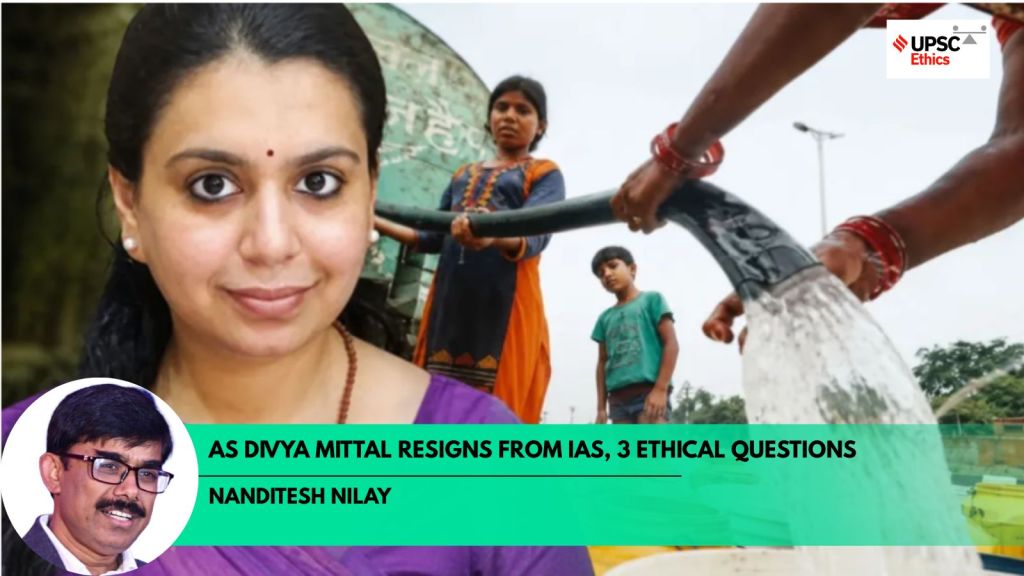 Divya Mittal ensured piped water for a remote village in Mirzapur where residents had depended on tanker water (Photos: X/Divya Mittal; Vishal Srivastav).
(UPSC Ethics Simplified is a special series under UPSC Essentials by The Indian Express that explores ethical concepts relevant to the Civil Services Examination. In this article, ethicist Nanditesh Nilay looks at IAS officer Divya Mittal, who recently resigned from the civil services after a 13-year career and was known for her work in Mirzapur, including ensuring piped water reached households in Lahuria Dah village, and examines some fundamental questions around public service, ethical conduct and the role of a civil servant.)
“I was a fool to think I had come to give something. The truth is, I received the most, and that debt only grew deeper.”

As IAS officer Divya Mittal announced her resignation after 13 years in the civil services, her words offer a deeper way to think about public service. What does it mean to serve? Is it simply the exercise of authority within an institutional framework, or does it become meaningful when an officer begins to see the person behind every file, complaint and government scheme?
For a civil servant, water reaching a household, land rights reaching a family or a person receiving dignity may appear to be administrative outcomes. For a citizen, they can be life-changing experiences.
This raises a fundamental ethical question: What makes an officer truly committed to public service?
Ethics is not limited to conduct rules, procedures or compliance. It also demands empathy, responsibility and the ability to distinguish between what is merely convenient and what is right.
The story of Divya Mittal offers an opportunity to reflect on the difference between occupying a public position and giving meaning to it. An ideal officer is one who remains connected to the people. But how can a governance system retain and nurture such commitment?
What can Divya Mittal’s work teach us about public service?
We do not know why Mittal chose to resign, and there is no need to speculate. But her decision naturally invites reflection on the nature of public service itself.
How does someone walk away from a position that millions of aspirants dream of securing? Perhaps because the significance of the civil service is not limited to the position. For a citizen, the civil servant often represents a promise.
A beneficiary, a complainant, a listener, or simply a citizen holding onto hope may think: “The Collector is here. Perhaps something will finally be set right.”
This expectation is what makes the ethical character of a civil servant so important.
When Mittal discovered during the implementation of the Jal Jeevan Mission that water had not reached Lahuria Dah, a hilly village in Mirzapur, for decades, the problem could have remained another administrative entry. Instead, it became a question of responsibility.
Perhaps she asked herself a fundamental question: “Who am I in relation to this problem?”
The answer was not merely that she was the District Magistrate. Public office had placed her in a position where another person’s deprivation had become part of her responsibility. She pursued the issue until piped water reached the households in the village. That is where ethics in governance moves beyond compliance. It becomes a relationship between the state and the citizen, between public office and public trust.
And perhaps that is what we need to examine through three ethical questions.
#1 What makes an officer “good”?
Is an ethical officer simply someone who follows the rules?
Or is ethical conduct something deeper, where rules are accompanied by empathy, responsibility, courage and a willingness to act?
Aristotle’s understanding of virtue offers an interesting lens here. Moral philosophy, he argues, is not merely about asking how one ought to behave, but about becoming the kind of person for whom ethical conduct becomes a settled disposition.
In other words, a good person does not merely perform a good act. Good action flows from character.
The same distinction can be applied to public administration.
An officer may follow every rule and still remain disconnected from the people. Conversely, an officer who internalises values such as empathy, justice, compassion and public service begins to see administrative decisions through their human consequences.
This is what makes the stories of officers such as Divya Mittal and Tukaram Mundhe significant. Their stories remind us that good governance is not produced only by good rules. It also requires people who are willing to embody the values behind those rules.
An ideal officer, therefore, is not necessarily one who is perfect or one who always succeeds. It is one who remains conscious of the human purpose of public office.
#2 Can an individual officer transform the system?
An ideal officer can make a difference. But can one officer transform an entire system?
Probably not.
A single Tukaram Mundhe or Divya Mittal cannot, by themselves, transform the state into an ideal system of governance. Institutions are larger than individuals, and sustainable governance cannot depend entirely on individual virtue.
Yet individuals matter because institutions acquire meaning through human action.
This raises an important ethical dilemma: Should public servants adapt themselves completely to the system, or should they try to change the system from within when they encounter something that conflicts with their sense of public duty?
There may be no easy answer. The challenge lies in balancing institutional discipline with moral courage, administrative pragmatism with idealism, and obedience with conscience. The civil servant operates within rules, hierarchies and institutional limitations. But public service also demands the ability to recognise when a rule, procedure or institutional habit is failing to serve its larger purpose.
This is where ethical reasoning becomes important.
The question is not simply whether an officer has followed a rule. It is also whether the decision is consistent with the larger values of justice, dignity, public welfare and constitutional morality.
#3 What does public service ultimately mean?
We need to understand that human civilisation is, at its core, a story of relationships.
Our relationship with one another, with communities and with institutions gradually becomes as important as many of our material needs. To care for and serve another person without prejudice or immediate self-interest is one of the deepest expressions of that relationship.
We begin with a single identity and gradually develop a collective identity. Association, therefore, is not merely about living alongside one another. It is about recognising one another. Modern life, however, increasingly risks reducing people to numbers, consumers, beneficiaries, files or data points.
This becomes particularly important in an age of artificial intelligence, automation and increasingly impersonal systems of governance. Technology can make administration faster and more efficient, but ethical governance still depends upon our ability to recognise the person behind the process.
That is why interpersonal relationships, community bonding and our relationship with ourselves remain important to ethical governance.
A citizen does not experience the state as an abstract institution. The citizen experiences the state through the school that functions, the road that is built, the water that reaches a home, the official who listens to a complaint and the dignity with which a person is treated at a government office.
The system therefore needs that ideal consciousness among all officers who join public service.
A single Tukaram Mundhe or Divya Mittal cannot transform governance into an ideal reality. But such officers can remind the system, and those preparing to enter it, of the values that should animate it.
Perhaps that is their larger contribution.
Aspirants’ opportunity to examine themselves
Socrates famously believed that an unexamined life is not worth living. The same thought can perhaps be extended to public service.
Every aspirant should ask: Why do I want to become an officer? Is it status, authority and recognition, or is there also a deeper desire to serve, solve problems and make the state more responsive to its citizens?
The journeys of officers such as Tukaram Mundhe and Divya Mittal remind us that public service is rarely a straight road. There will be competing interests, institutional constraints, political pressures and situations where no option is entirely perfect. Ethics is tested precisely in these spaces.
That is why character matters. Aristotle saw moral philosophy not merely as asking how one ought to behave, but how one becomes the kind of person disposed to act ethically. Similarly, a good civil servant is not someone who occasionally does the right thing. Good conduct must emerge from character, shaped by empathy, courage, justice and a commitment to public service.
This is also why an officer’s conduct shapes public trust. Not because officers should seek popularity, but because every interaction with the citizen shapes their understanding of the state. A file may close and a posting may end, but the experience of being heard, treated with dignity or receiving something long denied can remain for a lifetime.
Divya Mittal’s recollection of an elderly woman in Lahuria Dah captures this relationship. When water finally reached the village, the woman simply touched her head and blessed her. The position may be left behind, but such moments remain.
An institution does not become ethical merely because it has ethical rules. It becomes ethical when the people within it have the character, consciousness and courage to give those values meaning. A single officer cannot transform governance. But one officer can remind an entire generation of what good governance ought to look like.
For aspirants, perhaps that is the question worth carrying forward: What kind of officer do I want to become?
Thank you, Divya Mittal, for the work you did in public service and for giving us an opportunity to reflect on what it truly means to serve. Good wishes for the journey ahead.
(The writer is the author of ‘Being Good’, ‘Aaiye, Insaan Banaen’, ‘Kyon’ and ‘Ethikos: Stories Searching Happiness’. He teaches courses on and offers training in ethics, values and behaviour. He has been the expert/consultant to SAARC countries, UPSC, Central Bureau of Investigation( CBI),National Judicial Academy, ATI, RAKNPA, Haryana Institute of Public Administration, ISA MountAbu, National Centre for Good Governance,Competition Commission of India (CCI), etc. He has PhD in two disciplines and has been a Doctoral Fellow in Gandhian Studies from ICSSR. His second PhD is from IIT Delhi on Ethical Decision Making among Indian Bureaucrats. He writes for the UPSC Ethics Simplified (concepts and caselets) weekly.)
Subscribe to our UPSC newsletter and stay updated with the news cues from the past week.
Stay updated with the latest UPSC articles by joining our Telegram channel – Indian Express UPSC Hub, and follow us on UPSC section of The Indian Express on Instagram and X.
For your queries and suggestions write at manas.srivastava@indianexpress.com
PREVIOUS ARTICLES ON UPSC ETHICS SIMPLIFIED:
Gen Z and the ethics of communication
IAS Tukaram Mundhe | Beyond the officer, study the ethical issues
Can development come at the cost of safety?
Can fear of punishment create an ethical society?
CJP protest: Why responses to protests are an ethics case study
Railway linen theft : A Case Study in everyday ethics
Can ethics stop the next fire tragedy?
How can India’s civil services and governance rebuild Gen Z’s trust?

 Share


