
This time too, the story was no different. In recent years, whenever the conversation turns to competitive examinations, alongside IIT-JEE, it invariably centres on NEET. However, the issue today extends beyond merely conducting an examination. It raises a far deeper question about ethics, institutional credibility, and governance itself.
NEET Exam paper leak: What are the real questions?
Every examination asks questions to students. But when examination papers themselves begin to leak repeatedly, perhaps it is society that must answer a few uncomfortable questions. Why is the leaking of examination papers becoming such a pervasive social phenomenon? Is this merely a social issue, or does it carry ethical implications as well? Should responsibility rest solely with a few individuals, or is there a deeper need to strengthen the entire systemic framework? And perhaps most importantly, when the dreams of millions are inextricably linked to a single examination, do we not, as a society, require a heightened sense of ethical sensitivity, a kind of ethical governance in public examinations?
After all, if question papers for such a massive examination continue to be leaked repeatedly, what exactly are we trying to achieve? Do we not, as a society, require a heightened sense of ethical sensitivity, a kind of ethical governance in public examinations?
Why do we need Ethical governance in public examinations?
Ethical governance in public examinations is not merely an administrative necessity; it is a constitutional and moral obligation towards millions of aspirants whose faith in justice, merit, and equality depends upon the integrity of these institutions.
The NEET controversy raises serious ethical concerns involving integrity, fairness, accountability, empathy towards aspirants, institutional transparency, and the moral responsibility of public authorities. At stake is not merely an examination, but citizens’ trust in public institutions.
Administrative Evil and Institutional Failure
Administrative evil can exist either in a state of ignorance or as a deliberate act.
Administrative evil often emerges not only through corruption, but also through negligence, indifference, normalisation of unethical practices, and failure of institutional vigilance.
In the case of NEET, the issue appears to stem largely from deliberate actions. Ethical governance draws upon both teleological and deontological ethics. However, in public decision-making, it is deontological ethics that safeguards the integrity of the examination system and preserves the sanctity of citizen’s faith. It reassures examinees about the efficiency and fairness of the entire process. Yet, the system failed, and administrative evil eclipsed everything.
The other stakeholders, beyond students
The ethical failure of examination systems does not affect only aspirants; its consequences ripple through society. The consequences extend beyond students. Parents suffer emotional and financial distress. Millions of families across the country aspire to see their children become doctors, and those children dedicate themselves to preparing for the examination. It is one thing if a student fails to qualify on their own merit. But when students suffer because of institutional negligence, or when an entire examination is cancelled due to the misconduct of a few individuals, the dreams of countless families are shattered.
There are also others. For example, honest administrators face institutional distrust; society risks normalising unethical shortcuts; and ultimately the credibility of meritocracy itself comes under question.
Beyond individual wrongdoing, the controversy points towards a larger governance deficit.
Stakeholders analysis
Probity in Governance and Public Trust
The issue also reflects a deeper crisis of probity in governance. When institutions entrusted with conducting examinations fail to safeguard confidentiality and fairness, governance loses moral legitimacy and public trust.
It is often argued that unethical acts can be prevented through stronger controls, higher ethical standards, and stricter laws and regulations. Yet ethics also functions as an internal standard of conduct, acting as a moral compass in morally chaotic situations.
Therefore, despite all mechanisms of fairness and institutional checks, examination leaks can only be permanently prevented when both institutions and citizens work towards improving the examination process. Real change requires collaboration among examination boards, educational institutions, and civil society to create transparent and accountable systems that protect students’ dreams from administrative failures.
Ultimately, laws and surveillance alone cannot sustain ethical systems. Human greed and administrative evil must be minimised through the power of ethics. There is no other way. If the benefits of unethical behaviour continue to outweigh the costs, moral disengagement will gradually become the new social normal through examination leaks.
On the one hand, examinees are frisked from head to toe in the name of fairness and distrust. From monitored dress codes to biometric checks, NEET aspirants are subjected to extraordinary scrutiny in the name of maintaining integrity. Yet, when the system itself fails, who bears the consequences? Students.
Also, what about protecting the heart of the examination itself, the question paper? Ultimately, the purpose of an examination is to recognise and nurture the brightest minds. Just as Pablo Picasso said, “The purpose of art is washing the dust of daily life off our souls,” education and public examinations too should inspire hope, integrity, and human potential, not bury young aspirations under corruption and distrust.
Post Read Question:
A major public examination conducted for lakhs of students recently came under controversy after allegations of a question paper leak surfaced soon after the test. The incident triggered public outrage, protests by aspirants and parents, and widespread concerns regarding fairness, transparency, and institutional accountability. Many students claimed that years of hard work had been undermined due to systemic failures and possible collusion within the examination process.
The controversy also exposed weaknesses in examination security, administrative oversight, grievance redressal, and mechanisms for fixing responsibility. While authorities announced inquiries and corrective measures, public trust in the credibility of competitive examinations suffered significantly.
Questions:
1. What ethical issues are involved in the case?
2. Who are the key stakeholders, and how are they affected?
3. As a public administrator, what measures would you suggest to strengthen integrity, transparency, and accountability in public examinations?
(The writer is the author of ‘Being Good’, ‘Aaiye, Insaan Banaen’, ‘Kyon’ and ‘Ethikos: Stories Searching Happiness’. He teaches courses on and offers training in ethics, values and behaviour. He has been the expert/consultant to UPSC, SAARC countries, Civil services Academy, National Centre for Good Governance, Central Bureau of Investigation (CBI), Competition Commission of India (CCI), National Judicial Academy, etc. He has PhD in two disciplines and has been a Doctoral Fellow in Gandhian Studies from ICSSR. His second PhD is from IIT Delhi on Ethical Decision Making among Indian Bureaucrats. He writes for the UPSC Ethics Simplified (concepts and caselets) fortnightly.)
Edited by Manas Srivastava
Subscribe to our UPSC newsletter and stay updated with the news cues from the past week.
Stay updated with the latest UPSC articles by joining our Telegram channel – Indian Express UPSC Hub, and follow us on UPSC section of The Indian Express on Instagram and X.
For your queries and suggestions write at manas.srivastava@indianexpress.com
PREVIOUS ARTICLES ON UPSC ETHICS SIMPLIFIED:
Dear UPSC aspirants, how do you know what’s ethical in everyday life
Are humans failing ethically in the AI age?
How fake success claims by aspirants reveal a deeper moral crisis
Minister vs Civil Servant : In governance, mature conversation is the key
This Republic Day, understanding idea of ‘Self-Sovereignty’ and why ethics matter
How does Vivekananda’s philosophy take us from ‘I’ to humanity?
Beyond the ‘Word of the Year’: Why 2026 needs a ‘Value of the Year’ and what should it be?

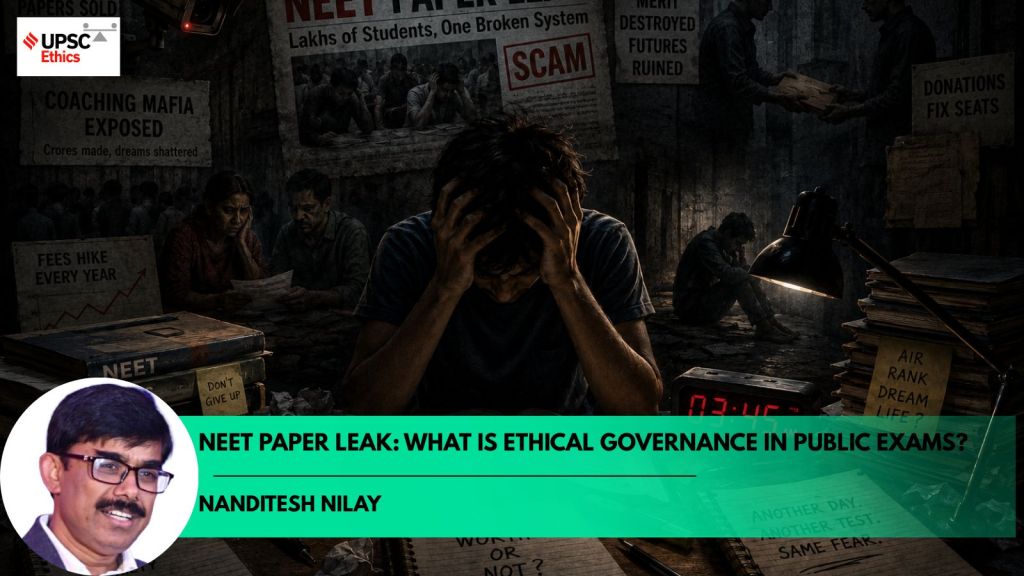 Nanditesh Nilay writes: The NEET controversy raises serious ethical concerns involving integrity, fairness, accountability, empathy towards aspirants, institutional transparency, and the moral responsibility of public authorities. At stake is not merely an examination, but citizens’ trust in public institutions. (Image: AI generated)

 Stakeholders analysis

 Share


