


Journalism of Courage
 Civic virtues are qualities that help individuals act as responsible members of a political community.
(UPSC Ethics Simplified, a special series under UPSC Essentials by The Indian Express, explores ethical concepts relevant to the Civil Services Examination. In today’s article, we examine what our conduct on the road reveals about civic virtue and ask a larger question: What happens when citizens fail to exercise self-restraint, responsibility and respect for others in public spaces? Our ethicist examines the issue through the lenses of civic virtue, good citizenship, self-restraint and moral duty.)
What happens when a person is involved in an accident on the road? If someone is hit, intentionally or unintentionally, an immediate ethical response should be to stop, check on the person and take responsibility for one’s actions.
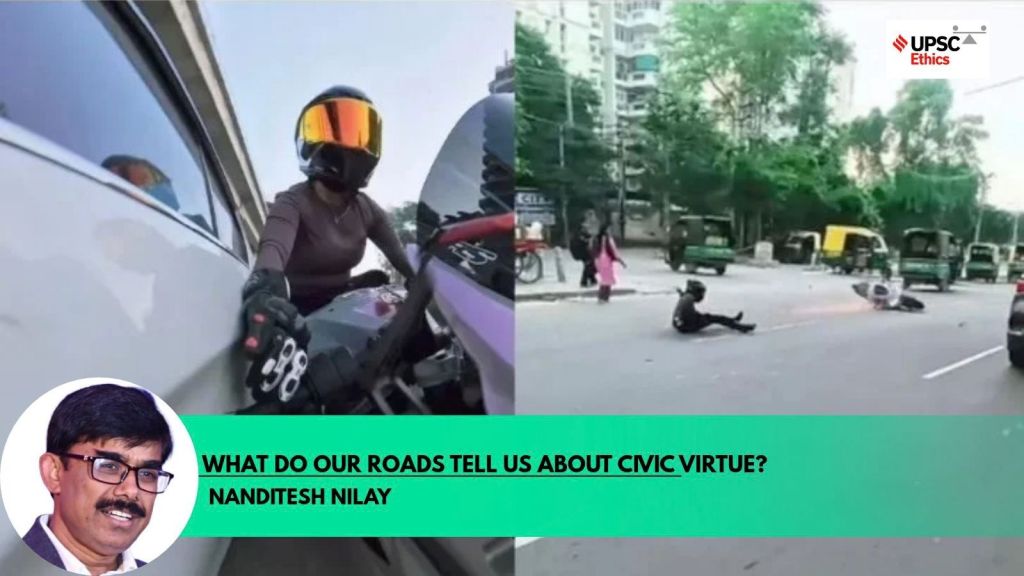
The recent Gurugram case involving a woman biker raises questions about these basic civic responsibilities. The Indian Express reported that a woman biker was allegedly chased and rammed by a car on Golf Course Road. Video footage showed the car following the biker before colliding with her motorcycle. The police later added sections relating to attempt to murder, stalking and insulting the modesty of a woman to the FIR.
The incident is therefore not only about road safety. It also provides an opportunity to examine a larger ethical question: What do our everyday actions on public roads tell us about our civic virtues?
A virtue is a set of traits, habits and qualities that enable individuals to fulfil their responsibilities effectively.
Civic virtues are qualities that help individuals act as responsible members of a political community. They include concern for the common good, participation in public life, respect for institutions, opposition to corruption and responsibility towards fellow citizens. The importance and formation of civic virtues have been central questions in political philosophy from ancient times.
Roads provide a simple but powerful setting in which these virtues are tested. Patience, self-restraint, respect, responsibility and concern for another person’s safety are not abstract ethical concepts when we are behind the wheel. They directly influence the safety and dignity of other citizens.
Aristotle drew a subtle distinction between a good person and a good citizen. The virtues of a good person are universal or absolute in character, while the virtues of a good citizen are also related to the constitution and the responsibilities of living in a political community.
Aristotle further connected the two through virtue of character. Qualities such as courage, temperance, justice and practical wisdom are cultivated through habituation in a well-ordered community and expressed through civic engagement. This idea of habituation is particularly relevant to civic life. Ethical conduct is not developed merely by knowing what is right. It is strengthened by repeatedly practising the right behaviour.
For instance, stopping after an accident, helping an injured person, controlling anger during a traffic dispute or respecting another person’s right of way may appear to be small acts. But repeated acts of self-restraint and responsibility help build civic character.
Thus, the question is not merely whether a person knows the rules. It is whether the person has developed the character to follow them, especially when emotions run high.
British moral philosopher W.D. Ross rejected the idea that all moral decisions can be reduced to one supreme principle. He proposed the idea of prima facie duties. These are genuine moral duties that normally carry weight, although in a particular situation one duty may have to take precedence over another.
Ross identified duties such as fidelity, reparation, gratitude, justice, beneficence, self-improvement and non-maleficence.
The idea is important because real-life ethical situations often involve competing considerations. Determining which duty should take precedence requires moral judgement and practical wisdom. It cannot always be reduced to a mechanical formula or an algorithm.
Ross’s idea of self-improvement also has a direct connection with civic virtue.
Self-improvement is not limited to acquiring knowledge or professional skills. It includes cultivating one’s virtues, character and capacity for self-control. A person must understand one’s own intentions and limitations well enough to fulfil promises, avoid causing harm and prevent personal desires from overriding one’s duties. This is where self-restraint becomes important.
On a road, anger, impatience, ego or the desire to assert one’s power can quickly affect another person’s safety. A mature ethical response requires an individual to recognise these emotions and exercise control over them.
The principle of non-maleficence, or the duty to avoid causing harm, becomes particularly relevant. If an action can seriously harm another citizen, the individual’s responsibility cannot end with saying that the harm was unintended. Ethical conduct also requires us to consider the foreseeable consequences of our actions and our responsibility towards others.
The Gurugram incident brings these questions into sharp focus. The woman biker questioned why the driver did not stop to help her if the collision had been unintentional. The police investigation later examined video footage and escalated the charges.
The ethical lesson goes beyond one individual or one incident. When self-restraint, justice, responsibility and concern for others are absent from civic conduct, public spaces can become places where power, aggression or privilege determine who feels safe. This is why civic virtue matters in both personal and professional life.
A society cannot depend only on laws and punishment. Laws provide an external framework for behaviour, but civic virtues help create the internal willingness to act responsibly even when no one is watching.
India often views roads, highways and other infrastructure as visible symbols of development. They are important indicators of economic progress and connectivity.
But development cannot be measured only by the quality or length of our highways. A developed society also requires citizens who can share public spaces with discipline, empathy, responsibility and respect for others. If physical infrastructure advances while civic virtues remain weak, development remains incomplete. The road, therefore, becomes more than a means of transportation. It becomes a test of citizenship.
The fundamental question is not only: How good are our roads? It is also: How good are we as citizens while using them?
The Dalai Lama’s emphasis on cultivating a compassionate mindset provides another dimension to this discussion.
When our thoughts are dominated by excessive preoccupation with the self, emotions such as fear, anger, jealousy and mistrust can become stronger. Concern for the well-being of others, on the other hand, can make our minds clearer and our conduct more peaceful.
This idea has relevance for civic life.
A road is shared by strangers. We may never know the person driving beside us, walking across the road or riding a motorcycle ahead of us. Yet our actions can directly affect their safety. Civic virtue begins with recognising that the stranger on the road is also a citizen with equal dignity and rights.
The Gurugram case can be used to connect several concepts in UPSC Ethics GS Paper IV:
Civic virtue: Responsibility towards the common good and fellow citizens.
Self-restraint: Controlling anger, ego and impulses.
Non-maleficence: Avoiding actions that cause harm to others.
Justice: Respecting the equal rights and dignity of other citizens.
Self-improvement: Cultivating ethical character and emotional control.
Compassion: Recognising and responding to the vulnerability of others.
For a future civil servant, these values matter not only in extraordinary situations but also in everyday public life.
Roads can testify to a country’s physical development. But the way citizens behave on those roads can testify to its civic character.
Story continues below this ad
1. “A good citizen is not merely one who obeys the law, but one who possesses civic virtues.” Discuss with reference to Aristotle and contemporary public life.
2. How can self-restraint, non-maleficence and compassion contribute to safer and more ethical public spaces?
(The writer is the author of ‘Being Good’, ‘Aaiye, Insaan Banaen’, ‘Kyon’ and ‘Ethikos: Stories Searching Happiness’. He teaches courses on and offers training in ethics, values and behaviour. He has been the expert/consultant to SAARC countries, UPSC, Central Bureau of Investigation( CBI),National Judicial Academy, ATI, RAKNPA, Haryana Institute of Public Administration, ISA MountAbu, National Centre for Good Governance,Competition Commission of India (CCI), etc. He has PhD in two disciplines and has been a Doctoral Fellow in Gandhian Studies from ICSSR. His second PhD is from IIT Delhi on Ethical Decision Making among Indian Bureaucrats. He writes for the UPSC Ethics Simplified (concepts and caselets) weekly.)
Subscribe to our UPSC newsletter and stay updated with the news cues from the past week.
Stay updated with the latest UPSC articles by joining our Telegram channel – Indian Express UPSC Hub, and follow us on UPSC section of The Indian Express on Instagram and X.
For your queries and suggestions write at manas.srivastava@indianexpress.com

Read UPSC Magazine


