The UPSC Ethics paper is a thinking and application-based paper. Just before listing the GS-IV syllabus, the UPSC notification explains that the paper tests a future public officer’s “attitude and approach” to integrity, probity, problem-solving and conflicts in dealing with society.
Memorising ethical values, principles, definitions, thinkers and quotes is only the starting point. The real test is your ability to apply an ethical lens to everyday issues, weigh competing values and stakeholders, and arrive at practical, balanced solutions. Aspirants are expected to develop ethical reasoning, not ready-made answers.

UPSC Ethics Answer Practice series is an attempt to build that skill. Every week, we will take up an issue from the news, identify the ethical values, principles, stakeholders and conflicting duties involved, and apply them through a UPSC-style question or case study. What follows the questions is not a model answer, but a thought process to help you approach the question.
The questions below address the theme of ethical reasoning and moral dilemmas.
QUESTION 1 (Theory)
Ethics begins where the question of ‘what can be done’ gives way to ‘what ought to be done’. Explain how ethical reasoning helps individuals resolve conflicts in their everyday lives.
(AI generated)
— What is ethics? That is generally how you will start thinking on this question. It is a normative framework that guides human conduct towards what is right. It comes into play when there is a choice. And that is where ethical reasoning begins: What ought one to do, and why?
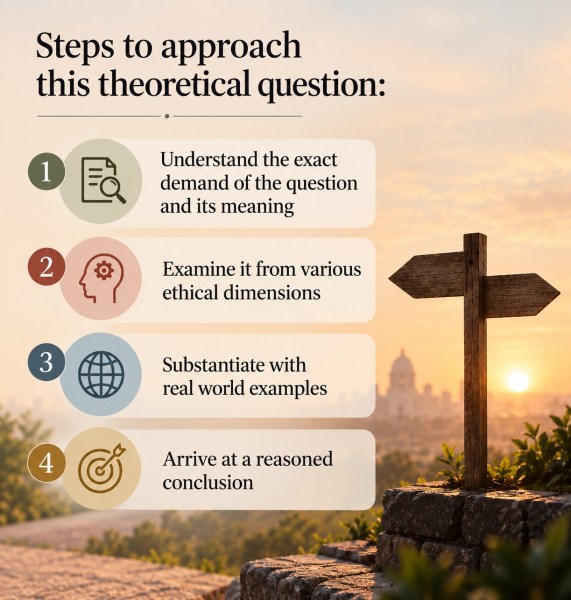
— But don’t start answering by simply explaining what ethics is. Instead, your thought process should ask: When a person has several possible choices, how does ethical reasoning help determine which choice ought to be made?
For Your Information:
1. The question gives you a fundamental distinction: What can be done does not equal what ought to be done.
2. The question asks about everyday lives. So move beyond abstract definitions. Think of situations where a person has to choose between competing values.
QUESTION 2 (CASELET)
Apply the similar framework given in the theoretical question above and use it to arrive at an ethically justifiable decision in the following caselet.
You are a postgraduate student preparing for a competitive examination. One of your closest friends, with whom you have a childhood bonding and shared your joys and sorrows, has been struggling financially and is under considerable family pressure. He confides in you that he has used unfair means during a recent examination. He requests you not to disclose the matter, arguing that losing the opportunity could seriously affect his career and his family’s financial situation.
You know that reporting him could have serious consequences for his future. At the same time, remaining silent would mean allowing him an unfair advantage over other candidates who adhered to the rules. Your friend also argues that nobody was harmed directly and that he intends to never repeat the act.
(Image generated by AI)
Questions:
1. What are the ethical issues and dilemmas involved in the situation?
2. What values or principles are in conflict?
3. What options are available to you? Examine their ethical implications.
4. What would you do? Give reasons for your decision.
— How to approach case studies: These can be called the final test of your applied thinking, taking ethical reasoning a step further. You are placed in a situation where values and principles may conflict. The challenge is to identify the ethical issues, dilemmas, weigh competing options, make an ethical judgement, and arrive at a balanced, morally defensible and practical course of action. Can you make an ethical decision in tough situations?
— As you start answering, keep one essential thought process in mind: Apart from remaining silent or reporting the matter immediately, a third option could be to confront the friend and encourage voluntary disclosure. The point is not that the third option is automatically the “correct answer”. The point is to consider the alternatives before making a choice.
Express Tip: ‘The Defence Tip’
Before you finish any ethics case study, ask yourself three questions:
1. Why this option as a solution?
(Can I explain why my choice is better than the alternatives?)
2. What if my decision becomes public?
(Would I still be able to defend it before the people affected by it? Do I need to?)
3. Can I protect both the principle and the person?
(Where possible, can I uphold integrity and fairness without being unnecessarily harsh or insensitive?)
This does not mean compromising ethical principles. Rather, it means recognising that ethical decision-making requires both moral courage and human sensitivity.
(Refer: 1.Values which make us Human — the concept
2. From Values to Morality — the concept
3. Conscience and Ethical Decision Making: The Concept
4. CJP protest: Why responses to protests are an ethics case study)
🚨For any queries and feedback, contact raveena.baneta@indianexpress.com. Click Here to read the UPSC Essentials magazine for August 2026.
🚨 Subscribe to our UPSC newsletter. Stay updated with the latest UPSC articles by joining our Telegram channel – IndianExpress UPSC Hub, and follow us on Instagram and X.

 The choices we make reveal not just what we can do, but what we ought to do. (Image generated by AI)

 (AI generated)
 (Image generated by AI)


 Share


