UPSC Ethics is not about memorising definitions, thinkers or ethical terms. It is about how you think when a difficult situation has no easy answer. The UPSC notification says GS-IV assesses a future public servant’s “attitude and approach” towards integrity, probity, problem-solving and social challenges. Knowledge of values, principles and thinkers is only the starting point. What matters is recognising ethical dilemmas, examining different perspectives and arriving at a reasoned course of action.
This is especially important in healthcare, where decisions affect life, dignity and well-being, and ethical responsibilities extend beyond the doctor-patient relationship to institutions and society.
Last week, we attempted questions related to the theme of development and environment conservation. This week, the questions focus on the theme of Medical Ethics.
QUESTION 1 (Theory)
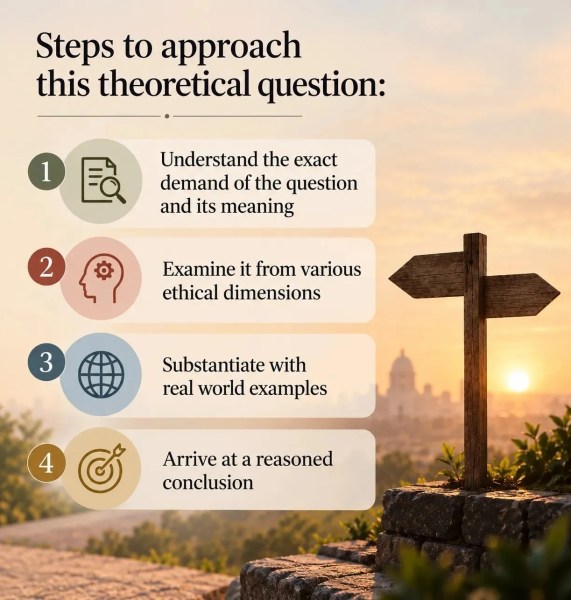
“In healthcare, corruption is not merely a violation of probity; it can become a violation of medical ethics.” Discuss with suitable examples.
 (AI generated)
— Probity refers to a kind of proven honesty and universal moral uprightness. Simply, it means being entirely ethical and incorruptible, especially when holding a position of trust, handling financial transactions, or performing a public or professional role.
— In public administration, probity is closely linked with transparency, accountability, impartiality and the responsible use of public resources. When decisions concerning medicines, medical equipment and public funds are allegedly influenced by considerations other than public welfare, the ethical concern is not merely financial.
— It is also a question of public trust. A public servant entrusted with public money and decision-making authority is expected to act as a trustee of public resources. The State is effectively a steward of resources (also linked to fiduciary duty) entrusted for the protection of human life and health. Citizens are the ultimate beneficiaries of these resources. Any breach of this trust can therefore affect not only the exchequer but also the quality and accessibility of public services.
— The Constitution of India guarantees the right to life to every citizen (Article 21), and those in positions of power must understand that they are guardians of people’s trust and trustees of the values of probity.
— When we investigate the incident through Principlism, an approach associated with Beauchamp and Childress and widely used in bioethics, four important principles emerge: autonomy, beneficence, non-maleficence and justice.
— Non-maleficence, a core ethical principle, means doing no harm or refraining from causing harm to others. It is a fundamental duty, particularly in healthcare, where the potential risks and benefits of any action must be carefully weighed. It is often expressed through the maxim primum non nocere, or “first, do no harm”.
— In a public healthcare system, this principle does not apply only to doctors treating patients. It can also extend to the wider chain through which medicines, equipment and healthcare services reach patients. If procurement decisions compromise the quality, safety or timely supply of essential healthcare, vulnerable patients may ultimately bear the consequences.
— Beneficence requires individuals and institutions to act for the welfare of others. A healthcare procurement system should therefore function with the objective of ensuring safe, effective and timely healthcare for citizens.
— Justice requires fairness in the distribution of resources and opportunities. Misuse or diversion of public resources can affect citizens who depend most heavily on public healthcare, thereby raising questions of distributive justice.
— Autonomy requires respect for an individual’s ability to make informed decisions about their own healthcare. Meaningful autonomy is difficult to exercise when patients do not have access to safe and reliable healthcare or adequate information.
— Duty-based ethics asserts that morality is grounded in duties and principles. Deliberately misrepresenting a product, manipulating a process or deceiving another person would violate the duty of honesty.
— According to Kant, treating another person merely as a means to an end is morally wrong. In the context of public healthcare, citizens and patients cannot be treated merely as means for achieving private financial interests, they are the ends in themselves, with State and it’s functionaries having an obligation to protect public health.
— From a utilitarian or consequentialist perspective, an action is assessed partly by the consequences it produces. The right action is one that produces the greatest overall good.
— Kerala’s experience during COVID-19 illustrated how institutional preparedness, primary healthcare infrastructure, community participation and clear protocols during emergencies can translate ethical principles into public-health practice. It shows that responsibility for patient welfare does not rest only with individual doctors but institutions themselves have an ethical duty to anticipate risks and protect vulnerable populations.
— Moreover, India’s experiences with polio eradication, community-led HIV advocacy, TB survivor networks and women’s collectives show the importance of citizen ownership of public health initiatives.
QUESTION 2 (Case Study)
Apply the similar framework given in the theoretical question above and use it to arrive at an ethically justifiable decision in the following caselet.
You are the Head of a government agency responsible for procuring medicines, surgical supplies and medical equipment for government hospitals. You are reviewing a recently awarded tender for specialised medical equipment.
You notice that the eligibility conditions were unusually restrictive, allowing only two suppliers to qualify. Two members of the tender committee had raised objections to the specifications, arguing that they could hinder competition, but the tender was approved after the committee was reportedly persuaded by a non-member that the requirements were technically necessary.
While reviewing the payment records, you also find that some of the suppliers who had supplied essential medicines to government hospitals have been awaiting payment for a long period, while payments to certain suppliers with big orders under recently awarded tenders were released within a very short period.
(Representational image generated by AI)
You order your officials to retrieve the records relating to the tender. Several files containing the details of officials involved in preparing the tender conditions and evaluating the bids are found to be missing. A senior officer tells you that the missing records may be an administrative lapse and advises you not to reopen the matter. He argues that doing so could delay the supply of essential equipment to hospitals and undermine public confidence in the agency.
One of the members of the earlier tender committee later meets you privately and shares that members had faced pressure to approve certain specifications. However, he is unwilling to make a formal statement, fearing repercussions. You have no conclusive evidence of corruption, but the circumstances raise serious concerns about the integrity of the procurement process.
As the head of the agency, you must decide how to proceed in this situation.
Questions:
(a) Identify the ethical issues involved in the case.
(b) What course of action would you adopt? Give reasons.
(c) What institutional safeguards would you recommend to prevent professional expertise from being used to conceal arbitrary or vested decision-making?
Express Tip: ‘The Ethics Defence Tip’
Before you finish any ethics case study involving healthcare, ask yourself four questions:
1. Can I defend my choice ethically?
(Which ethical principles support my decision? Does it uphold integrity, justice and public trust?)
2. Have I protected the public interest?
(Does it protect patients and other vulnerable stakeholders?)
3. Have I followed due process?
(Have I respected fairness, transparency and institutional safeguards? At the same time, have I recognised that merely following procedure may not be sufficient if the process itself raises ethical concerns?)
4. Is my decision both principled and practical?
(Does it uphold ethical values without compromising essential healthcare delivery?)
— Ultimately, medical ethics extends beyond the doctor–patient relationship to the way institutions exercise power, use public resources and protect human welfare. Ethical healthcare therefore requires both individual integrity and institutional accountability.
(Refer: 1. UPSC Ethics Simplified: What Rs 700 crore Delhi medical scam teaches about probity, bioethics,
2. UPSC Ethics Simplified | What can a doctor’s story teach future public servants? Revisiting medical ethics after the cough syrup tragedy)
🚨For any queries and feedback, contact raveena.baneta@indianexpress.com. Click Here to read the UPSC Essentials magazine for September 2026.
🚨 Subscribe to our UPSC newsletter. Stay updated with the latest UPSC articles by joining our Telegram channel – IndianExpress UPSC Hub, and follow us on Instagram and X.

 When public resources are meant to protect human life, can their misuse be treated as merely an administrative or financial failure? (AI generated image)

 (AI generated)
 (Representational image generated by AI)


 Share


