The UPSC Ethics paper is not merely a test of what you know, but of how you think and apply ethical principles to real-life situations. Before outlining the GS-IV syllabus, the UPSC notification states that the paper seeks to assess the “attitude and approach” of a future public servant towards integrity, probity, problem-solving and the challenges of dealing with society.
Knowing ethical values, principles, definitions, thinkers and quotations is an important foundation, but it is only the first step. The real challenge lies in using an ethical perspective to examine everyday situations, balance competing values and interests, consider different stakeholders, and arrive at solutions that are both practical and balanced. What UPSC ultimately looks for is ethical reasoning, rather than memorised or ready-made answers.

UPSC Ethics Answer Practice series is an effort to help develop this ability. Each week, we take up an issue connected to contemporary events, identify the ethical values, principles, stakeholders and conflicting responsibilities involved, and explore them through a UPSC-style question or case study. What follows the questions is not a model answer, but a thought process that can help you think through and approach the issue.
Last week, we attempted questions centred on ethical reasoning and moral dilemmas. This week, the questions focus on the theme of public/civil service values and ethics in public administration.
QUESTION 1 (Theory)
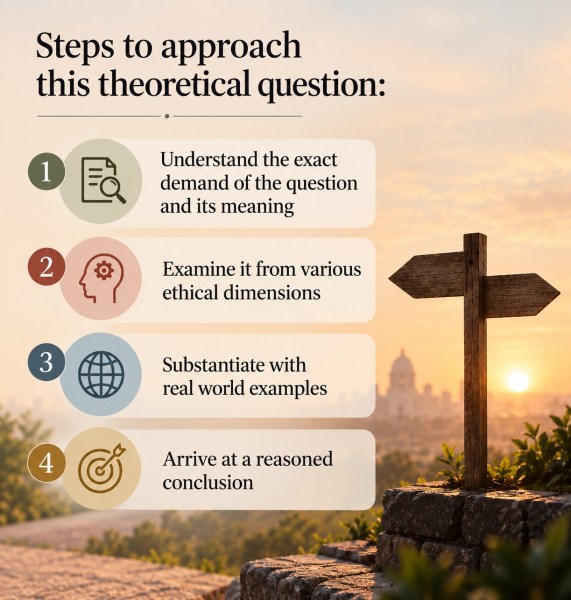
“An ethical civil servant must be willing to do what is right even when doing so is personally inconvenient. But ethical governance cannot depend on the courage of exceptional individuals alone.” Discuss.
(AI generated)
— For Your Information: At the heart of the question is a tension between individual moral courage and the role of institutions. As you think through the answer, ask: should good governance solely depend on the personal courage of an individual officer? Can institutions be designed in a way that integrity, accountability and public welfare become the norm.
— A utilitarian perspective would ask whether institutions can be designed to produce better outcomes for the greatest number of people consistently, rather than relying on the occasional courage of individual officers.
— Kant’s concept of the categorical imperative asks individuals to act only according to principles that they could reasonably will to become universal laws, regardless of personal desires and consequences.
— If applied to public administration, this reinforces the idea that ethical conduct and integrity should be guided by principles and institutional norms rather than the personal morality of whoever happens to occupy an office.
— The Bhagavad Gita’s Nishkama Karma is about performing one’s duty without attachment to the fruits of one’s actions. This does not mean blindly performing one’s duties. Rather, it can be understood as acting with a sense of responsibility while maintaining ethical judgment and avoiding excessive attachment to personal rewards or outcomes.
— For a civil servant, this raises an important ethical ideal: Can one remain committed to public welfare even when the decision may not provide immediate personal or professional benefits?
— An officer who acts in the public interest despite the possibility of transfers, criticism, institutional inertia or professional inconvenience demonstrates an important dimension of moral courage. IAS Tukaram Munde is a striking example of this. Despite personal consequences, he chooses to uphold public service ethos by demonstrating integrity, impartiality in action and an unwavering dedication to public service. But if a system functions well only when an exceptionally courageous officer is present, then the system itself needs introspection.
— If such integrity repeatedly exposes an officer to political pressure, institutional shunting or personal and professional consequences, the ethical focus shifts from the individual to the institution: what safeguards can ensure that acting in the public interest does not depend on personal courage alone and institutions create a work culture where ethical conduct is rewarded. The ultimate challenge for public administration is therefore not merely to produce more heroic officers, but to build institutions where integrity, accountability, transparency and public welfare become the normal way of functioning.
— Perhaps the real measure of good governance is not how many heroes a system produces, but how little it needs heroes to function well.
QUESTION 2 (Caselet)
Apply the similar framework given in the theoretical question above and use it to arrive at an ethically justifiable decision in the following caselet.
You are the District Magistrate of a rapidly growing district. A routine inspection by the Food Safety Department led by you reveals that several popular food-processing units supplying products across the district are using unsafe practices. Expired products are relabeled to a new expiry date and sold at lower prices. Several products were found to be contaminated with harmful chemicals. Laboratory reports indicate that these products pose a significant health risk.
The inspection comes just before a major festival. The affected businesses employ thousands of workers, and an immediate shutdown could disrupt supplies, cause substantial financial losses and affect the livelihoods of small vendors who depend on these units.
(Representational image generated by AI)
The local MLA asks you to avoid immediate closure and instead issue warnings and allow the businesses to operate until the festival is over. You are told that the economic aftermath of strict action could be considerable and that the matter can be addressed ‘sensitively’.
Your senior also informally advises you to “avoid creating unnecessary controversy” and assures you that the administration can review the matter after the festival. You believe that delaying action could expose citizens to preventable health risks. At the same time, immediate closure could impose heavy economic costs on workers and small businesses who were not responsible for the violations.
Questions:
(a) Identify the ethical issues and dilemmas involved.
(b) What options are available to you? Critically evaluate and examine each of these options.
(c) Which of the options, do you think, would be most appropriate for you to adopt and why?
(d) What institutional and administrative measures would you suggest to strengthen food-safety governance and prevent similar violations in the future?
— How to approach case studies: These questions can be called the final test of your applied thinking, taking ethical reasoning a step further. You are placed in a situation where values and principles may conflict. The challenge here is to identify the ethical issues, dilemmas, weigh competing options, make an ethical judgement, and arrive at a balanced, morally defensible and practical course of action. Can you make an ethical decision in tough situations?
— Think like a public servant, not just an individual. The decision should reflect the responsibilities of public office, including the rule of law, public interest, impartiality, accountability and the duty to protect citizens. Political or informal pressure should not replace these institutional responsibilities.
— Protecting public health does not necessarily mean ignoring the economic consequences. Think about how the ethical obligation can be upheld while reducing avoidable hardship for workers, vendors and other affected stakeholders. A balanced response does not mean compromising on public safety. Instead, identify what cannot be compromised, and then look for practical ways to address the legitimate concerns of businesses, workers and vendors.
Express Tip: ‘The Defence Tip’
Before you finish the ethics case study, ask yourself three questions:
1. Is my choice morally defensible?
(Why should I prefer an option to the alternatives? Which ethical principles and values support it, and how does it address the core ethical dilemma?)
2. Have I balanced competing interests fairly?
(Have I considered the rights, interests and consequences for all relevant stakeholders? Can I protect the larger public interest while minimising avoidable harm to those affected?)
3. Is my decision both ethical and practical?
(Does it uphold integrity and the rule of law without becoming unnecessarily rigid or tactless? Can the decision actually be implemented, and does it offer a way forward in the long term? Can it trigger institutional reforms?)
A strong ethics answer should therefore go beyond simply identifying the ‘right’ option. Defend your choice with ethical reasoning, acknowledge the competing values and consequences, and show how moral principles can be translated into a fair and practical course of action.
(Refer: 1. Values which make us Human — the concept
2. From Values to Morality — the concept
3. Conscience and Ethical Decision Making: The Concept
4. UPSC Ethics Simplified: IAS Tukaram Mundhe | Beyond the officer, study the ethical issues)
🚨For any queries and feedback, contact raveena.baneta@indianexpress.com. Click Here to read the UPSC Essentials magazine for August 2026.
🚨 Subscribe to our UPSC newsletter. Stay updated with the latest UPSC articles by joining our Telegram channel – IndianExpress UPSC Hub, and follow us on Instagram and X.

 Ethical governance requires both individual moral courage and institutions that uphold integrity, accountability and public welfare. (Image generated by AI)

 (AI generated)
 (Representational image generated by AI)


 Share


