
UPSC Essentials | Daily subject-wise quiz : Economy MCQs on Semicon 2.0, Merchant Discount Rate and more (Week 180)
Are you preparing for UPSC CSE Prelims 2027? Check your progress and revise your topics through this quiz on Economy.
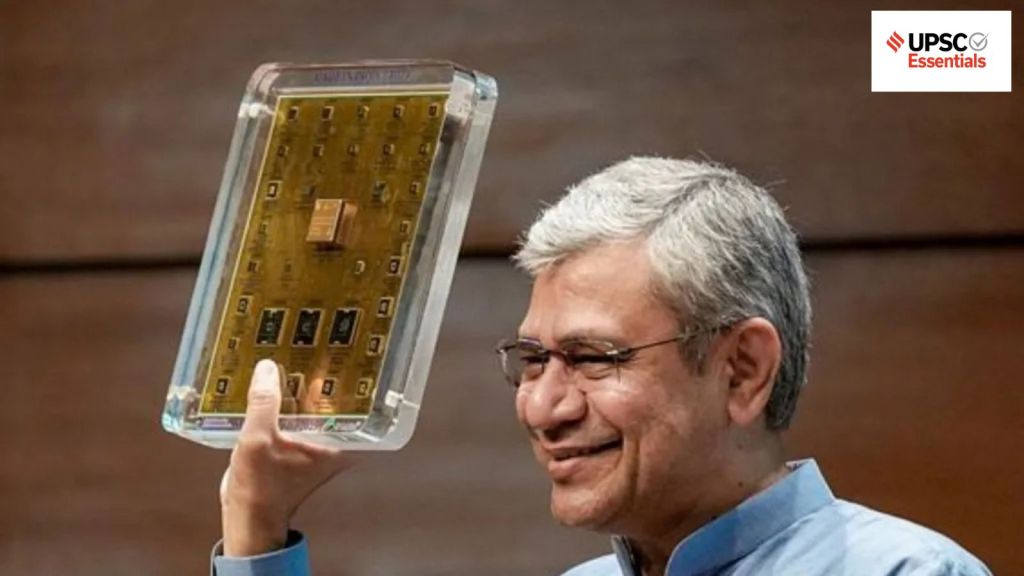 Are you preparing for UPSC CSE Prelims 2027? Find a question on Semicon 2.0 in today's quiz. (PTI Photo)
UPSC Essentials brings to you its initiative of subject-wise quizzes. These quizzes are designed to help you revise some of the most important topics from the static part of the syllabus. Attempt today’s subject quiz on the Economy to check your progress.
🚨As we mark the 3rd anniversary of the UPSC Essentials magazine, we thank our readers for being part of this journey. Your trust, feedback and continued support have shaped the magazine and encouraged us to keep improving with every edition. Click Here to read the UPSC Essentials magazine for September 2026. Share your views and suggestions in the comment box or write to us at manas.srivastava@indianexpress.com.🚨

QUESTION 1
With reference to Semicon 2.0, consider the following statements:
1. Under the scheme, for the commercial category, eligibility has been widened to companies owned and controlled by Overseas Citizens of India (OCIs).
2. The scheme targets semiconductor technologies considered important for national security and critical infrastructure.
3. All the facilities to be established under Semicon 2.0 are eligible for 40% capex support.
How many of the statements given above are correct?
(a) Only one
(b) Only two
(c) All three
(d) None
Relevance: The question tests awareness of India’s semiconductor ecosystem, semiconductor manufacturing and chip-design capabilities under Semicon 2.0. It also links with government incentives, capital expenditure support and investment eligibility for strategic high-technology industries.
Explanation
— Prime Minister Narendra Modi inaugurated the fifth edition of Semicon India 2026, as New Delhi looks to attract global chip manufacturing companies and talent, and showcase its fledgling semiconductor base that did not exist just half a decade ago.
— The three-day conference and exhibition, being held from September 17 to 19, will be organised on the theme ‘Silicon to Systems: Building the Ecosystem’. It will bring together global and Indian companies, policymakers, investors, researchers, start-ups, and academic institutions from across the semiconductor and electronics value chain.
— Semicon 2.0 seeks to build more Indian-owned intellectual property and fabless semiconductor companies — firms that design and sell chips while outsourcing the work of physical fabrication.
— The scheme targets semiconductor technologies considered important for national security and critical infrastructure. The government will identify IP, chips, systems-on-chip (SoCs) and modules that it wants developed, including building blocks for compute, memory, radio frequency, power, networking and sensors. It also focuses on commercial chip-design companies, where the government will provide access to expensive electronic design automation tools, multi-project wafer fabrication services and other systems to eligible companies. Hence, statement 2 is correct.
— For this commercial category, eligibility has also been widened to companies owned and controlled by Overseas Citizens of India (OCIs), provided they are incorporated and headquartered in India and maintain a significant operational and manpower presence here. The IP and associated design and development files must remain in India. Hence, statement 1 is correct.
— The scheme is also aimed at filling gaps across the semiconductor supply chain. Companies setting up semiconductor-equipment R&D facilities, plants manufacturing wafers, photomasks, photoresists, substrates, chemicals and gases, testing facilities, or units producing semiconductor equipment and components can receive 30% capital expenditure support. Equipment manufacturers will additionally get a production-linked incentive that declines from 10% to 2% over five years on the value of their bill of materials sourced domestically.
— Large silicon wafer fabs will be eligible for 40% capex support, while compound semiconductor, photonics, sensor and discrete semiconductor fabs can receive 35%. Advanced chip-packaging facilities will receive 35%, compared with 25% for legacy packaging. These incentives have reduced compared to the uniform 50% capex subsidy the government had offered in the first iteration of the scheme, introduced in 2021 to build a full-stack chip ecosystem. Hence, statement 3 is not correct.
— Talent development has been carved out as a separate pillar under Semicon 2.0. The government wants to train not only chip designers, but also engineers, researchers, technicians and shop-floor operators required across fabrication and packaging plants.
Therefore, option (b) is the correct answer.
QUESTION 2
With reference to the Merchant Discount Rate, consider the following statements:
1. In India, from October 15, UPI payments above Rs 2,000 to merchants will attract a 0.4% levy called the Merchant Discount Rate (MDR).
2. The amount generated by the MDR framework will be shared between Banks and the government only.
Which of the statements given above is/are correct?
(a) 1 only
(b) 2 only
(c) Both 1 and 2
(d) Neither 1 nor 2
Relevance: The question tests understanding of Merchant Discount Rate (MDR) and its role in India’s digital-payment ecosystem, particularly UPI merchant transactions. It also connects a recent change in UPI transaction pricing with broader issues of digital-payment adoption, transaction costs and the sustainability of India’s payment infrastructure.
Explanation
— Beginning October 15, UPI payments above Rs 2,000 to merchants will attract a 0.4% levy called the Merchant Discount Rate. MDR is the fee merchants pay to the entities that help facilitate a digital transaction. Hence, statement 1 is correct.
— The new MDR framework is expected to generate around Rs 15,000 crore, an official linked to the payments platform told The Indian Express. This amount — which will be shared between banks, payment apps and payment service providers — marks the first step in the direction of a levy to be charged through the country’s payment systems for the UPI payment mode that had become almost an equivalent to cash over the last six years. Hence, statement 2 is not correct.
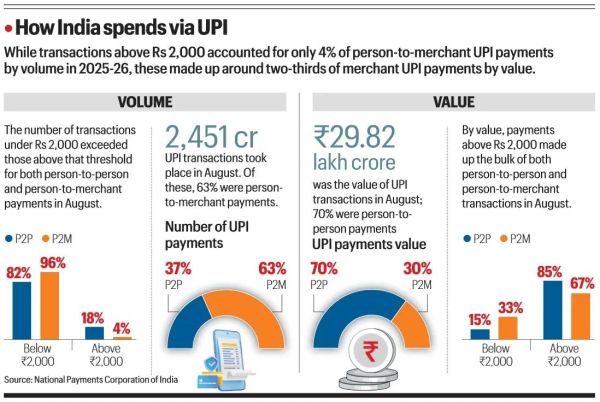 How India pays via UPI.
— Banks and other financial players in the payments framework have long been calling for the MDR charge, citing the high costs of running the payments infrastructure. The government has been subsidising payments of up to Rs 2,000 made to small merchants. The incentive was capped at 0.15% of the transaction value for small merchants with turnover less than Rs 50 crore. The government paid a total of Rs 8,730 crore under the incentive scheme between FY22 to FY25.
— According to critics of the fee, UPI is one of India’s greatest digital achievements and should remain a no-cost public good. That this could potentially reverse the momentum in favour of the digital transition, and force a move towards the cash economy. And the NPCI’s revised MDR framework triggers a wider concern: since the law barring the levy of MDR on UPI transactions is now amended, the government could extend charges to more categories of UPI and RuPay debit-card transactions through notifications — without having to go back to Parliament.
Therefore, option (a) is the correct answer.
QUESTION 3
With reference to ‘Demat 2.0’, consider the following statements:
1. It is a pilot program to test the tokenisation of corporate bonds and quicker settlement using the central bank digital currency and blockchain technology.
2. It has been launched by the Reserve Bank of India (RBI) and the Securities and Exchange Board of India (SEBI).
Which of the statements given above is/are correct?
(a) 1 only
(b) 2 only
(c) Both 1 and 2
(d) Neither 1 nor 2
Relevance: The question tests awareness of recent reforms and innovations in India’s financial-market infrastructure, particularly the tokenisation and settlement of corporate bonds. It relates to economic current affairs, making it relevant to questions on financial regulators, capital markets, and digital financial infrastructure.
Explanation
— The Reserve Bank of India (RBI) and the Securities and Exchange Board of India (SEBI) launched “Demat 2.0” — a pilot program to test the tokenisation of corporate bonds and quicker settlement using the central bank digital currency and blockchain technology. Hence, statements 1 and 2 are correct.
— The initiative is being led by depositories such as the Central Depository Services Ltd (CDSL) and the National Securities Depositories Ltd (NSDL), exchanges like the BSE and the National Stock Exchange (NSE), banks such as the HDFC Bank and ICICI Bank, and the National Payments Corporation of India (NPCI).
— The pilot launched with 3 issuances, including a Rs 500 crore issue by Larsen & Toubro that attracted investors such as SBI, Axis Bank, SBI Mutual Fund, and NSDL, among others.
— While “Demat 1.0”, launched in 1996, digitised shares that were held in paper form until then, the latest avatar combines tokenised securities with digital settlement assets using smart contracts and settles through the CBDC. The project also focuses on preserving the legal certainty around ownership even as the market experiments with new technology and infrastructure.
Therefore, option (c) is the correct answer.
QUESTION 4
With reference to MyUPI, consider the following statements:
1. It is an AI-powered revamp capable of delegating pre-authorised payments and automatic and seamless filing of payment disputes.
2. It has been launched by the Reserve Bank of India.
3. For using MyUPI, only the details of the Virtual Payment Address is required to file a complaint.
How many of the statements given above are correct?
(a) Only one
(b) Only two
(c) All three
(d) None
Relevance: The question tests awareness of recent developments in the UPI ecosystem, including AI-enabled payment assistance and dispute-resolution mechanisms. The question connects Artificial Intelligence with digital financial services, including automated payment management, customer assistance and grievance redressal.
Explanation
— Artificial intelligence (AI) is the hot topic right now, with industries such as IT already seeing a structural change with the adoption of new technologies. The payments industry is also integrating AI into its services, particularly agentic AI.
— Conventional AI has been integrated into the payments ecosystem for quite some time, helping reduce friction in the payments process and enhancing digital safety by making the backend process more reliable, and screening consumers from potentially fraudulent transactions. However, agentic AI might take the industry towards agentic commerce, where an AI agent will take care of a consumer’s entire payment journey, making it frictionless.
— The Global Fintech Fest (GFF) held in Mumbai last week saw many of the country’s top payments companies showcase AI integration into their products. The National Payments Corporation of India (NPCI) unveiled MyUPI — an AI-powered revamp capable of delegating pre-authorised payments, and automatic and seamless filing of payment disputes. It also launched a backend tool that acts as a “connective tissue” for AI interaction across the financial ecosystem, called Agentic Orchestration and Messaging (AtOM). Hence, statement 1 is correct and statement 2 is not correct.
— For filing a complaint, you need the 12-digit Transaction ID (UTR), the registered mobile number, the Virtual Payment Address (VPA) used, and the date of the transaction. Hence, statement 3 is not correct.
Therefore, option (a) is the correct answer.
(Other Source: http://www.upihelp.npci.org.in)
QUESTION 5
With reference to the Plurilateral trade agreements, consider the following statements:
1. These are negotiated and implemented by any member country of the WTO groups.
2. These agreements always act against developing nations’ interests.
Which of the statements given above is/are correct?
(a) 1 only
(b) 2 only
(c) Both 1 and 2
(d) Neither 1 nor 2
Relevance: The question tests conceptual understanding of plurilateral, multilateral and bilateral trade agreements within the WTO framework. It also links with debates over trade rules, participation, policy space and the interests of developing economies in the evolving international trading system.
Explanation
— After staunch opposition to plurilateral pacts at the World Trade Organisation’s (WTO’s) 14th Ministerial Conference in Cameroon earlier this year, India offered its proposal on WTO reforms which could help insert plurilateral agreements within the WTO framework, the country’s submission to the body’s General Council on Wednesday showed.
— Plurilateral trade agreements are negotiated and implemented by exclusive WTO groups rather than by all members. The country’s concern is that these pacts would act against developing nations’ interests, including India. A number of developed countries have opposed India’s public stockholding programme on grounds that they are distorting trade. Hence, statement 1 is not correct.
— The plurilateral agreements “act against developing nations’ interests” is an absolute generalisation. Their effects on developing countries can vary by agreement and by whether a country participates. WTO-related research notes both concerns about policy space/limited participation and the possibility of economic gains from participation. Hence, statement 2 is not correct.
Therefore, option (d) is the correct answer.
Previous Daily Subject-Wise-Quiz
Daily Subject-wise quiz — History, Culture, and Social Issues (Week 163)
Daily subject-wise quiz — Polity and Governance (Week 180)
Daily subject-wise quiz — Science and Technology (Week 180)
Daily subject-wise quiz — Economy (Week 179)
Daily subject-wise quiz — Environment and Geography (Week 179)
Daily subject-wise quiz – International Relations (Week 179)
Subscribe to our UPSC newsletter and stay updated with the news cues from the past week.
Stay updated with the latest UPSC articles by joining our Telegram channel – IndianExpress UPSC Hub, and follow us on Instagram and X

 Share


