
QUESTION 1
Consider the following statements:
1. Protein is the body’s primary source of energy during normal physiological conditions.
2. Protein provides the building blocks needed to repair tissues, maintain muscle strength and support the immune system.
Which one of the following is correct in respect of the above statements?
(a) Both Statement 1 and Statement 2 are correct and Statement 2 is the correct explanation for Statement 1.
(b) Both Statement 1 and Statement 2 are correct and Statement 2 is not the correct explanation for Statement 1.
(c) Statement 1 is correct but Statement 2 is incorrect.
(d) Statement 1 is incorrect but Statement 2 is correct.
Relevance: The question is relevant to the biological functions of proteins and their role in tissue repair, muscle maintenance and immune function. It links macronutrients with energy metabolism and the nutritional requirements of the human body.
Explanation
— Protein provides the building blocks needed to repair tissues, maintain muscle strength and support the immune system. “During illness, people may eat less while the body may break down more muscle, especially during prolonged infection or hospitalisation”. Adequate protein can help limit this muscle loss and support the return of strength and physical function.
— Protein is not the body’s primary source of energy under normal physiological conditions. Carbohydrates are generally the body’s preferred energy source, while fats are also an important energy reserve. Hence, statement 1 is not correct.
— Protein supplies amino acids, which are required for tissue repair and muscle maintenance. Proteins also play an important role in immune function, including the formation of antibodies and other immune-related proteins. Hence, statement 2 is correct.
Therefore, option (d) is the correct answer.
QUESTION 2
Which of the following fields are open to Indian Microgravity Experiments – IMEx-2026?
1. Space Agriculture
2. Fluid Physics and Thermal Transport
3. In-space Manufacturing and Processing
4. Planetary Geology and Seismology
5. Space Weather and Solar Physics
Select the correct answer using the codes given below:
(a) 1, 2 and 3 only
(b) 2, 3, 4 and 5
(c) 2, 3 and 5 only
(d) 1, 3 and 5 only
Relevance: The question links microgravity research with space agriculture, fluid physics, thermal transport and in-space manufacturing. The question is relevant to science and technology for the UPSC prelims.
Explanation
— Indian astronaut and fighter pilot Shubhanshu Shukla recently posted a glimpse of the same from his latest Axiom-4 (Ax-4) mission following his return to Earth. “What’s for lunch when your restaurant is travelling at 28,000 km/h?” he captioned the video, which showed him eating dehydrated mango salad.
— ISRO announced the Indian Microgravity Experiments – IMEx-2026, an Announcement of Opportunity (AO) inviting proposals from the Indian research community to conceptualise, develop, and demonstrate scientifically meaningful microgravity experiments.
— IMEx-2026 encourages proposals spanning a wide range of microgravity disciplines, including but not limited to: Materials Science, Space Biology and Biotechnology, Space Agriculture, Pharmacology and Drug Research, Fluid Physics and Thermal Transport, Combustion and Fire Safety, In-space Manufacturing and Processing.
— Planetary Geology and Seismology, Space Weather and Solar Physics are not among the listed fields for the programme.
Therefore, option (a) is the correct answer.
(Other Source: http://www.isro.gov.in)
QUESTION 3
Consider the following statements:
1. The Agni missile family is capable of carrying nuclear warheads with a range of 5,500 km.
2. Rudram-III is a long-range hypersonic anti-radiation missile.
3. The Akash-NG is a ship-borne air defence system.
How many of the statements given above are correct?
(a) Only one
(b) Only two
(c) All three
(d) None
Relevance: The question is relevant to India’s indigenous development of ballistic missiles, anti-radiation missiles and air-defence systems. It covers different missile roles and technologies, including strategic missiles, suppression of enemy air defences and surface-to-air defence.
Explanation
— The Agni missile family comprises ballistic missiles capable of carrying nuclear warheads. The Agni-V has a range of about 5,000–5,500 km. Hence, statement 1 is correct.
— The Rudram-3 is India’s advanced indigenous, long-range hypersonic anti-radiation missile. It uses a multi-stage solid-propellant motor to achieve speeds exceeding Mach 5 (approx. Mach 5.5). Hence, statement 2 is correct.
— Akash-NG is a land-based, medium-range surface-to-air missile system developed for the Indian Armed Forces. It is not a ship-borne air-defence system. Hence, statement 3 is not correct.
Therefore, option (b) is the correct answer.
(Source: drdo.gov.in)
QUESTION 4
Consider the following statements about hydrogen trains:
1. The hydrogen train generates electricity onboard through a fuel-cell system using hydrogen and oxygen.
2. It generates carbon dioxide and water vapour as a direct by-product.
Which of the statements given above is/are correct?
(a) 1 only
(b) 2 only
(c) Both 1 and 2
(d) Neither 1 nor 2
Relevance: The question links hydrogen fuel-cell technology with electrochemical energy conversion and clean mobility. It is relevant to low-emission transport, energy transition and reduction of dependence on fossil fuels in the transport sector.
Explanation
— Indian Railways flagged off its first hydrogen train between Jind and Sonipat on July 17, 2026. According to the Ministry of Railways, the hydrogen train had travelled more than 1,200 km by July 25 and saved more than 3,200 litres of diesel.
— Unlike a conventional diesel train, the hydrogen train generates electricity onboard through a chemical reaction between hydrogen and oxygen. Its only direct by-product is water vapour, with no smoke or direct tailpipe carbon emissions. Hence, statement 1 is correct and statement 2 is not correct.
Therefore, option (a) is the correct answer.
QUESTION 5
With reference to the Oort Cloud, consider the following statements:
1. The Oort Cloud is made up of ice space debris.
2. The Oort Cloud is located beyond the Kuiper Belt’s outer edge.
3. It has been directly observed through modern space telescopes.
How many of the statements given above are correct?
(a) Only one
(b) Only two
(c) All three
(d) None
Relevance: The question is relevant to the structure of the Solar System and the distribution of small icy bodies beyond the known planetary region. It tests conceptual knowledge of the Oort Cloud, Kuiper Belt and observational limits of modern astronomy.
Explanation
— The Oort Cloud is made up of ice space debris, some of which are larger than mountains and orbit our Sun at distances of up to 1.6 light years. This shell of material is thick, ranging from 5,000 to 100,000 astronomical units. One astronomical unit (AU) is the distance from the Sun to Earth, which is approximately 93 million miles (150 million km). Hence, statement 1 is correct.
— The Oort Cloud is located beyond the Kuiper Belt’s outer edge. This massive spherical shell encircles our solar system. It has never been directly observed, but its presence is anticipated using mathematical models and observations of comets that are believed to originate there. Hence, statement 2 is correct and statement 3 is not correct.
Therefore, option (b) is the correct answer.
(Source: science.nasa.gov)
Previous Daily Subject-Wise-Quiz
Daily Subject-wise quiz — History, Culture, and Social Issues (Week 165)
Daily subject-wise quiz — Polity and Governance (Week 182)
Daily subject-wise quiz — Science and Technology (Week 181)
Daily subject-wise quiz — Economy (Week 181)
Daily subject-wise quiz — Environment and Geography (Week 181)
Daily subject-wise quiz – International Relations (Week 181)
Subscribe to our UPSC newsletter and stay updated with the news cues from the past week.
Stay updated with the latest UPSC articles by joining our Telegram channel – IndianExpress UPSC Hub, and follow us on Instagram and X

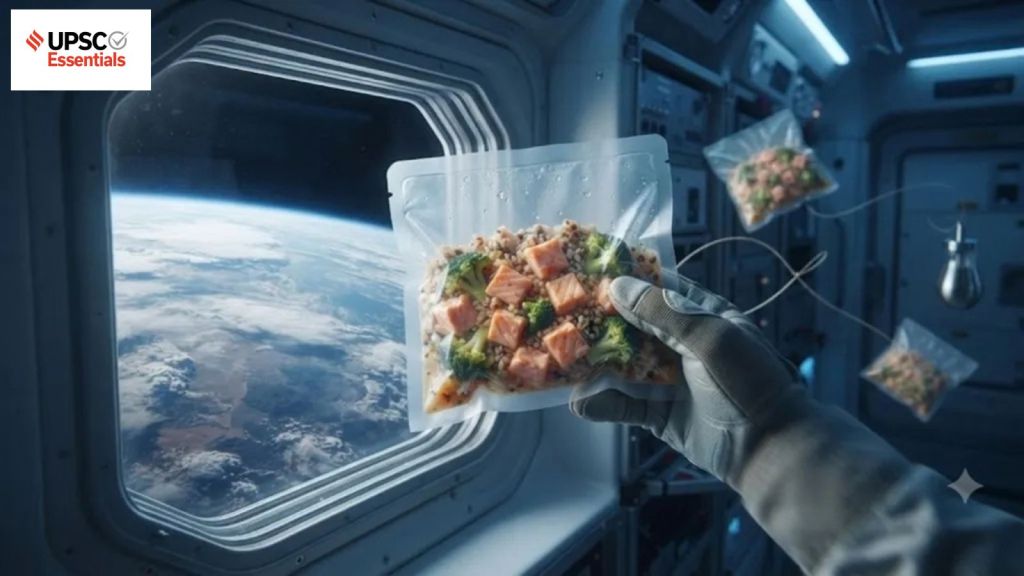 Are you preparing for UPSC CSE Prelims 2027? Find a question on the Indian Microgravity Experiments in today's quiz. (AI-generated Image)


 Share


