
UPSC Essentials daily subject quiz : Environment and Geography MCQs on UN Declaration on Sea Level Rise, Green Energy Corridor (Week 182)
Are you preparing for UPSC CSE Prelims 2027? Check your progress and revise your topics through this quiz on Environment and Geography. Practice and solve questions on the UN Declaration on Sea Level Rise, Green Energy Corridor, and more.
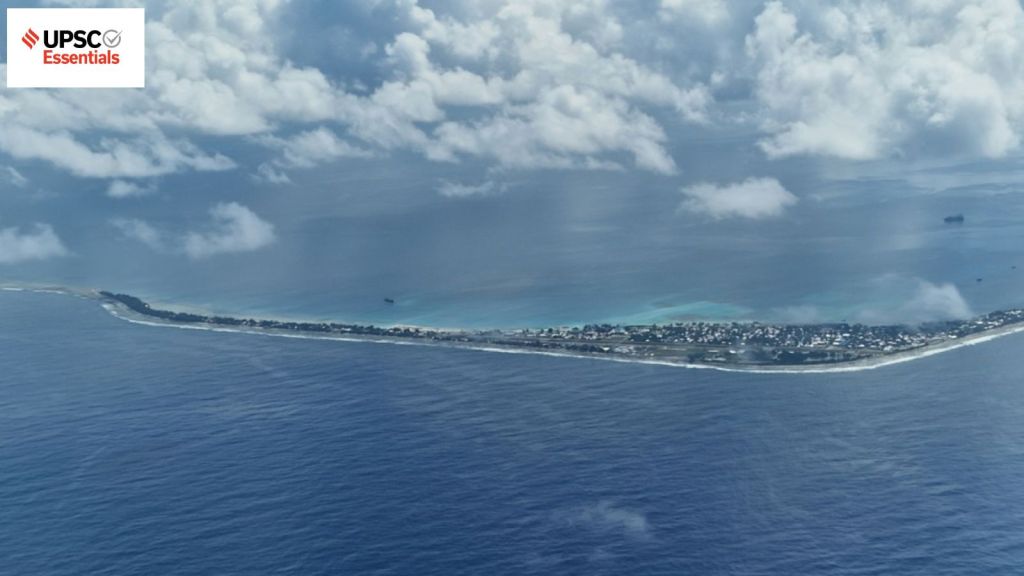 Check your progress and revise your topics through this quiz on Environment and Geography. Find a question on the UN Declaration on Sea Level Rise in today's quiz. (Wikimedia Commons)
UPSC Essentials brings to you its initiative of subject-wise quizzes. These quizzes are designed to help you revise some of the most important topics from the static part of the syllabus. Attempt today’s subject quiz on Environment and Geography to check your progress.
🚨As we mark the 3rd anniversary of the UPSC Essentials magazine, we thank our readers for being part of this journey. Your trust, feedback and continued support have shaped the magazine and encouraged us to keep improving with every edition. Click Here to read the UPSC Essentials magazine for September 2026. Share your views and suggestions in the comment box or write to us at manas.srivastava@indianexpress.com.🚨

QUESTION 1
With reference to the UN Declaration on Sea Level Rise, consider the following statements:
1. The declaration addresses the issue of loss of territory faced by low-lying countries that are particularly vulnerable to rising sea levels and persistent coastal erosion.
2. It is the first-ever UN Declaration on Sea Level Rise.
3. The declaration mentions Ghoramara Island in the Sundarbans.
How many of the statements given above are correct?
(a) Only one
(b) Only two
(c) All three
(d) None
Relevance: The question is relevant to sea-level rise, coastal erosion and climate-change-induced risks faced by low-lying and island countries. It connects with India’s coastal vulnerability, particularly the Sundarbans, islands and densely populated coastal regions.
Explanation
— On 24 September, the UN General Assembly adopted its first ever declaration on rising sea levels, which pose an existential threat to populations around the world. The rise in sea levels has been “accelerating” (to quote the declaration) for some time now. The rate of global rise more than doubled from 2.1 mm a year in 1993-2002 to 4.7 mm a year in 2015-2024, according to the World Meteorological Organization. In 2024 alone the sea rose 6 mm, the largest annual increase on record. Hence, statement 2 is correct.
— The declaration addresses the issue of loss of territory faced by low-lying countries that are particularly vulnerable to rising sea levels and persistent coastal erosion. Hence, statement 1 is correct.
— Under the 1933 Montevideo Convention, a State is defined using four main criteria: a permanent population, a defined territory, a government and the capacity to enter into relations with other states.
— The declaration mentions a “presumption in favour of continued statehood”, so such a country keeps its sovereignty, its rights and its seat at the UN.
— The declaration calls adaptation and mitigation action “essential”, but leaves the negotiation of emission cuts to the UN climate convention and the Paris Agreement.
— Ghoramara Island, which shrank from about 7.2 sq km in 1972 to 3.6 sq km in 2022, is an example of coastal erosion in the Sundarbans, but it is not mentioned in the UN declaration itself. The declaration schedules another high-level meeting on sea level rise by September 2030, which gives India four years to show results. Hence, statement 3 is not correct.
— Low-lying islands are particularly vulnerable because much of their land lies only a few metres above sea level. Rising seas can therefore cause coastal erosion, flooding and saltwater intrusion into freshwater sources, while threatening homes, infrastructure and habitable land.
— In 2015, the low-lying Republic of Kiribati said that climate change effects were threatening its existence as a nation. Similarly, in 2021, Tuvalu’s representative Simon Kofe addressed the COP26 standing knee-deep in seawater from a location he claimed was once dry land that had been lost to coastal erosion.
Therefore, option (b) is the correct answer.
QUESTION 2
With reference to the Green Energy Corridor (GEC) programme, consider the following statements:
1. It is aimed at building dedicated transmission infrastructure to integrate large-scale RE.
2. The programme will help in achieving the target of 1000 GW installed Non-Fossil capacity by 2030.
3. The programme does not include a battery energy storage component.
How many of the statements given above are correct?
(a) Only one
(b) Only two
(c) All three
(d) None
Relevance: The question is relevant to India’s renewable energy transition and electricity transmission infrastructure. It covers the role of Green Energy Corridors in integrating large-scale renewable energy into the national grid.
Explanation
— The Centre approved the third phase of the Green Energy Corridor (GEC), with an outlay of Rs 1.86 lakh crore, aimed at facilitating the evacuation of up to 135 gigawatts (GW) of renewable energy (RE). Evacuation refers to the process of transferring electricity generated from renewable sources to the places where consumers are located.
— The GEC is a flagship Indian government programme aimed at building dedicated transmission infrastructure to integrate large-scale RE, such as solar and wind power, into the national power grid. Hence, statement 1 is correct.
— For the first time, the GEC includes a dedicated battery energy storage component, with provisions for deploying 50 gigawatt-hours (GWh) of Battery Energy Storage Systems (BESS). Hence, statement 3 is not correct.
— Energy storage refers to systems that can store excess renewable electricity during periods of high generation and discharge it when demand rises but power generation remains low. At its core, energy storage systems convert electricity from renewable sources, when it is available, into forms that can be stored. Later, it converts these back into electricity when need arises.
According to pib.gov.in
— “The scheme will help in achieving the target of 900 GW installed Non-Fossil capacity by 2035. The scheme will also contribute to long term energy security of the country and promote ecologically sustainable growth by reducing carbon footprint. It will generate large direct & indirect employment in the power sector, manufacturing, and construction industries.” Hence, statement 2 is not correct.
Therefore, option (a) is the correct answer.
QUESTION 3
With reference to the Flood Hub, consider the following statements:
1. It is a research initiative developed by Meta, which takes data from leading weather agencies worldwide and uses a prediction model.
2. It was first used during floods in India in 2018 to forecast flooding events.
3. It can generate advisories up to seven days earlier.
Which of the statements given above is/are correct?
(a) 1 and 3 only
(b) 1 only
(c) 2 and 3 only
(d) 1, 2 and 3
Relevance: The question links Artificial Intelligence with disaster management, particularly flood forecasting and early-warning systems. it is relevant to flood-prone regions, disaster preparedness and climate-related extreme events in India.
Explanation
— Disaster preparedness and management are no longer confined to designated authorities. Companies like Google, national and local telecom providers, satellite companies, and others have now become an integral part of disaster management. Smartphones, and increasingly, drones, act as force multipliers, producing large amounts of data.
— Numerous AI-enabled tools have been developed and deployed of late. Examples include GraphCast, DisasterAWARE, Google’s Flood Hub, and SKAI, which provide services such as early warning, hazard mapping, and satellite imagery.
— Google’s Flood Hub, a research initiative, takes data from leading weather agencies worldwide and uses a prediction model. This was first used during floods in India in 2018 to forecast flooding events, including localised urban floods. It can generate advisories up to seven days earlier and even predicted recent floods in Thailand, Japan and parts of India. Hence, statement 1 is not correct and statements 2 and 3 are correct.
Therefore, option (c) is the correct answer.
QUESTION 4
The ‘Kerguelen Islands’ were recently in the news due to the southeastern gentoo penguin. The Kerguelen Islands are located in:
(a) Southern Pacific Ocean
(b) Indian Ocean
(c) Atlantic Ocean
(d) Northern Pacific Ocean
Relevance: The question tests knowledge of important islands and their geographical locations in the world. It is relevant to biodiversity and species distribution, particularly penguins and other sub-Antarctic fauna.
Explanation
— Penguins aren’t exactly difficult to recognise: black-and-white feathers, a waddling walk, and flippers instead of wings. But apparently, they are. Scientists have identified a new penguin species for the first time in more than 100 years, and the giveaway was not a dramatically different appearance. It was hidden in the bird’s DNA.
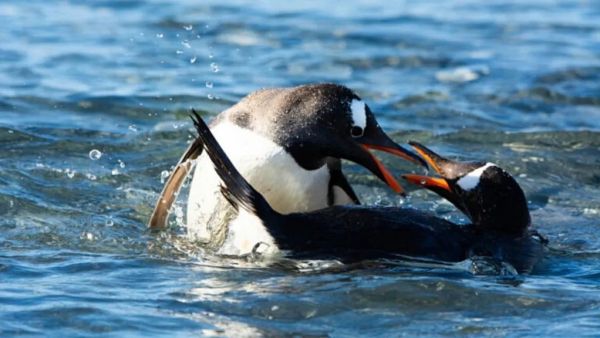 Gentoo penguin (Image: UC Berkeley, Vice Chancellor for Research Office/ Claudia Ulloa)
— The newly described species, Pygoscelis kerguelensis, known as the southeastern gentoo penguin, lives on the remote Kerguelen Islands in the Indian Ocean, about 1,200 miles north of Antarctica. The islands are among the most isolated places on Earth.
— For years, scientists classified gentoo penguins across different parts of the Southern Ocean as one species. A new genomic analysis, however, shows that what was considered a single species is actually four distinct species.
Therefore, option (b) is the correct answer.
QUESTION 5
With reference to the Sambhar Lake, consider the following statements:
1. It is India’s largest inland salt lake.
2. Flamingos visit Sambhar Salt Lake as part of their annual migration along the Central Asian Flyway.
3. It has been designated as a Ramsar site.
Which one of the following conclusions based on the above statements is correct?
(a) All three statements are correct.
(b) There are two correct statements, that include statement 1.
(c) There is only one correct statement.
(d) There is no correct statement.
Relevance: The question is relevant to Indian geography, particularly inland saline lakes and their distribution. It connects with wetland conservation and the Ramsar Convention, including India’s Ramsar sites.
Explanation
— The National Green Tribunal (NGT) has constituted a joint committee to inspect Sambhar Lake and submit a factual and action-taken following allegations of alleged encroachments, unauthorised salt pans, groundwater extraction and obstruction of natural water inflows at the Ramsar wetland.
— The Sambhar Salt Lake, located in Sambhar Lake Town in Jaipur district of Rajasthan, is India’s largest inland salt lake. Hence, statement 1 is correct.
— Sambhar has been designated as a Ramsar site (recognized wetland of international importance) because the wetland is a key wintering area for tens of thousands of flamingos and other birds that migrate from northern Asia. Hence, statement 3 is correct.
— Flamingos visit Sambhar Salt Lake as part of their annual migration along the Central Asian Flyway. They travel from regions in Africa, the Middle East, and Central Asia, arriving between October and March to breed and feed in the lake’s saline waters. The lake’s shallow waters and abundant food make it an ideal stopover during their long migratory journey. Hence, statement 2 is correct.
Therefore, option (a) is the correct answer.
Previous Daily Subject-Wise-Quiz
Daily Subject-wise quiz — History, Culture, and Social Issues (Week 165)
Daily subject-wise quiz — Polity and Governance (Week 182)
Daily subject-wise quiz — Science and Technology (Week 182)
Daily subject-wise quiz — Economy (Week 182)
Daily subject-wise quiz — Environment and Geography (Week 181)
Daily subject-wise quiz – International Relations (Week 181)
Subscribe to our UPSC newsletter and stay updated with the news cues from the past week.
Stay updated with the latest UPSC articles by joining our Telegram channel – IndianExpress UPSC Hub, and follow us on Instagram and X

 Share


