
UPSC Essentials daily subject quiz : Environment and Geography MCQs on Project Cheetah, functions of the National Green Tribunal (Week 180)
Are you preparing for UPSC CSE Prelims 2027? Check your progress and revise your topics through this quiz on Environment and Geography. Practice and solve questions on Project Cheetah, functions of the National Green Tribunal, and more.
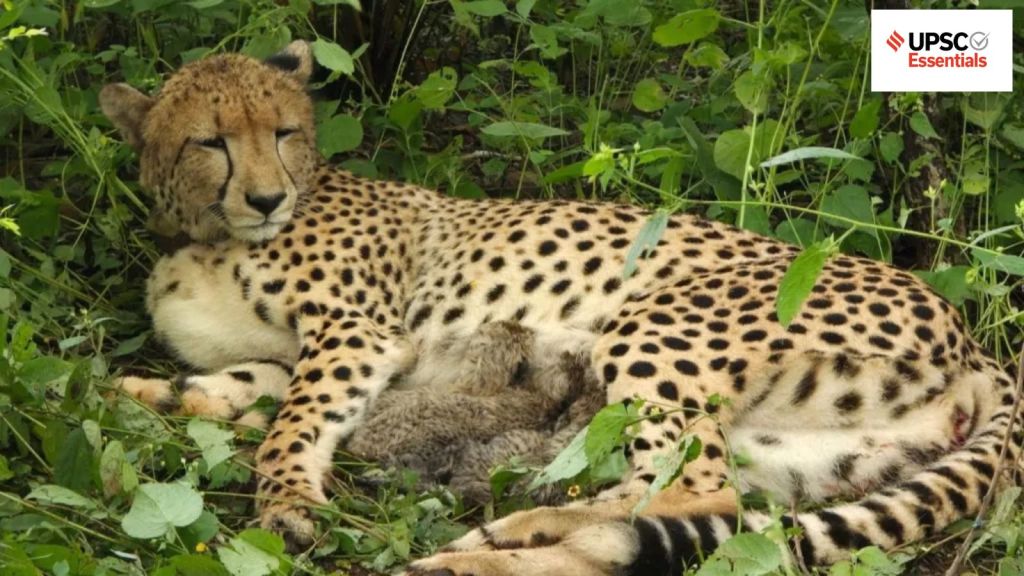 Check your progress and revise your topics through this quiz on Environment and Geography. Find a question on Project Cheetah in today's quiz. (Image:@byadavbjp/X)
UPSC Essentials brings to you its initiative of subject-wise quizzes. These quizzes are designed to help you revise some of the most important topics from the static part of the syllabus. Attempt today’s subject quiz on Environment and Geography to check your progress.
🚨As we mark the 3rd anniversary of the UPSC Essentials magazine, we thank our readers for being part of this journey. Your trust, feedback and continued support have shaped the magazine and encouraged us to keep improving with every edition. Click Here to read the UPSC Essentials magazine for September 2026. Share your views and suggestions in the comment box or write to us at manas.srivastava@indianexpress.com.🚨

QUESTION 1
Consider the following statements about Project Cheetah:
1. The project began in 2020, with eight cheetahs brought from South Africa.
2. The project’s longer-term objective is to establish a viable population that can survive and breed under natural conditions.
3. The project is being implemented under the direct supervision of the National Tiger Conservation Authority.
How many of the statements given above are correct?
(a) Only one
(b) Only two
(c) All three
(d) None
Relevance: The question tests factual and conceptual understanding of Project Cheetah, including its launch, translocation programme and long-term conservation objectives. The question is relevant for mapping and environment questions involving cheetah habitats, conservation programmes and the role of institutions.
Explanation
— A day after Project Cheetah completed four years in India, an Indian-born cheetah gave birth to four cubs at Kuno National Park, marking a milestone for a programme that began with the translocation of animals from Africa and is now seeing successive generations born in India.
— Project Cheetah began on September 17, 2022, with eight cheetahs brought from Namibia. A further 12 were brought from South Africa in February 2023, followed by nine from Botswana this year. Over four years, the programme has shifted from the initial translocation of adult animals to breeding and establishing India-born generations. Hence, statement 1 is not correct and statement 2 is correct.
— The project is implemented by the Ministry of Environment, Forest and Climate Change (MoEFCC), with the National Tiger Conservation Authority (NTCA) playing an important coordinating role. Hence, statement 3 is not correct.
Therefore, option (a) is the correct answer.
QUESTION 2
Which of the following are the objectives and functions of the National Green Tribunal (NGT)?
1. NGT has the power to hear cases concerning violations of the laws related to the protection of the environment.
2. NGT has the authority to impose penalties or fines.
3. NGT can determine the compensation for environmental damage.
4. NGT can amend environmental laws passed by Parliament.
5. NGT can issue directions for the formulation of international environmental treaties on behalf of India.
Select the correct answer using the codes given below:
(a) 1, 3, 4 and 5
(b) 1, 2, and 3
(c) 2, 4 and 5 only
(d) 1, 2, 3, 4 and 5
Relevance: The question tests conceptual understanding of the National Green Tribunal (NGT), its jurisdiction, adjudicatory powers and role in environmental governance. It is relevant to the Environment and Ecology syllabus, particularly environmental institutions, laws, dispute resolution and mechanisms for addressing environmental damage.
Explanation
— The National Green Tribunal directed the Madhya Pradesh Forest Department to plant 7,000 trees by September 30 as compensation for the felling of around 700 trees for the road being constructed for the proposed cricket stadium in Bhopal.
The main objectives and functions of the NGT are to:
— Adjudicate on Environmental Disputes: It primarily hears cases concerning environmental laws, such as the violation of environmental regulations, pollution control, and forest conservation.
— Environmental Protection: The NGT has the power to hear cases concerning violations of the laws related to the protection of the environment, including issues related to air and water pollution, wildlife protection, and forest conservation.
— Settlement of Disputes: It is designed to provide a forum for the rapid resolution of disputes that affect the environment, promoting the sustainable use of natural resources and maintaining ecological balance.
— Enforcement of Environmental Laws: The NGT has been granted the authority to impose penalties, fines, or compensation orders in cases of violations of environmental laws. It can also issue directives to authorities or parties to take corrective action.
— Environmental Compensation: It can determine the compensation for environmental damage caused by individuals, organizations, or the state. This includes damage to air, water, and soil quality, as well as the loss of biodiversity.
Therefore, option (b) is the correct answer.
(Other Source: http://www.greentribunal.gov.in)
QUESTION 3
With reference to Loktak Lake, consider the following statements:
1. The lake is known for floating masses of vegetation, soil and organic matter.
2. It is home to Keibul Lamjao National Park.
3. The protected area is famous for the sangai deer.
How many of the statements given above are correct?
(a) Only one
(b) Only two
(c) All three
(d) None
Relevance: The question is relevant for map-based and species–habitat questions involving important wetlands, national parks and biodiversity hotspots of India.
Explanation
— If one landscape in India most closely resembles a floating world, it is Loktak Lake in Manipur. The lake is known for phumdis — floating masses of vegetation, soil and organic matter that have accumulated over time. Hence, statement 1 is correct.
— Fishing communities have traditionally used these waters for their livelihoods, with small huts and boats scattered across parts of the lake.
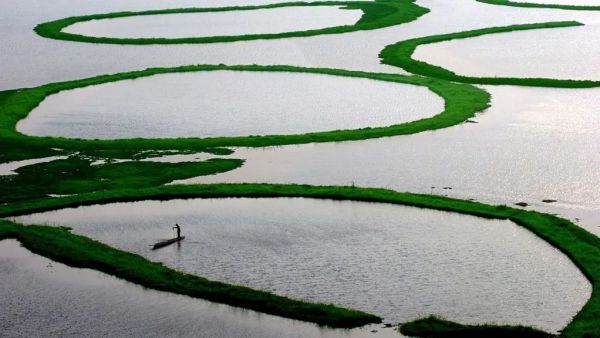 Floating lake, Manipur (Photo: Wikipedia)
— Loktak is also home to Keibul Lamjao National Park, the world’s only floating national park. The protected area sits on the lake’s phumdis and is famous for the endangered sangai, or Manipur brow-antlered deer. Hence, statements 2 and 3 are correct.
Therefore, option (c) is the correct answer.
QUESTION 4
The Kuribeel grasslands were recently in the news. These grasslands are part of:
(a) Kanha National Park
(b) Keoladeo National Park
(c) Bandhavgarh National Park
(d) Manas National Park
Relevance: The question tests knowledge of places in news and protected areas. It helps connect grassland ecosystems with national parks, wildlife habitats and biodiversity conservation in India. It is also relevant for mapping-based questions involving national parks.
Explanation
— A tiny wild pig that once teetered on the brink of extinction is slowly making its way back into Assam’s grasslands. The pygmy hog (Porcula salvania), India’s only endemic wild pig and one of the world’s rarest mammals, has been at the centre of a decades-long conservation effort.
— The story began in 1996, when six pygmy hogs were captured from the Kuribeel grasslands of Manas National Park. They were brought into captivity as conservationists feared that the remaining wild population could disappear altogether. These six animals became the foundation of the Pygmy Hog Conservation Programme (PHCP).
— In June 2026, 15 captive-bred pygmy hogs — nine females and six males — were released into the Kuribeel grasslands. The release was particularly significant because there had been no confirmed signs of the species there for nine years. Since 2020, six groups have been released in Manas, taking the national park’s total to 78. Across Assam, the programme has now bred and reintroduced 194 pygmy hogs. But increasing numbers is only part of the challenge. The animals must now survive, reproduce and establish self-sustaining populations in the wild.
Therefore, option (d) is the correct answer.
QUESTION 5
With reference to the Striped hyenas, consider the following statements:
1. Striped hyenas are largely nocturnal.
2. It consumes carcasses and animal remains, helping remove dead organic matter from the landscape.
3. In India, the striped hyena is found across parts of India, particularly in dry and semi-arid landscapes.
Which of the statements given above are correct?
(a) 2 and 3 only
(b) 1 and 2 only
(c) 1 and 3 only
(d) 1, 2 and 3
Relevance: The question tests knowledge of the ecology, behaviour and distribution of the striped hyena, a species associated with India’s dry and semi-arid ecosystems. It is relevant to Environment and Ecology, particularly species–habitat associations, wildlife distribution and biodiversity conservation in arid and semi-arid regions.
Explanation
— Often misunderstood and associated with fear in folklore, striped hyenas play an important yet often overlooked role in India’s ecosystems. As scavengers, they feed on animal remains that might otherwise decay, helping recycle nutrients back into the ecosystem.
— The striped hyena’s most important role is scavenging. It consumes carcasses and animal remains, helping remove dead organic matter from the landscape. Hence, statement 2 is correct.
— Scavengers like hyenas, vultures, etc. play an important role in the cycle of life and death. Their scavenging also means they can make use of carcasses left behind by other predators.
— The availability of carcasses is closely linked to the wider balance of an ecosystem. Changes in wild prey populations, livestock practices, and how animal remains are disposed of can all affect scavengers.
— Striped hyenas are largely nocturnal and can live in landscapes that are also used by people. Their presence may therefore go unnoticed—or be misunderstood. Hence, statement 1 is correct.
— Unlike the more widely recognised spotted hyena of Africa, the striped hyena (Hyaena hyaena) is found across parts of India, particularly in dry and semi-arid landscapes. Hence, statement 3 is correct.
— Three broad threats commonly affect endangered and threatened wildlife:
1. Habitat loss
2. Illegal hunting
3. Persecution and ignorance
Therefore, option (d) is the correct answer.
Previous Daily Subject-Wise-Quiz
Daily Subject-wise quiz — History, Culture, and Social Issues (Week 163)
Daily subject-wise quiz — Polity and Governance (Week 180)
Daily subject-wise quiz — Science and Technology (Week 180)
Daily subject-wise quiz — Economy (Week 180)
Daily subject-wise quiz — Environment and Geography (Week 179)
Daily subject-wise quiz – International Relations (Week 179)
Subscribe to our UPSC newsletter and stay updated with the news cues from the past week.
Stay updated with the latest UPSC articles by joining our Telegram channel – IndianExpress UPSC Hub, and follow us on Instagram and X

 Share


