
UPSC 2025 AIR 6 Zinnia Aurora: Beyond the syllabus, aspirants ask, topper answers
“We are moving too quickly, and often forget that there is a part of life that has to be ‘lived’.” UPSC CSE 2025 AIR 6 Zinnia Aurora on the questions every aspirant faces beyond UPSC preparation.
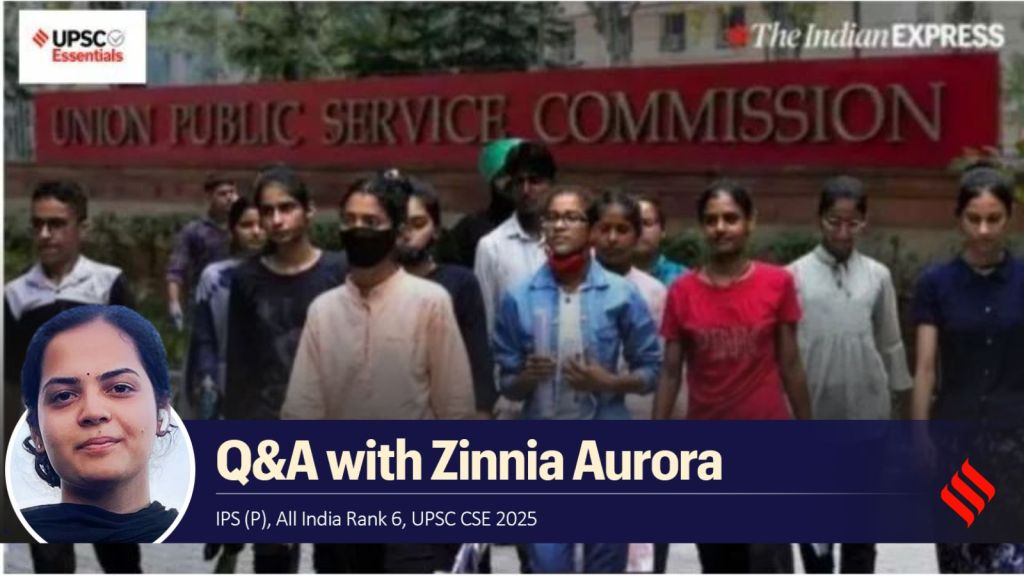 An aspirant may ask: “What do I do now?”
Perhaps there is no single answer to that question. But as Zinnia Aurora's journey reminds us, the UPSC journey is also an opportunity to know yourself better, build confidence and develop an identity that extends beyond an examination.
“What do I do now?” It is a question that may be on the minds of many aspirants after UPSC CSE Mains 2026. For some, the wait for the result begins. For others, it is time to turn towards the next Preliminary Examination. But this in-between phase can also bring uncertainty about what to study, how to stay consistent and, more importantly, how to keep the right mindset.
Who better to ask than someone who has been through this journey herself?

Zinnia Aurora, who secured AIR 6 in the UPSC Civil Services Examination, knows what it means to navigate the highs, lows, uncertainty and pressure that come with the examination. Her journey has also taught her that preparation is not only about completing the syllabus or clearing stages of the exam. It is about building confidence, developing an identity beyond UPSC and learning to keep moving when the journey gets difficult.
UPSC Essentials of The Indian Express asked Zinnia some of the questions that aspirants and readers often find themselves asking. From staying motivated and rebuilding confidence to developing skills beyond UPSC and preparing with the right mindset, here is what she had to say.
Q1. In the lean months of preparation, when motivation was low and the result seemed distant, how did you keep yourself charged up and consistent?
Motivation has been a very heavy word for me. Since I graduated, I have had to find ways to keep procrastination in check. Fair warning: I often struggled to enter the ‘hustle’ of studying every day. There were days when I had no motivation or had too much going on outside Civil Services preparation. People often ask me how I manage to do so many disparate things at once. I realised that, for me, having an identity beyond UPSC helped me avoid obsessing over the exam and, most importantly, build confidence in myself.
After failing the Preliminary Examination in 2023, I decided to drop everything else for a few months and completely immerse myself in the examination. I abhor the feeling of not being ‘good enough’ in spaces I once thought would be my forte. I work doggedly towards goals that mean more than just ‘clearing’. It is about winning, always.
Advertisement
I joined an optional course, read for ethics and kept up my general reading. But by October, I hit rock bottom. I was performing poorly in tests, lacked the courage to write more and, honestly, was bored. After watching countless ‘how to get motivated’ videos and trying every technique I could find, I realised something important: when my confidence drops, I tend to enter a state of slumber. So I decided to rebuild it. Here’s what I did:
1. Profile enrichment: I reached out to contacts I had built during college and beyond and shamelessly approached people who inspired me. This led to volunteer work and eventually back to UNEP. I attended UNDP’s training in December 2023 and was later selected by UNEP, based on my work on resolutions and constant writing, to join their team. I was working on UN resolutions in May 2024, including the night before my prelims. On the night of the prelims, I flew to Geneva. The confidence I had was unparalleled.
2. Competitive anchors: I like putting a face to who I am competing against. I found those faces in my friends, whom I have always wished the best for. I asked myself: same resources, same circumstances, so why are they performing better than me? Do I need to work harder, read better or test myself more? I did what I needed to. It is gruelling because you question yourself shamelessly, but in my case, it yielded results.
3. Library: What a beautiful place. People often ask me what books they should read for a particular subject. My answer is: pick up a book and start reading. Every book has a story to tell. Find nuance in everything you read. A library also gives you a quiet space and the social pressure many people need to get their studious engine going. Just get yourself in a chair and read, read, test!
4. Lock your phone: If you are a phone geek, identify the top three consumers of your time and lock those apps. Also, use an app to track how much you study. It can really improve the quality of your preparation.
5. Build a routine: This is crucial for consistency. Waking up at 5 AM every day for six months and getting some physical activity in the evening helped me build a healthier mindset.
Q2. UPSC preparation demands so much time and energy. What skills do you think an aspirant should consciously build alongside preparation, so that the years spent preparing also contribute to their growth even if they do not clear the exam?
In a session with some college students recently, the only thing that was discussed was collecting diverse experiences. These do not have to be at Fortune 500 companies, but can be at the grassroots level. Here are the skills:
1. Adaptive agility: Proud to have coined this. This is the mantra I made for myself while I was working at Unilever. Life is so drastic and dramatic; it feels good to be in charge. It lessens the uncertainty, even if just by a cent. Adaptive agility refers to quickly absorbing shocks and finding solutions to overcome the consequences of the said shock.
2. Communication: Your verbal and non-verbal spectrum helps in places you cannot fathom. Communication entails the ability to be rational, knowing how to construct arguments, having a flexible mind that hears more than it speaks and, finally, having the language (linguistic and non-verbal) to convince the person before you. From interviews to writing a simple résumé, this skill is unbeatable.
3. Objectivity-subjectivity switch: To define what I mean by this: the ability to know when your objectivity is needed and when your mind needs to be subjective in understanding a particular situation. Knowing how to take an objective decision in your own life or someone else’s life is a key skill. The Civil Services teaches you this through the ‘art of avoidance’ in prelims. Subjectivity is to be employed when you need to understand a context, in places where your value judgement is required. For example, whether you should become friends with a certain person or if you are trying to understand why beggary is something we are not able to do away with.
4. Research: This has multivariate utility. It helps you think, comes in handy for the exam and helps bring a flair to your language. You learn boundlessly if you take up one topic every six months.
5. Professional building: If you build a skill for six months, you can freelance and earn money. This can be in the area of your graduation. From copywriting to vibe coding, the opportunities are endless.
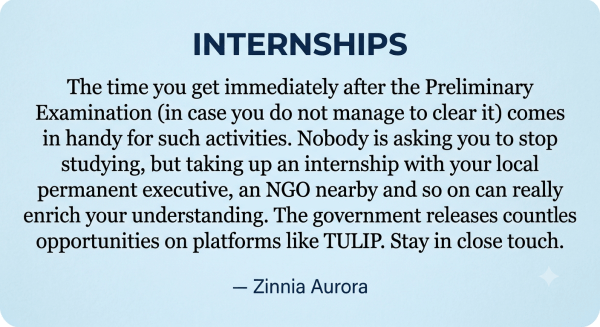
Q3. What role did hobbies, friendships and interests outside UPSC preparation play in keeping you grounded? Do you think an aspirant should consciously make space for a life beyond the examination?
There is a beautiful song, ‘Moving Too Quickly’ by Unlike Pluto. I would encourage the reader to hear it. We are moving too quickly, and often forget that there is a part of life that has to be ‘lived’. In the quicksand of stress and anxiety that ambitious goals create, it is easy to lose connection with the world and with oneself. Hobbies, friendships and interests help build that connection.
Friendships have been the most beautiful thing I have gained at every stage of life, especially during periods of enormous stress. My friends have been sources of happiness, lessons and motivation. My best friend has been my mom. She is my anchor, pillar and everything else. Anything and everything I am is because of her.
My CSE circle was about ‘improvement, improvement, improvement’. They helped me find the competitive spirit that became my fuel. At the same time, my college friends kept me connected to the world outside UPSC and reminded me that there was a life beyond the examination. Both sets of friendships inspired me to keep going.
Hobbies and interests help build your personality. I started writing poetry in middle school, and it taught me to appreciate the world, immerse myself in experiences and think beyond the immediate. In fact, I would argue that poetry played a role in shaping my idea of ‘mindset as a game-changer’. The line, ‘Not fare well, but fare forward, voyagers’, helped me calm my nerves before entering the interview hall last year.
Hobbies also help you survive the difficult stretches of preparation. Whether it is going to the gym, taking a walk, gardening or simply arranging flowers in a pot, these little things help you find some semblance of ‘you’ amid the mania. They help the fighter in you regain their fuel and take on the world anew.
Finally, build interests that can help you professionally. Hedging is not just a financial strategy but a real-life truth. Ask yourself: what would I want to do if things do not work out? Find something you care about that can also help you earn a living, and build it alongside your preparation. In my case, I knew that building my reading and conceptualisation around the environment was essential to working in the climate sector, where I already had some experience.
I know this is easier said than done, but if you are facing an economic crunch, let your survival instinct push you further. I have found that whenever I am desperate for something, I work harder.
A 19-year-old girl from Rajasthan once reached out to me. With no financial support and limited opportunities to attempt the exam, she helps at her local SHG to earn her coaching fees while pursuing her undergraduate degree. Let that be the example I leave you with.
Q4. What is one thing you wish you had understood about yourself much earlier in your UPSC journey?
That there is always more to everything you already know. From human nature to the workings of the world, it has been bizarre. In fact, my first attempt burst the bubble I had when I graduated. Rose-tinted glasses are the most important thing this examination broke, and I will always be grateful that it did.
Q5. If you had to prepare for UPSC again, but with everything you know today, what would you do differently?
Here are the basic principles I would craft for myself if I was an aspirant.
The most important thing that the exam asks for is the mindset. Your logical reasoning, coupled with a basic understanding of the nation, can help you triumph in the exam, like I did twice. How do you build this?
1. Complete your NCERT books.
2. Go through Previous Year Questions. Go as far back as possible.
3. Read the newspaper daily. Apart from that, find a website where good questions are provided for attempting daily/monthly.
4. While doing all this, ask yourself ‘why’ about every single event you come across. For example, why are sedimentary rocks found in the sea? Why is India a democracy? The more you answer this ‘why’, the better your conceptual clarity gets.
5. Most important ingredient: trust yourself!
If the going seems tough, know that the tough keep going! All the best!
(Zinnia Aurora is an Indian Police Service (IPS) probationer and secured All India Rank 6 in the UPSC Civil Services Examination (CSE) 2025.)
From UPSC Essentials deskAn aspirant may ask: “What do I do now?” Perhaps there is no single answer to that question. The months after Mains can mean waiting, restarting, reassessing or simply finding your rhythm again. But as Zinnia’s journey reminds us, the UPSC journey is also an opportunity to know yourself better, build confidence and develop an identity that extends beyond an examination. And perhaps, at this stage, you have questions of your own. What are you struggling with after Mains 2026? How do you stay consistent when the result is uncertain? How should you approach the next Prelims? Or is there something about preparation, confidence, career, friendships or life beyond UPSC that you want to understand better? Write to us. Send your questions to manas.srivastava@indianexpress.com, and we will try to bring you answers and perspectives that can help you navigate this phase of the journey. Because sometimes, asking the right question is the first step towards finding your way forward. Until then, keep going. And as Zinnia reminds us: trust yourself. |
🚨 Click Here to read the UPSC Essentials magazine for August 2026. Share your views and suggestions in the comment box or at manas.srivastava@indianexpress.com🚨
Subscribe to our UPSC newsletter. Stay updated with the latest UPSC articles by joining our Telegram channel – IndianExpress UPSC Hub, and follow us on Instagram and X.

Manas Srivastava is an Assistant Editor at The Indian Express Read More
 Share


