
Top 20 UPSC Current Affairs Pointers of the past week | September 21 to 27, 2026
What were the most important current affairs for UPSC this week? From the 81st session of the United Nations General Assembly and Visegrad Group to ECI’s functioning and ‘Veer Guardian, Sulphur, World Rhino Day, Domestic Tourism Expenditure Survey, Tulu, and other key developments for your Prelims and Mains preparation.
 Here are the UPSC Current Affairs Pointers from September 21 to 27, 2026. (Image: AI-generated)
Every Monday, we bring you UPSC Current Affairs Pointers—a concise, exam-focused guide to help you stay ahead in your Prelims and Mains preparation.
If you missed the UPSC Current Affairs Pointers of the past week | September 14 to 20, 2026, read it here.

Report
(FYI: The data provided in these reports can be used to substantiate your Mains answer and create a broad understanding of the topic.)
• Domestic Tourism Expenditure Survey
— The Ministry of Statistics and Programme Implementation’s (MoSPI) released Domestic Tourism Expenditure Survey on September 23. The previous survey was conducted from July 2014 to June 2015.
— The latest Domestic Tourism Expenditure Survey covered 2.46 lakh households from across the country, except villages in the Andaman and Nicobar Islands which are difficult to access. Of the surveyed households, 1.43 lakh were from rural areas and 1.04 lakh from urban.
— Overall, the 2025-26 survey showed holidaying was the main purpose for 22% of trips, pilgrimage and religious trips 48%, and health and medical reasons were behind almost 30% of them.
— Tamil Nadu accounted for 23.8% of overnight holiday trips, followed by Maharashtra (9.6%), and Karnataka (8.6%).
— Tamil Nadu also led in the ‘pilgrimage and religious’ category and was responsible for 14.8% of these trips, followed by Uttar Pradesh (13.6%), and Rajasthan (9.2%).
— The largest contributors to health and medical trips were Uttar Pradesh (12.1%), West Bengal (10.9%), and Bihar (8.9%). The most money was spent on health and medical trips.
— In addition to overnight trips, details were also sought on same-day trips made in the last 30 days. While ‘pilgrimage and religious’ was the main reason for nearly half of all overnight trips, ‘social’ and ‘shopping’ were the leading purposes for nearly 60% of all same-day trips.
Art & Culture
• Tulu
— During the first Cabinet meeting at Mangaluru on September 18, the D K Shivakumar-led Congress government decided to accord Tulu the second additional administrative language status.
— Tulu is classified among the five Dravidian languages, the others being Tamil, Telugu, Kannada, and Malayalam. It is spoken mainly in the coastal districts of Dakshina Kannada and Udupi in Karnataka, and parts of northern Kerala.
— The language has a strong oral tradition, rich folklore, and cultural practices like Yakshagana, Bhoota Kola, and others. Although historically it had its own script, today it is largely written using the Kannada script.
International Cooperation
• 81st session of the United Nations General Assembly (UNGA)
— The UNGA is United Nation’s main deliberative and representative forum, bringing representatives of almost every country in the world together in one place. 81st session of UNGA is going on in New York.
— External Affairs Minister S Jaishankar, referring to Pakistan as “a serial practitioner of terrorism”, told the United Nations General Assembly September 26 that attempts to “normalise terrorism and claim immunity from its consequences” will not stand and India will exercise its right to defend itself.
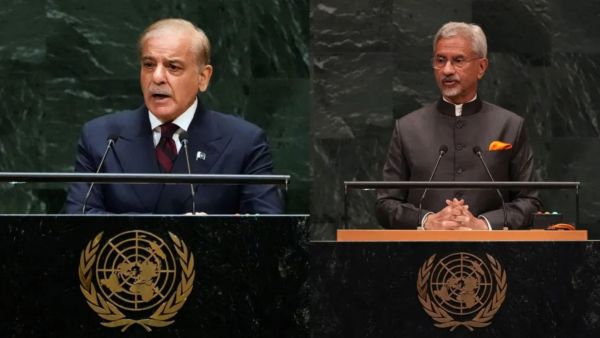 Prime Minister of Pakistan Shehbaz Sharif and External Affairs Minister S Jaishankar. (Photo: AP)
— He also called out “weaponisation of everything” in a world roiled by conflicts — from chokepoints to constricting market access — and flagged the “mindset of extreme competition” that is “undermining institutions”.
- Called the previous day’s speaker a “serial practitioner of terrorism”
- Attempts to normalise terrorism “will not stand”
- India’s right to defend itself “will be exercised”
- Governments that sponsor terrorism “must be held accountable”
- Terror financing must be exposed and countered
- Attacks on commercial ships and seafarers, from the Red Sea to the Black Sea and in the Gulf, are unacceptable
- Indian seafarers are among the casualties
- “Endless war must give way now to an end to war”
- Early humanitarian help after the Nepal flash floods and the Venezuela earthquake
- Medical supplies to conflict zones
- About 600 major development projects in 78 countries
- Warns of a “4F crisis”: food, fuel, fertiliser and finance
- Raises Kashmir, seeking a “just and fair solution”
- Refers to the 2025 India–Pakistan conflict
- Credits Trump’s “timely intervention” with saving “hundreds of millions of lives”
- Calls Pakistan “a regime of the army, by the army, and for the army”
- Says Operation Sindoor showed “terrorists will have nowhere to run, nowhere to hide”
- “Yesterday, a serial practitioner of terrorism misrepresented facts before this assembly.”
- Says attempts to normalise terrorism “will not stand”
- “Our right to defend ourselves against terrorism will be exercised.”

— Notably, the UN General Assembly is the main policy-making organ of the Organization. Comprising all Member States, it provides a unique forum for multilateral discussion of the full spectrum of international issues covered by the Charter of the United Nations. Each of the 193 Member States of the United Nations has an equal vote.
— The Assembly meets in regular sessions from September to December each year, and thereafter as required. Sitting arrangements in the General Assembly Hall change for each session.
• Deal between the US, Denmark and Greenland,
— The United States, Denmark and Greenland have agreed to a new deal. It lets America build up a much bigger military presence on the Arctic island.
— Under the deal, no country seen as a US rival will be allowed to build military bases on Greenland. America, on the other hand, gets far more freedom to expand its own military presence there.
— This isn’t starting from zero. The US already had wide rights to fly over and use bases in Greenland, thanks to a treaty signed back in 1951.
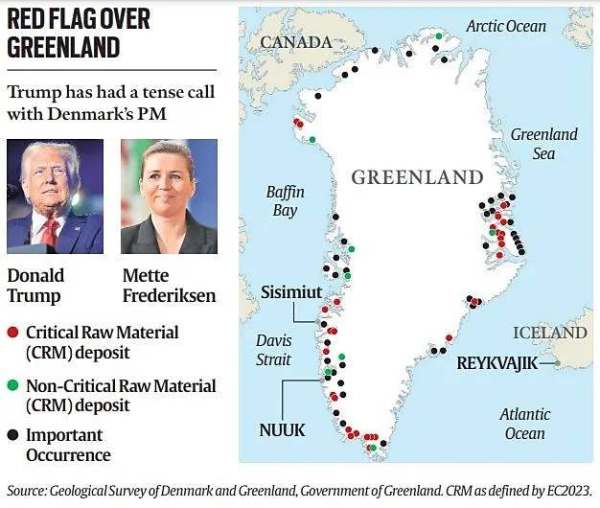
— Greenland is a self-governing territory within the Kingdom of Denmark. Under the 2009 Self-Government Act, its government exercises wide legislative and executive powers, while Greenlanders retain the right to determine the island’s future.
|
India rejects reference to J&K in OIC communique India on September 23 categorically rejected references to the Union territory of Jammu & Kashmir in a joint communique released by the Organisation of Islamic Cooperation (OIC) Contact Group on Jammu & Kashmir, after a meeting was held on the sidelines of the 81st session of United Nations General Assembly (UNGA) in New York. The statement came hours after Turkish President Recep Tayyip Erdogan had also raised the Kashmir issue during his address to world leaders on Tuesday. Alongside Pakistan, Turkey, Saudi Arabia, Azerbaijan and Niger are part of the five-member group. |
• ISRO and ESA Space Cooperation
— The Indian Space Research Organisation (ISRO) and the European Space Agency (ESA) have announced the renewal of their existing cooperation till 2032.
— The decision was made at the recently concluded International Space Summit in Paris, where the chiefs of the two space agencies signed a pact extending their long-standing cooperative agreement. At the summit held on September 9 and 10, the signatories confirmed and reaffirmed long-term commitment by both Europe and India to expanding cooperation in space.
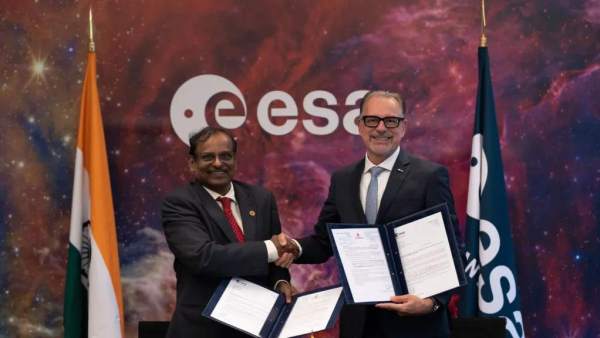 ISRO Chairman V Narayanan (left) and Josef Aschbacher, Director General, ESA, signing the pact extending their long-standing Cooperative Agreement at the International Space Summit held on September 9 and 10 in Paris (Photo Credit: ESA)
— Some of the recent engagements between the European and the Indian space agencies have been for missions Aditya-L1, Proba-3, and the upcoming Chandrayaan-5, to name a few.
— The latest agreement expands the collaboration in space weather and human and robotic exploration, considering the growing importance of sustainable use of outer space. Notably, the ISRO-ESA cooperation began in 1978, initially to support mutual needs in Earth observation and remote sensing. However, the two space agencies collaborated closely on science missions and programmes after the Cooperative Agreement inked in January 2002.
• Visegrad Group and India
— Four-nation Visegrad Group (V4) has backed India’s inclusion as a permanent member of the United Nations Security Council, with Slovakia’s Foreign Minister Juraj Blanar saying India “must be at the table” as a permanent member of the UN’s top decision-making body.
— The four countries part of Visegrad Group are Poland, Hungary, Slovakia and the Czech Republic. Speaking after the first Visegrad Group (V4)+India Foreign Ministers’ Meeting, Blanar said all four V4 countries agreed on India’s permanent membership, according to ANI.
— The meeting was held on the sidelines of the 81st session of the UN General Assembly in New York on September 21. Blanar made the remark during External Affairs Minister S Jaishankar‘s meeting with foreign ministers from Poland, Hungary, Slovakia and the Czech Republic under Slovakia’s presidency of the V4.
— The V4+India format provides an additional platform for dialogue and cooperation, building on India’s longstanding bilateral relations with Poland, Hungary, Slovakia and the Czech Republic.
|
In her first-ever address to the United Nations General Assembly on September 22, Japan’s Prime Minister Sanae Takaichi called on the UN to remove references to “enemy states” in its Charter. The label has recently been used by China and Russia to attack Japan’s plans to ramp up its defence spending. The UN Charter, which was drafted towards the end of World War II and came into force in its immediate aftermath on October 24, 1945, includes numerous references to “enemy states”. Paragraph 2 of Article 53 says: “The term enemy state as used in paragraph 1 of this Article applies to any state which during the Second World War has been an enemy of any signatory of the present Charter.” |
Polity
• Centre doubles validity of environmental clearances
— The Centre has notified a major relaxation in the country’s environmental clearance process, doubling the validity of clearance granted to ports and harbours to a minimum of 20 years, with room for two five-year extensions subject to conditions.
— The notification, published on September 21, amended the Environment Impact Assessment (EIA) notification 2006, which governs the country’s environmental clearance process.
— Environmental clearance for ports and harbour projects can now be extended by another five years, beyond the 20-year period, subject to the condition that the adequacy of existing environmental safeguards is examined by appraisal committees. Another five-year extension can be granted in “deserving cases” where the project has not been operationalised within the first extension.
— The sectoral expert appraisal committee or state-level expert appraisal committee can recommend the second extension after examination and subject to environmental safeguards, the amendment stated.
— Under the EIA notification 2006, new projects of a specified case need prior environmental clearance across several sectors. In addition, project expansion, modernisation, capacity addition, and product mix changes, beyond specified thresholds, also need environmental clearance. This is based on environmental impact assessment studies, public hearings—depending on project size and impact—and final appraisal by expert committees.
• Right not to sing the national anthem
— Hearing a petition by Carnatic vocalist T M Krishna who has challenged the law mandating the singing of all six stanzas of the Vande Mataram, the Supreme Court, while reminding the Centre Tuesday about its 1986 ruling on an individual’s right not to sing the national anthem, said it was up to “a conscientious objector not to recite one or all stanzas of the national song” and the person cannot be subjected to “criminal consequences”.
— It said it will examine whether refusal to sing the Vande Mataram could have penal consequences. Krishna’s plea said the guideline on singing of all six stanzas of Vande Mataram at official functions violates the constitutional principle of secularism because the last four stanzas contain explicit Hindu references.
— Justice Joymalya Bagchisaid, “The national song expressing homage to a particular God or form of God would not perhaps impact secularism, but your point whether a conscientious objector can be subjected to penal consequences… may require examination.”
— He said the law as it stands was laid down in its ruling on Bijoe Emmanuel and Others vs State of Kerala and Others. In the 1986 case, the Supreme Court ruled that expelling students, who belonged to Jehovah’s Witnesses, for refusing to sing the national anthem, while standing respectfully in silence, violated their fundamental rights.
— Notably, the Centre has amended Section 3 of the Prevention of Insults to National Honour Act, 1971, extending the same legal protection to Vande Mataram as Jana Gana Mana.
• Conflict and Consensus in the ECI’s functioning
— The functioning of the three-member Election Commission of India is under scrutiny this week, after an investigation by The Indian Express published on September 23 revealed that two Election Commissioners had placed their objections on record at least 14 times in 10 months.
— The Election Commission has responded by saying that the decisions taken by the Commission have been unanimous, saying that “observations” were a part of the deliberative process.
— The Election Commission derives its powers from Article 324 of the Constitution, which provides for a Commission for the “superintendence, direction and control of the preparation of the electoral rolls for, and the conduct of, all elections to Parliament and to the Legislature of every State and of elections to the offices of President and Vice-President…”
— It further says that the commission will consist of the Chief Election Commissioner (CEC) and “such number of other Election Commissioners” that the President may appoint, subject to provisions of law. The CEC “shall act as the Chairman of the Election Commission”.
— How the Election Commission is supposed to arrive at decisions is laid out in the Chief Election Commissioner and Other Election Commissioners (Appointment, Conditions of Service and Term of Office) Act, 2023.
— Section 17 of the Act says that the “business of the Election Commission shall be transacted in accordance with the provisions of this Act.”
|
EC appointment: Why SC placed matter before CJI A two-judge bench of the Supreme Court on September 23 referred petitions challenging the 2023 law on the appointment of the Chief Election Commissioner and other Election Commissioners — which excludes the Chief Justice of India (CJI) from the process — to the CJI to consider forming a Constitution Bench (which has a minimum of five judges). |
• SC raises bar on re-arrests, stresses Art 22
— Underlining that when an accused is released due to violation of his fundamental rights, he is not “enlarged on bail” but released from illegal and unconstitutional detention, the Supreme Court on September 21 laid down strict guidelines for re-arresting a person if he was earlier released for not being provided grounds of arrest.
— The bench of Justices Ujjal Bhuyan and Atul S Chandurkar said the safeguards provided under Article 22 cannot be “tinkered with”.
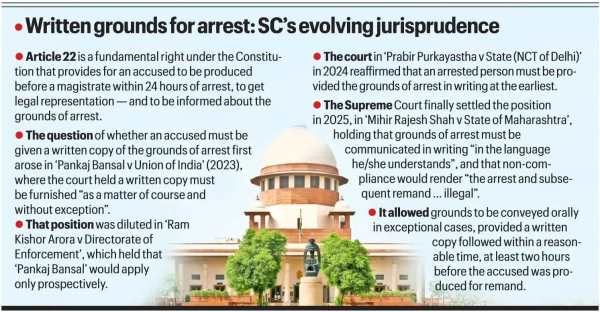
— The bench also directed high courts across the country to grant “suitable mandatory compensation” when arrests violate procedural safeguards.
— Article 22(1) requires police to inform an arrested person of the grounds of arrest, and Article 22(2) requires production before a magistrate within 24 hours.
• Armed Forces (Special Powers) Act, 1958,
— The Centre has extended the Armed Forces (Special Powers) Act, 1958, in specified areas of Nagaland, Manipur and Arunachal for another six months, according to Gazette notifications issued on September 25. This follows a review of the law and order situation there.
— The Act in its original form was promulgated by the British in response to the Quit India movement in 1942. After Independence, Prime Minister Jawaharlal Nehru decided to retain the Act, which was first brought in as an ordinance and then notified as an Act in 1958.
— AFSPA has been imposed on the Northeast states, Jammu & Kashmir, and Punjab during the militancy years. In 1997, Punjab was the first state in which it was repealed.
Maharashtra declares drought— With Maharashtra recording a rainfall deficit of 18% this year, the state government on September 26 declared drought in 265 of the state’s 358 tehsils — about three-fourths of Maharashtra. — The first trigger under the drought assessment process, which includes a continuous dry spell of at least 21 days without significant rainfall during the monsoon, has been found applicable in these areas. — A drought is a period of unusually persistent dry weather that continues long enough to cause serious problems such as crop damage and/or water supply shortages. |
Science and Technology
• India has a new fertiliser problem – Sulphur
— Soaring prices of sulphur linked to the escalating West Asia and Russia-Ukraine conflicts is impacting the availability of di-ammonium phosphate (DAP), single super phosphate (SSP) and other major complex fertilisers.
— Sulphur (identified by the letter S) is a non-metallic chemical element. It is a valuable commodity and integral component of the world economy.
— It combines directly with almost all the elements with the exception of gold, platinum and the noble gases. In its native form, sulphur is a yellow crystalline solid. It can be found as a pure element or as sulphate or sulphide minerals.
— Only a tenth of the world’s sulphur output is directly mined. The rest comes as a byproduct of petroleum oil refining (56%) and natural gas processing (34%). Environmental rules mandate desulphurisation – removal of sulphur from crude oil and raw gas – for the production of clean, low-emission fuels.
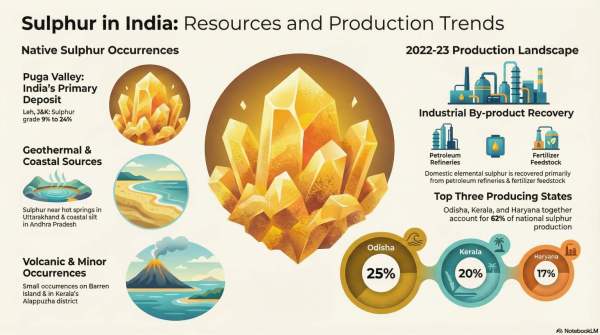 (Infographic: AI-generated)
— This recovered sulphur is, however, essential for agriculture. The fertiliser sector alone accounts for roughly 60% of the 70 million tonnes (mt) annual global sulphur consumption. Most of the world’s sulphur gets converted into sulphuric acid that is, in turn, a core chemical for manufacturing all fertilisers containing phosphorous (P).
— The last few years have also witnessed a surge in sulphuric acid demand for extracting nickel from laterite ores and processing it into mixed hydroxide precipitate (MHP), a material used for electric vehicle batteries.
— According to the India Mineral Yearbook 2023, in 2022-23 among the states, Odisha accounted for 25% of the total sulphur production and it was followed by Kerala 20%, Haryana 17%, Gujarat 16%, West Bengal 9%, Uttar Pradesh 6%, Maharashtra 5%, and remaining production was contributed by Bihar and Assam.
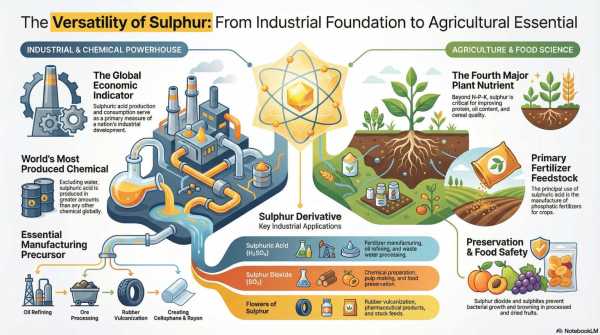 (Infographic: AI-generated)
Click here to read more on sulphur.
Defence
• ‘Veer Guardian 2026’ Exercise
— The Indian Air Force (IAF) and the Japan Air Self-Defence Force conducted the bilateral air exercise Veer Guardian 2026 at Air Force Station Jodhpur. The 14-day exercise focused on advanced operational missions and extensive professional interactions between the two air forces.
— The IAF is participated with a diverse mix of frontline combat aircraft, including the indigenous Light Combat Aircraft Tejas, Su-30MKI and Rafale. Japan participated with F-2A fighter aircraft.
— Exercise Veer Guardian 2026 reflects the deepening strategic partnership between India and Japan by enhancing tactical proficiency and aerospace operational synergy.
— Notably, India and Japan also conducts bilateral exercises such as Japan-India Army exercise ‘Dharma Guardian’ and the Japan-India Maritime Exercise “JAIMEX”.
• AASHVAST labs
— The Indian Army will soon be operating six AASHVAST labs across the country, where all its drones—and eventually CCTV cameras too—will undergo mandatory inspections to identify and eliminate firmware-level vulnerabilities. This will ensure that these do not fail during operations in contested zones and can perform their tasks effectively.
— AASHVAST stands for Assessment and Analysis of Electronic Systems Hardware for Vulnerabilities and Security Threats. Currently, one lab has been inaugurated in Delhi, with plans to establish at least five more in the coming months.
— AASHVAST, a Firmware Analysis and Validation Suite, developed by QuickPay Pvt Ltd for the Directorate General of Electronics and Mechanical Engineering (DG EME), is designed to do more than just physically inspect drones. It also examines the software that operates these unmanned aerial vehicles (UAVs) – to identify and eliminate firmware-level vulnerabilities.
— Firmware vulnerabilities can be introduced during the manufacturing stage of a component or an upgrade process. There are approximately 14 types of vulnerabilities that the labs can detect.
• Tarang Shakti exercise 2026
— The Indian Air Force (IAF) will host the second edition of its largest-ever multinational air exercise, Tarang Shakti-26, beginning later this week in Jodhpur. The maiden edition of the exercise took place in August-September 2024 in two phases.
— Around 40 countries are expected to participate in the exercise, which will bring together a range of advanced combat aircraft, including the US F-35s, French Rafales and UAE F-16s, along with various other aerial assets, for joint aerial operations, tactical training and interoperability drills.
— The exercise, to be held between September 26 and October 12 at Air Force Station, Jodhpur, and adjoining air bases will see participation from eight forces — India, Australia, Bangladesh, France, the US, Germany, Sri Lanka and UAE. Thirty-two countries will attend the event as observers. Around 10 Air Chiefs or equivalents are likely to attend the exercise.
— Tarang Shakti-26, Vice Chief of Air Staff Air Marshal Ashutosh Dixit said, has three aims: operational learning, greater interoperability and stronger partnerships.
Environment
• Botswana Cheetah released in Gandhi Sagar sanctuary
— Madhya Pradesh Chief Minister Mohan Yadav on September 20 released CCB-2 — a female cheetah brought to India from Botswana — in the wildlife sanctuary.
— CCB-2, around three years old, has been relocated from Kuno National Park situated in the Gwalior-Chambal region of the state.
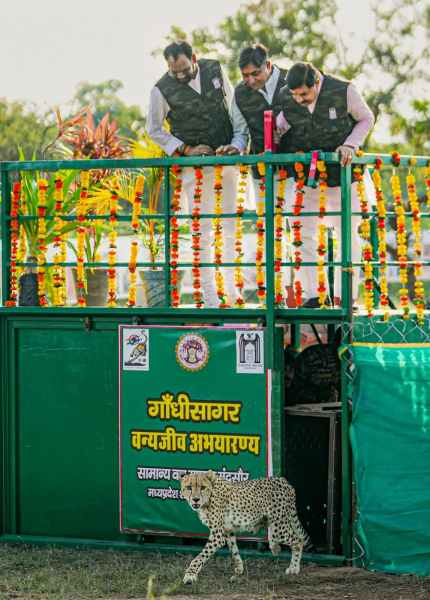 Madhya Pradesh Chief Minister Mohan Yadav releases a female cheetah at Gandhi Sagar Sanctuary, in Neemuch, Madhya Pradesh. (@DrMohanYadav51/X via PTI Photo)
— With her relocation, Gandhi Sagar now has four cheetahs — two males and two females. Wildlife officials hope the arrival of CCB-2 would help kickstart a new family of cheetahs considering the existing female cheetah has so far failed to mate with the two male cheetahs at this site.
— Gandhi Sagar, spread across the Mandsaur-Neemuch region along the Madhya Pradesh-Rajasthan border, became the country’s second cheetah habitat when two male cheetahs, Pawak and Prabhas, were moved there from Kuno in April 2025.
— Conservation Status of Cheetahs:
— IUCN Red List- Asiatic cheetah “critically endangered”, African Cheetah is listed as a vulnerable (VU).
— Wildlife Protection Act, 1972: Asiatic cheetah-Schedule 1, African Cheetah-Schedule 1.
Project CheetahProject Cheetah was launched in September 2022 with the intercontinental translocation of African cheetahs from Namibia and South Africa to the Kuno National Park in Madhya Pradesh. This translocation took place in two batches of eight and then 12 cheetahs. The ambitious project has two overarching objectives: (i) First, to establish a stable, breeding population of cheetahs in central India. (ii) Two, to use cheetahs as an umbrella species to restore open natural ecosystems such as scrubs, savannahs, grasslands, and degraded forests. |
• World Rhino Day
— World Rhino Day was observed on September 22 across the world, including India, to raise awareness about protecting the five remaining rhinoceros species. This year’s theme is “Keep the Five Alive”.
— India is home to the greater one-horned rhinoceros (Rhinoceros unicornis), whose population has recovered to nearly four thousand in India and Nepal, from around 200, following sustained conservation efforts.
— For India, the greater one-horned rhinoceros is much more than an iconic species. It is an integral part of the ecological and cultural landscape of the floodplains and grasslands of the Brahmaputra and the Terai.
— The National Conservation Strategy for the Greater One-Horned Rhinoceros was launched in 2019. The strategy provides a framework for strengthening existing populations, restoring the species to suitable former habitats, maintaining genetic security and habitat connectivity, promoting scientifically planned translocations and building climate resilience into rhino conservation.
— IUCN Conservation status of one-horned rhinoceros is Vulnerable.
• Offshore mineral blocks near Great Nicobar
— The Ministry of Mines has notified two more offshore mineral blocks near Great Nicobar Island in the Andaman Sea, covering a combined area of 1,632 square kilometres, for grant of composite licences for polymetallic nodules and crusts.
— The two blocks are West Sewell Ridge-01, off Great Nicobar Island, covering 1,000 square kilometres, and Sewell Rise-01, in the southern part of Sewell Rise near Great Nicobar Island, covering 632 square kilometres.
— Polymetallic nodules and crusts are seabed mineral deposits containing metals such as nickel, cobalt, manganese, copper and rare earth elements.
Click here to read more on Polymetallic nodules.
Awards
• 72nd National Film Awards
— The 72nd National Film Awards were held in Kevadia, Gujarat, on September 22. The event was attended by the winners, who were honoured for their contribution to Indian cinema in the year 2024. They received the honour from President Droupadi Murmu.
— Anant Nag was present to collect the highest honour in Indian cinema, the Dadasaheb Phalke Award. The Best Actor win was shared by Kartik Aaryan (Chandu Champion) and Mammootty (Bramayugam). The Best Actress award was given to Yami Gautam (Article 370).
— The Best Feature Film award was won by Article 370. The Best Supporting Actor award was won by Sanjay Mishra (Bhakshak), and the Best Supporting Actress award was shared by Ropashree Varkady (Mithya) and Sachana Namidass (Maharaja).
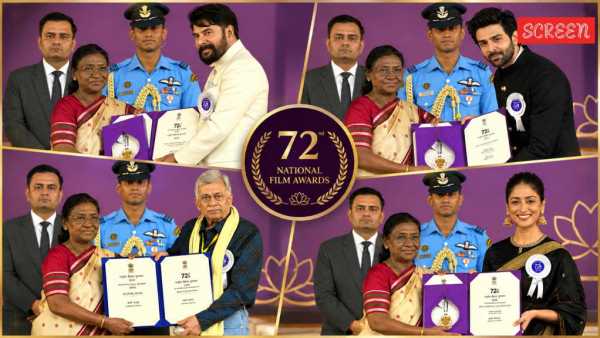 The 72nd National Film Awards was held in Gujarat on Tuesday.
— The Best Director award was won by Rajkumar Periasamy for Amaran. The Best Debut Film of a Director was won by Randeep Hooda for Swatantrya Veer Savarkar.
— The Best Feature Film Providing Wholesome Entertainment was won by Kalki 2898 AD and Captain Miller won the Best Film Promoting National, Social and Environmental Values. 35 Chinna Katha Kaadu won the Best Children’s Film award.
• TIFF Platform Prize
— Kohima-based Theja Rio’s debut feature Angh has won the Platform Award at the Toronto International Film Festival (TIFF), securing a direct pathway to compete for the Oscars 2027 in the International Feature Film category.
— By winning TIFF’s top prize, Angh, as per a new rule that allows non-English-language films to qualify for the Best International Feature Film category at the Oscars by securing a top award at one of six major international film festivals, bypasses the traditional single-country submission requirement.
— Set against the backdrop of 1960s Nagaland, Angh follows an ageing Konyak village chief and his son, who remain among the last people holding on to their ancestral faith and way of life as their world undergoes remarkable change.
— Notably, Marathi film Gondhal is India’s official entry to the Oscars.
Persons in News
(Just FYI: Noting historical personalities’ anniversaries aids UPSC prep. UPSC often includes such personalities in questions, so revisiting their lives refreshes your static syllabus.)
• Dr G Vijayaraghavan
— Renowned cardiologist Dr G Vijayaraghavan, who is credited with introducing 2D echocardiography or 2D Echo test in India, died in Thiruvananthapuram on September 20.
— A recipient of the Padma Shri award in 2009, Dr Vijayaraghavan had done pioneering and extensive research on tropical endomyocardial fibrosis – a medical condition in which thick scar tissue forms inside the heart chambers – which was prevalent in southern India.
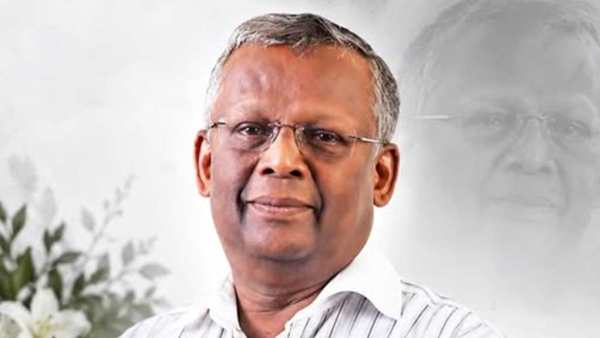 Dr G Vijayaraghavan (1942-2026).
— He was instrumental in establishing India’s first 2D echocardiography laboratory at Government Medical College in Thiruvananthapuram in the late 70s. The technique enabled more non-invasive imaging of the heart and helped expand the role of echocardiography in clinical cardiology.
Test Your Knowledge
(Note: The best way to remember facts for UPSC and other competitive exams is to recall them through MCQs. Try to solve the following questions on your own.)
(1) Consider the following statements: (UPSC CSE, 2017)
1. The Election Commission of India is a five-member body.
2. Union Ministry of Home Affairs decides the election schedule for the conduct of both general elections and bye-elections.
3. Election Commission resolves the disputes relating to splits/mergers of recognised political parties.
Which of the statements given above is/are correct?
(a) 1 and 2 only
(b) 2 only
(c) 2 and 3 only
(d) 3 only
(2) With reference to the United Nations General Assembly, consider the following statements: (UPSC CSE 2022)
1. The UN General Assembly can grant observer status to the non-member States.
2. Inter-governmental organisations can seek observer status in the UN General Assembly.
3. Permanent Observers in the UN General Assembly can maintain missions at the UN headquarters.
Which of the statements given above are correct?
(a) 1 and 2 only
(b) 2 and 3 only
(c) 1 and 3 only
(d) 1, 2 and 3
Answer key
1. (d) 2. (d)
For your suggestions and feedback, write to Roshni.Yadav@indianexpress.com
Click here to read the UPSC Essentials magazine for September 2026. Share your views and suggestions in the comment box or write to us at manas.srivastava@indianexpress.com.🚨
Subscribe to our UPSC newsletter. Stay updated with the latest UPSC articles by joining our Telegram channel – Indian Express UPSC Hub, and follow us on Instagram and X.


Roshni Yadav is a Deputy Copy Editor with The Indian Express. At The Indian Express, she writes for ... Read More
 Share


