

Journalism of Courage


The G20 Summit in South Africa, the past weekend, made more headlines for the US boycotting it than announcements made during the two-day event. But the biggest news story this week was the United States, Russia, Ukraine, and the European countries advancing the talks on Donald Trump’s proposed peace plan to end the war in Ukraine. Although a deal is yet to be made, the talks this week took it to within reach. Another country that made headlines throughout the week was China – from squabbling with Japan over Taiwan to announcing the construction of the world’s first floating artificial island with a nuclear-proof bunker. It was also a busy week for former Bangladesh prime minister Sheikh Hasina, who was awarded a 21-year jail sentence in a corruption case, even as India remained non-committal on her extradition.
Johannesburg played host to the G20 Summit, the first to take place on the African continent on November 22 and 23.

Johannesburg G20 Summit attendees
G20 member countries Argentina, Australia, Brazil, Canada, China, France, Germany, India, Indonesia, Italy, Japan, South Korea, Mexico, Russia, Saudi Arabia, South Africa, Turkiye, and the United Kingdom attended the summit along with the European Union and the African Union.
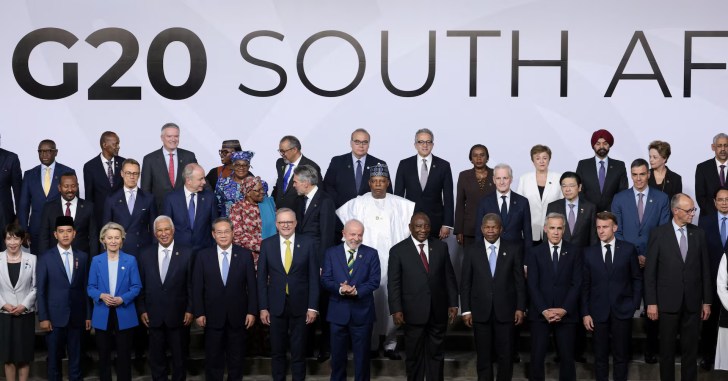
The United States is the only G20 member to have not attended the Summit.
Algeria, Egypt, Ethiopia, Finland, Ireland, Jamaica, Malaysia, Namibia, the Netherlands, Nigeria, Norway, Qatar, Sierra Leone, Singapore, Spain, Vietnam and Zimbabwe, along with representatives from the United Nations, World Bank, IMF, WTO, and the African Development Bank, attended the Summit as guests.
Key announcements and declarations
The G20 Summit adopted a consensus declaration focusing on global challenges like the climate crisis, debt relief for developing nations, and global inequality. Argentina did not endorse the declaration due to its references to the conflict in the Occupied Palestinian Territory.
According to the G20 leaders’ declaration, there is a need to scale up climate finances from all sources.
Indian Prime Minister Narendra Modi called for a global compact on Artificial Intelligence (AI) to prevent its misuse in deep fakes, crime, and terror activities.
The G20 leaders also highlighted the need to reform global institutions like the UN Security Council and development banks to better represent the voices of the Global South.
Next G20 Summit
South Africa will hand over the rotating G20 presidency to the US in December 2025, with the next Summit scheduled for Miami in 2026.
The international efforts to end the deadliest war in Europe after World War II continued throughout the week. Peace talks to end the war in Ukraine are currently focused on a US-initiated draft plan, which has been revised after inputs from Ukraine and European allies.

Where does the peace plan stand?
Russian President Vladimir Putin has indicated that the plan could serve as a basis for “serious” discussions.
Ukrainian President Volodymyr Zelenskyy has also expressed readiness to move forward with the US-backed peace proposal.
US President Trump has expressed optimism about reaching a deal, saying negotiators are “making progress”.
The European Union has also welcomed the progress in the peace talks, but insists that any peace agreement must not involve Ukraine’s capitulation or the changing of borders by force.
Key disagreements
The US, Russia, and Ukraine have accepted that significant disagreements still remain, primarily regarding territorial concessions.
Russia demands Ukraine cede the territories it has seized, while Ukraine insists on the restoration of its internationally recognised borders and security guarantees to prevent future aggression.
What changed this week?
US President Trump had originally proposed a 28-point peace plan, which initially included conditions viewed as highly favourable to Russia. But this week, following emergency talks in Geneva involving US, Ukrainian, and European officials, the plan was revised to 19 points.
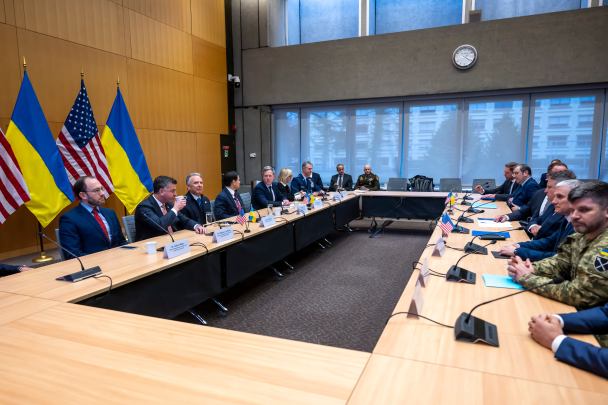
Russia-Ukraine peace talks – key persons
United States: President Donald Trump, Secretary of State Marco Rubio, US Secretary of the Army Dan Driscoll and US Special Envoy to the Middle East Steve Witkoff.
Ukraine: President Volodymyr Zelenskyy, Andriy Yermak, the presidential chief of staff, and Rustem Umerov, Ukraine’s Defence Minister.
Russia: President Vladimir Putin, Yuri Ushakov, the Russian President’s foreign policy aide, and Kirill Dmitriev, the Head of Russia’s sovereign wealth fund.
Other international figures, including European leaders such as French President Emmanuel Macron, German Chancellor Friedrich Merz, UK Prime Minister Keir Starmer, and Turkish President Recep Tayyip Erdogan, are also involved in the negotiations.
US President Donald Trump and Chinese President Xi Jinping held a telephonic conversation this week, which was dominated by Taiwan. Xi told Trump that the return of Taiwan to China is an integral part of the post-World War II international order.
Why did Trump and Xi discuss Taiwan?
The phone call followed Japanese Prime Minister Sanae Takaichi’s comment that a Chinese attack on Taiwan could pose a threat to Japan’s security and potentially trigger a military response.

Status of Taiwan
Taiwan, which is officially called the Republic of China (ROC), is an island located off the southeastern coast of mainland China. The People’s Republic of China (PRC) considers Taiwan as a breakaway province that must be reunified with the mainland, and has not ruled out the use of force for unification.
The current China-Taiwan conflict began in 1949 when the Kuomintang, which had ruled mainland China from 1928, retreated to the island after being defeated by Mao Zedong’s Communist Party in the Chinese Civil War.
China has maintained that Taiwan should come under the rule of the mainland, a demand that successive democratically elected governments in the island have opposed.
US policy on Taiwan
The US maintains a policy of “strategic ambiguity” on Taiwan, wherein Washington does not recognise the island as an independent country, but opposes China’s use of force to change the status quo. The US also sells weapons and other defence assets to Taiwan.
China has announced the construction of what is being described as the world’s first floating artificial island designed with nuclear-blast-resistant capabilities. Officially called the Deep-Sea All-Weather Resident Floating Research Facility, the structure will be 138 metres long and 85 metres wide.
Where is it located?
It will be anchored off the coast of the Chinese province of Hainan, in the South China Sea. The 78,000-tonne, semi-submersible twin-hull platform, similar in displacement to China’s Fujian aircraft carrier, is designed to support 238 people for up to four months without external resupply. It is built to withstand extreme conditions, including category 17 typhoons, using a rare nuclear-blast-resistant design.
What is its purpose?
The intended purpose of the facility, which is expected to be operational in 2028, is said to be scientific, but analysts have pointed out that it has a potential “dual-use” capability, meaning that it has both civilian and military applications.
The Ministry of External Affairs (MEA) said this week that India is examining the request by Bangladesh to extradite former prime minister Sheikh Hasina, who was sentenced to death by the International Crimes Tribunal (Bangladesh).
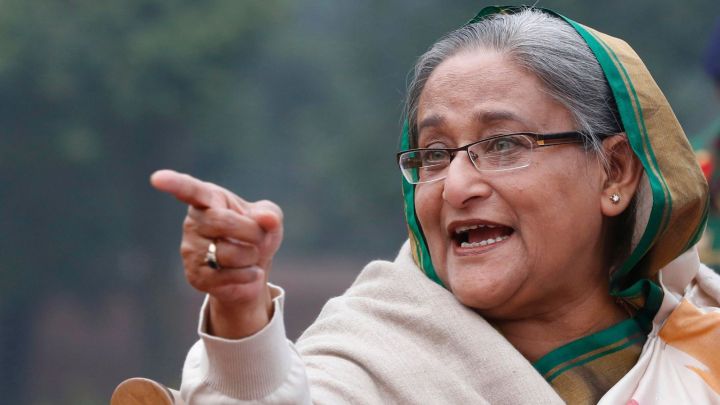
Where is Sheikh Hasina?
Hasina has been living in India since August 2024, when she was forced to flee Bangladesh following student-led protests against her government.
Charges against Hasina
The ICT found Hasina guilty of crimes against humanity, committed during the violent crackdown on student-led protests in July and August 2024.
Separately, this week, an anti-corruption court sentenced Hasina to 21 years in prison for three cases related to alleged irregularities in land allocations in a government housing project.
India-Bangladesh extradition treaty
India and Bangladesh signed an extradition treaty in 2013, and the interim government in Dhaka has sent multiple diplomatic requests to New Delhi for Hasina’s extradition.
What India said
MEA spokesperson Randhir Jaiswal said this week that the request to extradite Hasina is “being examined as part of ongoing judicial and internal legal processes.”


