How fast are sea levels rising?
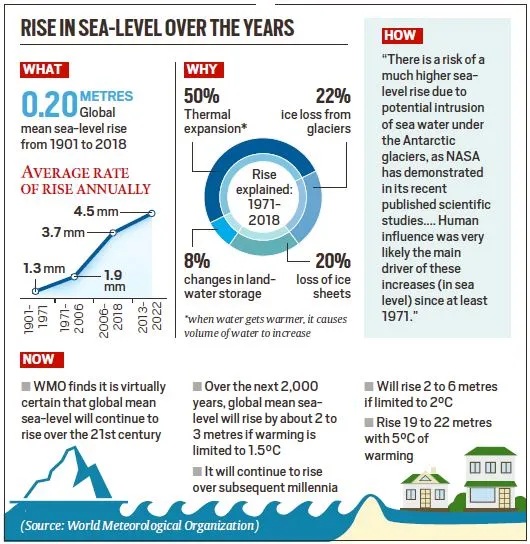
1. The global sea level has risen by about 21 cm since 1880, when records were first kept, according to the US agency National Oceanic and Atmospheric Administration (NOAA).
2. However, in recent years, this rise has been “accelerating” (to quote the declaration).
3. The rate of global rise more than doubled from 2.1 mm a year in 1993-2002 to 4.7 mm a year in 2015-2024, according to the World Meteorological Organization. In 2024 alone the sea rose 6 mm, the largest annual increase on record.
4. In 2025, global mean sea level was comparable to the record-high levels observed in 2024 in the satellite altimetry record, according to the State of the Global Climate 2025 report.
What is causing the rise?
5. The global mean sea level is the average height of the sea surface. Sea level rise is essentially the increase in the average height of the ocean’s surface, measured from the centre of the Earth. There are two primary reasons why sea levels are currently rising.
6. One, the global warming-driven melting of glaciers (accumulation of ice and snow that slowly flows over land) and ice sheets (glaciers which cover more than 50,000 square km of land).
7. According to a recent study, since 2000, glaciers have lost between 2% and 39% of their ice regionally, and about 5% globally.
8. An average of 150 billion tons of ice mass are lost yearly from Antarctica and 270 billion tons from Greenland.
9. Recent scientific reports have also raised concern about climate “tipping points,” where increases in temperatures beyond 1.5 degrees Celsius could trigger the irreversible collapse of the entire Greenland and West Antarctic ice sheets, with severe repercussions for sea levels.

10. Two, the thermal expansion of seawater, a process by which water expands as it warms up. With global temperatures rising, oceans are becoming warmer, and as a result, the volume of water is increasing as well.
11. Thermal expansion of seawater is responsible for one-third to half of global sea level rise, according to the National Aeronautics and Space Administration (NASA).
12. Essentially, sea level is driven by global warming, caused by carbon dioxide, methane and other emissions released from the burning of fossil fuels for uses including energy, industry, and transport.
13. This is making the ocean heat up. Our seas have absorbed an estimated 90% of atmospheric warming over the past 50 years.
14. The pace of ocean heating has doubled in the last 20 years, rising three times faster than the global average in the southwest Pacific Sea. Ocean temperatures in 2023 were the hottest on record.
Which parts of the world are most impacted?
1. Rising seas can cause coastal erosion, flooding, stronger storm surges and saltwater intrusion into freshwater sources, while threatening homes, infrastructure and habitable land.
2. The declaration also addresses the issue of loss of territory faced by low-lying countries that are particularly vulnerable to rising sea levels and persistent coastal erosion.
3. Low-lying small islands, such as Fiji, the Maldives and Tuvalu, are facing some of the most critical threats from sea level rise — with even a moderate increase posing an existential danger.
4. By December 2025, more than a third of Tuvalu’s 11,000-strong population had applied for climate visas to migrate to Australia under a bilateral treaty.
5. Fiji, where sea levels are rising at about 6 mm a year—higher than the global average—has already had coastal communities relocated under its Climate Change Act in 2021, with a trust fund to pay for it.
6. However, sea level rises pose a global threat as nearly 40% of the world’s population lives near the coast and roughly 900 million in low-elevation zones.
7. Coastal cities and communities worldwide are already struggling with coastal erosion, agriculture and freshwater challenges due to saltwater intrusion and increasingly destructive flooding and storms.
8. According to a 2022 study, among the hardest hit places will be tropical regions, particularly in Asia, with Bangladesh, India, China particularly at risk. Some of the most vulnerable areas will be river deltas — broad areas where rivers meet the sea, often where port cities are located.
9. A 2022 analysis by RMSI, a global risk management firm, found that some critical properties and road networks in Mumbai, Kochi, Mangalore, Chennai, Visakhapatnam, and Thiruvananthapuram will be submerged by 2050.
10. The sea level along the Indian is rising at an average rate of about 1.7 mm per year with 3.3 mm per year in the recent decades (1993-2015), according to a response by the Ministry of earth sciences in Lok Sabha in 2021.
11. Other megacities such as Cairo, Lagos, Los Angeles, Buenos Aires and London are all expected to face serious impacts.
What can be done to respond?
12. Ultimately, experts say the solution to preventing dramatic sea level rise lies in rapidly reducing emissions.
13. However, some degree of sea level rise is now inevitable — this is because even if the world stops emitting all greenhouse gases tomorrow, there is a time lag in the effect global heating has on ocean temperatures and ice and glacier melting.
14. Countries worldwide are employing a range of adaptation measures, from creating sea walls and storm surge barriers to improving drainage systems and flood resistant buildings.
15. Some of the adaptation measures are simple and nature based: from staving off coastal erosion by driving wooden stakes into Senegal’s beaches or regenerating mangrove forests in Cameroon.
16. For low lying small island states responses to sea level rise include moving entire villages to higher ground in Fiji, building floating cities in the Maldives and reclaiming land from the sea in Tuvalu.
17. Many developing regions need financial help to deal with sea level rise and other consequences being felt due to climate change, experts say.
BEYOND THE NUGGET: What is regional sea level rise?
1. Notably, the sea level is not rising uniformly world over. For instance, the southwestern Indian Ocean region is seeing the sea level rise at a rate of 2.5 mm per year, faster than the global average, according to a 2022 World Meteorological Organization report.
2. The uneven rise is because “regional patterns of sea-level change are dominated by local changes in ocean heat content and salinity,” the report said.
3. Because sea level rise is not uniform across the world, there is a need to differentiate regional SLR from the global rates.
4. For instance, the gravitational pull of the polar ice sheets has different effects on sea levels in different parts of the world, which means regional SLR can be higher or lower than the global SLR.
5. Relatively too, regional SLR can be higher or lower. For instance, according to an article published in Yale Environment 360, SLR in places such as Scotland, Iceland and Alaska could be significantly less than the regional SLR for the eastern US.
Post Read Questions
Consider the following statements regarding sea level rise:
1. Thermal expansion of seawater is an important contributor to global sea level rise.
2. Sea level rise is spatially uniform across the world’s oceans.
3. Melting of land-based ice contributes to sea level rise.
4. Regional sea level rise can be influenced by changes in ocean heat content and salinity.
Which of the statements given above are correct?
(a) 1 and 3 only
(b) 1, 3 and 4 only
(c) 2 and 4 only
(d) 1, 2, 3 and 4
Answer: (b)
UPSC CSE Previous Year Mains Questions on similar theme:
(1) How are climate change and the sea level rise affecting the very existence of many island nations? Discuss with examples. (UPSC CSE, GS I/2025)
(2) The Intergovernmental Panel on Climate Change (IPCC) has predicted a global sea level rise of about one metre by AD 2100. What would be its impact in India and the other countries in the Indian Ocean region? (UPSC CSE, GS III/2023)
(Sources: Experts Explain | What the UN sea level declaration means for the world — and India’s eroding coast, Sea level rise: Can a country retain its statehood even if it loses its territory?, Almost 2 cm of sea level rise this century was due to melting glaciers, says study. Should you be concerned?, Warming up to climate change: Why does sea level rise matter?)
🚨Click here to read the UPSC Essentials magazine for September 2026. Share your views and suggestions in the comment box or write to us at manas.srivastava@indianexpress.com.🚨
🚨Subscribe to our UPSC newsletter. Stay updated with the latest UPSC articles by joining our Telegram channel – Indian Express UPSC Hub, and follow us on Instagram and X

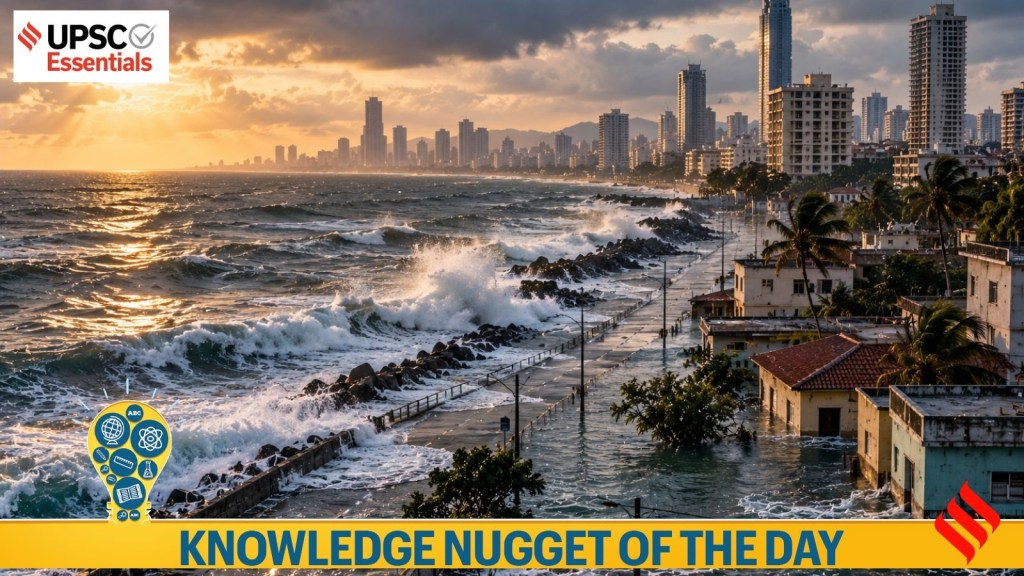 Nearly 40% of the world’s population lives near the coast, making rising sea levels a global concern rather than a threat limited to small island nations. (Image generated by AI)



 Share


