3. The Sambalpur facility will improve weather monitoring across Western Odisha and generate more comprehensive meteorological data for adjoining areas of Southern Jharkhand, Northern Chhattisgarh, parts of North Andhra Pradesh and West Bengal.
4. Expansion of the doppler weather radar network is being carried out under Mission Mausam, under which 40 more such radars are planned.
5. Dr. Jitendra Singh said that the expansion is part of the Government’s broader effort to strengthen India’s capacity to observe, understand and respond to extreme weather events.
6. He underlined that enhanced observation capabilities are particularly important for regions vulnerable to thunderstorms, lightning, heavy rainfall and other weather-related hazards.
How do Doppler Weather Radars work?
7. In radars, a beam of energy, called radio waves, is emitted from an antenna. When this beam strikes an object in the atmosphere, the energy scatters in all directions, with some reflecting directly back to the radar.
8. The larger the object deflecting the beam, the greater is the amount of energy that the radar receives in return.
9. Observing the time required for the beam to be transmitted and returned to the radar allows weather forecasting departments to “see” raindrops in the atmosphere, and measure their distance from the radar.
10. What makes a DWR special is that it can provide information on both the position of targets as well as their movement. It does this by tracking the ‘phase’ of transmitted radio wave pulses; phase meaning the shape, position, and form of those pulses.
 (Infographic generated by AI)
11. As computers measure the shift in phase between the original pulse and the received echo, the movement of raindrops can be calculated, and it is possible to tell whether the precipitation is moving toward or away from the radar.
12. In India, DWR of varying frequencies — S-band, C-band and X-band — are commonly used by the IMD to track the movement of weather systems and cloud bands, and gauge rainfall over its coverage area of about 500 km.
13. The radars guide meteorologists, particularly in times of extreme weather events like cyclones and associated heavy rainfall. An X-band radar is used to detect thunderstorms and lightning, whereas a C-band radar helps in cyclone tracking. S-band radar is the primary choice for deep coastal cyclone monitoring.
14. With the radar observations, updated every 10 minutes, forecasters can follow the development of weather systems as well as their varying intensities, and accordingly predict weather events and their impact.
Why are they called ‘Doppler’ weather radars?
15. The phase shift in these radars works on the same lines as the “Doppler effect” observed in sound waves, in which the sound pitch of an object approaching the observer is higher due to compression of sound waves (a change in their phase).
16. As this object moves away from the observer, the sound waves stretch, resulting in a lower frequency. This effect explains why an approaching train’s whistle sounds louder than the whistle when the train moves away.
17. The discovery of the phenomenon is attributed to Christian Doppler, a 19th-century Austrian physicist.
18. According to the US National Weather Service, in an hour, a DWR transmits a signal for only over seven seconds, and spends the remaining 59 minutes and 53 seconds listening to returned signals.
BEYOND THE NUGGET: Mission Mausam
1. Launched by PM Modi in Delhi on 14th January, 2025 on the occasion of 150th foundation day (January 15) of the India Meteorological Department (IMD), Mission Mausam is aimed at making the country a “weather-ready” and “climate-smart” nation.
2. In September 2024, the Union Cabinet had approved Mission Mausam with a budget of ₹2,000 crore over two years. It aims to cover all aspects of weather and forecasting services offered in the country.
3. The mission is being primarily implemented by three key institutions under the Ministry of Earth Sciences (MoES) — the India Meteorological Department, the Indian Institute of Tropical Meteorology and the National Centre for Medium-Range Weather Forecasting.
4. These are supported by other MoES bodies, such as the Indian National Centre for Ocean Information Services, the National Centre for Polar and Ocean Research and the National Institute of Ocean Technology.
5. Critical elements of Mission Mausam include-
(a) deployment of next-generation radars and satellite systems with advanced sensors.
(b) high-performance supercomputers, the development of enhanced Earth system models.
(c) GIS-based automated decision support system for real-time data sharing.
Post Read Question
Consider the following activities:
1. Identification of narcotics on passengers at airports or in aircraft
2. Monitoring of precipitation
3. Tracking the migration of animals
In how many of the above activities can the radars be used?
(a) Only one
(b) Only two
(c) All three
(d) None
Answer: (b)
(Sources: Doppler weather radars now cover 87% of India’s total area: How do these instruments work?, Knowledge nugget of the day: Mission Mausam, Mission Mausam launched by PM Modi today: What is it, how it will help Indians)
🚨Click Here to read the UPSC Essentials magazine for September 2026. Share your views and suggestions in the comment box or at raveena.baneta@indianexpress.com🚨
Subscribe to our UPSC newsletter. Stay updated with the latest UPSC articles by joining our Telegram channel – Indian Express UPSC Hub, and follow us on Instagram and X

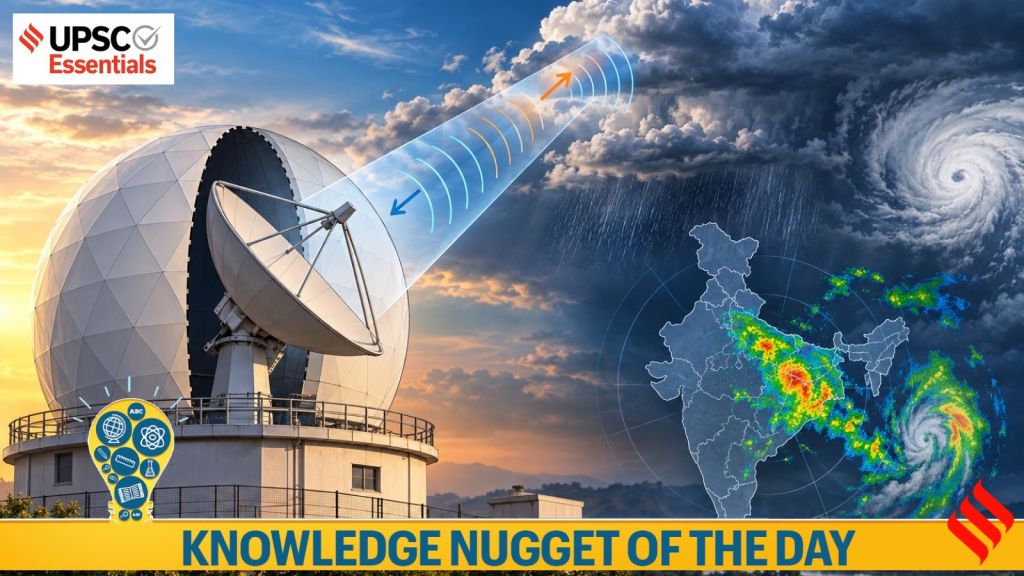 Doppler Weather Radars ‘see’ precipitation by sending radio waves into the atmosphere and analysing the signals scattered back by raindrops. (AI generated image)

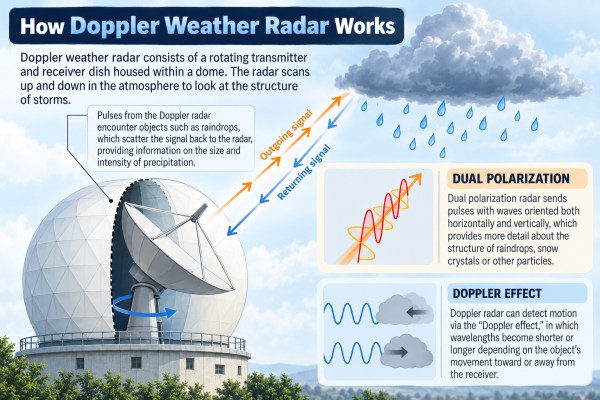 (Infographic generated by AI)


 Share


