
Knowledge Nugget | Nepal floods and compensation: Why Loss and Damage Fund matters
Which countries have contributed most to the world’s atmospheric CO₂? Why is Nepal demanding compensation? How does the ‘Loss and Damage Fund’ support countries bearing the brunt of climate change, and how is it connected to COP? Here’s all you need to know. Also, go “Beyond the Nugget” to understand the key takeaways from COP30.
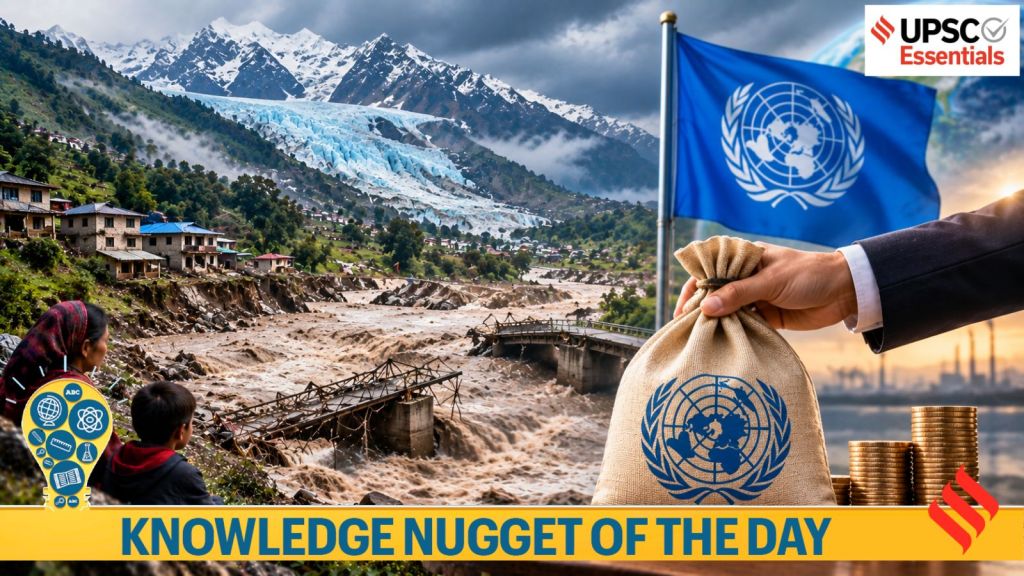 Nepal’s foreign minister, Shishir Khanal, said the country has written to the UN’s fund for responding to loss and damage. (Image: AI-generated)
Take a look at the essential events, concepts, terms, quotes, or phenomena every day and brush up your knowledge. Here’s your UPSC Current Affairs knowledge nugget for today on the Loss and Damage Fund.
Knowledge Nugget: Loss and Damage Fund
Subject: International affairs and Environment
Why in the news?
Nepal has suffered a catastrophic flash flood, with more than 1,000 dead, thousands still missing nearly 10 days later, and whole villages, bridges and roads swept away. Nepal’s foreign minister, Shishir Khanal, said the country has written to the UN’s fund for responding to loss and damage. In this context, let’s know who has contributed most to the world’s atmospheric carbon dioxide (CO₂), why Nepal is demanding compensation and what is the loss and damage fund all about.

Key Takeaways:
1. The US is the leading contributor, at 25%, to the key cause of climate change, CO₂ accumulated in the atmosphere. Europe is next at around 20% with the Chinese now fast catching up at 15% of the global stock. India’s contribution, on the other hand is under 4%. Moreover, India’s per-capita CO₂ emissions at around 2 tonnes per year are half of the global average of 4.5 tonnes.
2. After the floods, Nepal, whose own emissions are very little, said it is bearing the consequences of a problem it did not create.
3. “Nepal’s greenhouse gas emissions are virtually negligible. Yet, we are paying the ultimate price for a global crisis we did not create. The rapid melting of glaciers and these catastrophic mountain tsunamis are direct consequences of global climate change… This is not a matter of charity; it is a matter of legal and moral liability,” Khanal had said.
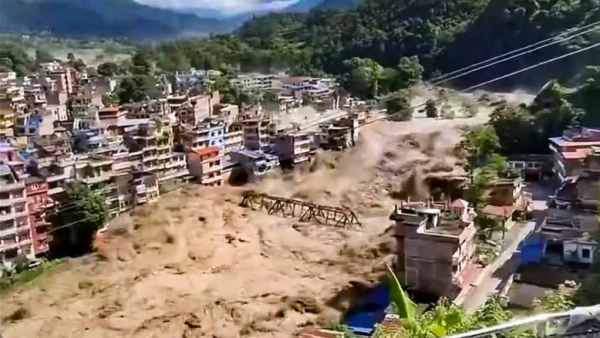 A videograb of the devastating flash floods in Nepal. (PTI)
What is the loss and damage fund?
4. At the UN Climate Change Conference of Parties 2022 (COP27) in Egypt, an agreement was reached to create a fund that will help low-income developing countries offset the damage from natural disasters caused by climate change. Named the “Loss and Damage Fund,” this financial mechanism was designed to provide crucial support to vulnerable nations facing the brunt of climate-related challenges.
5. The topic of climate finance for developing countries became one of the priorities on the agenda of the UN Climate Change Conference 2023 (COP28) in Dubai, UAE. During the inaugural plenary session on the conference’s first day, the participants made a historic decision to create a dedicated fund aimed at addressing and compensating for the losses and damages incurred due to climate change, and the Loss and Damage Fund was officially launched.
6. The loss and damage fund is a global financial package to ensure the rescue and rehabilitation of countries facing the cascading effects of climate change.
7. The term refers to the compensation that rich nations, whose industrial growth has resulted in global warming and driven the planet into a climate crisis, must pay to poor nations, whose carbon footprint is low but are facing the brunt of rising sea levels, floods, crippling droughts, and intense cyclones, among others. Notably, contributions to fund are voluntary.
What is COP?COP is the annual United Nations (UN) climate meeting. In 1992, at the Rio Earth Summit, 154 countries signed a multilateral treaty called the United Nations Framework Convention on Climate Change (UNFCCC). COP was a result of a strong belief in the power of international agreements to tackle environmental problems. The first ever COP took place in Berlin, Germany, in 1995. COP meetings aim to review progress towards the overall goal of limiting climate change. The annual conference is held to discuss a global agreement to reduce greenhouse gas emissions in the atmosphere. |
What is the status of the loss and damage fund?
8. Presently, around $822 million has been pledged to the UN’s loss and damage fund, but around $350 million is allotted for disbursement. The UAE has provided $100 million. Much of the other contribution has come from Europe.
9. The US, which had pledged around $17 million, has now pulled out of this funding mechanism, with climate change itself being referred to as a ‘hoax’ by President Donald Trump.
How much damage has been caused by industrialisation?
10. The Industrial Era started in 1850, disrupting Earth’s natural mechanism for the production and absorption of greenhouse gases. Today, the US, the UK and the EU are considered to be responsible for 50% of all emissions. Bring Russia, Canada, Japan, and Australia into the picture and it jumps to 65%, i.e. two-thirds of all emissions.
11. Greenhouse gases comprise methane, nitrous oxide, water vapour, and CO₂ — with CO2 responsible for most of the global heating. Carbon particles are being released in extremely large quantities and they have the ability to linger in Earth’s atmosphere seemingly endlessly, at least for a millennium or more, and warm it.
What Happened at COP30 in Brazil?
BEYOND THE NUGGET: Key takeaways of COP30
The 30th edition of the Conference of the Parties to the UN Framework Convention on Climate Change (COP30), held in Belem, Brazil in November last year. The conference ended with the adoption of the Belem Political Package. The key takeaways of COP30 are:
1. Belem Health Action Plan: It is a flagship outcome of Brazil’s COP 30 Presidency, which was unveiled on the dedicated Health Day of COP30 – 13 November 2025. It is aimed at strengthening global health systems to cope better with the impacts of climate change. It is structured around two cross-cutting principles and concepts: health equity and ‘climate justice’ and leadership and governance on climate and health with social participation.
2. Tropical Forests Forever Facility (TFFF): Brazil, on 6th November, formally launched the TFFF, which is designed as a “payment-for-performance” model that uses agreed satellite monitoring standards and systems to reward tropical forest countries with a continuing source of funding as long as they preserve their forests.
— TFFF aims to mobilise around USD 125 billion through public and private investment, using returns to pay nations that conserve forests. Brazil made the first $1 billion investment in the facility.
3. The Open Planetary Intelligence Network (OPIN): This is launched for data interoperability, which will accelerate the global climate transformation by unifying critical digital technologies.
4. Belem 4x pledge: Belém 4X pledge on sustainable fuel is a “call to action” to accelerate the energy transition and expand the supply of liquid biofuels, biogas, hydrogen, and other inputs. It aims to provide political support and promote international cooperation to increase at least fourfold the use of sustainable fuels by 2035, from 2024 levels.
5. Belem Declaration on Hunger, Poverty, and People-Centered Climate Action: At the climate summit, leaders from 43 countries and the European Union signed this declaration, placing the world’s most vulnerable populations at the center of global climate policy.
— The declaration recommends that “countries continue investing in mitigation, while giving greater priority to adaptation—particularly human-centered measures such as social protection, crop insurance, and other instruments that strengthen community resilience.”
6. National Adaptation Plan (NAP) Implementation Alliance: It is a multistakeholder partnership aimed at accelerating the effective and impactful implementation of National Adaptation Plans (NAP), which was announced at the summit.
Post Read Question
With reference to the “loss and damage fund”, consider the following statements:
1. It is a global financial package to help vulnerable countries cope with the impact of climate change.
2. It was first announced during COP 27.
3. It refers to the compensation that developed nations pay to vulnerable nations whose carbon footprint is low but are facing the brunt of rising sea levels.
How many of the statements given above are correct?
(a) Only one
(b) Only two
(c) All three
(d) None
Answer key
(c)
(Sources: Expert Explains | How floods triggered Nepal’s demand for compensation, Loss and damage fund approved at COP28 summit: All you need to know, undp.org)
🚨 Click Here to read the UPSC Essentials magazine for August 2026. Share your views and suggestions in the comment box or at manas.srivastava@indianexpress.com🚨
Subscribe to our UPSC newsletter. Stay updated with the latest UPSC articles by joining our Telegram channel – Indian Express UPSC Hub, and follow us on Instagram and X


Roshni Yadav is a Deputy Copy Editor with The Indian Express. At The Indian Express, she writes for ... Read More
 Share


