
Knowledge Nugget | ‘Sagar Manthan’: Why an indigenous ocean research vessel matters
Garden Reach Shipbuilders and Engineers (GRSE) has recently launched ‘Sagar Manthan’, an indigenous Ocean Research Vessel (ORV). What is the significance of the vessel? How will it support India’s deep-ocean research ambitions? Here's all you need to know. Also, go beyond the nugget to know about the objectives of Deep Ocean Mission.
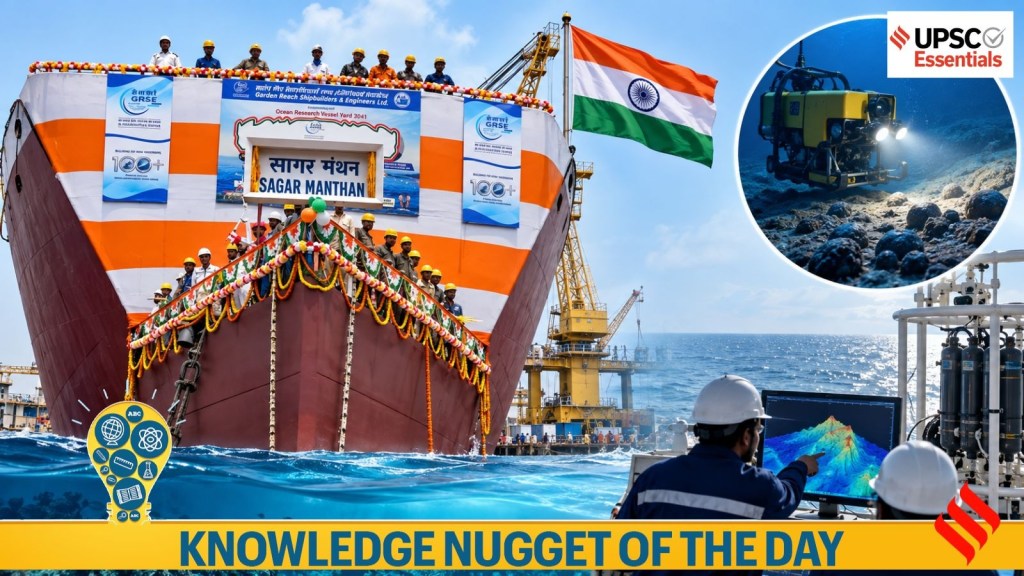 ‘Sagar Manthan’, an indigenous ocean research vessel being built by GRSE, was launched in Kolkata to support India’s deep-ocean research and exploration efforts. (File photo enhanced using AI)
Take a look at the essential events, concepts, terms, quotes, or phenomena every day and brush up your knowledge. Here’s your UPSC Current Affairs knowledge nugget for today on ‘Sagar Manthan’ ocean research vessel (ORV).
Knowledge Nugget: ‘Sagar Manthan’ ORV
Subject: Geography, Science and Technology
Why in the news?
Kolkata-based Garden Reach Shipbuilders and Engineers (GRSE) Ltd on Wednesday (September 9) launched ‘Sagar Manthan’, an indigenous ocean research vessel (ORV) being built for the National Centre for Polar and Ocean Research (NCPOR), Union Ministry of Earth Sciences.

Key takeaways:
1. As per tradition, the ORV was named ‘Sagar Manthan’ by Manju Singh, wife of Dr Jitendra Singh, Minister of State (Independent Charge) for the Ministry of Science and Technology.
2. The vessel was launched at the GRSE’s Rishi Bankim Shipyard in Kolkata by Kavita Ellanti, wife of Dr Srinivas Kumar Tummala, Secretary, Ministry of Earth Sciences. The launch comes just five months after the keel-laying of the vessel.
3. Speaking at the launch ceremony, MoS Singh said the vessel being built at GRSE represents the growing strength of India’s indigenous shipbuilding, engineering and scientific capabilities.
What is ‘Sagar Manthan’?
4. ‘Sagar Manthan’ is a 89.5-m long and 18.8-m wide ORV with a gross tonnage of 5,900 tonnes, and speed of up to 14 knots at 90% maximum continuous rating (MCR).
5. The ORV is built for the Ministry of Earth Sciences (MoES), which has launched the Rs. 4,077 crore Deep Ocean Mission in 2021 and several initiatives since then have been taken to boost India’s deep ocean research.
6. The need for such a research vessel has been felt for a long time, as many of the country’s existing research vessels have either aged, pose limitations in equipping the latest scientific facilities and equipment or have been decommissioned.
7. In addition, it was not possible to perform certain mineral explorations using existing vessels and Indian researchers would often have to hire international vessels.
What will the ORV be used for?
8. The ORV will be capable of underway swath multibeam as well as geophysical seismic surveys in coastal seas and deep waters at a maximum depth of 6 km.
9. The vessel will also be able to carry out conductivity, temperature and depth (CTD) profiling and water sampling operations such as biological sampling using vertical and horizontal methods through various nets.
10. The research vessel will also effectively carry out surface and deep-sea mooring and data buoy operations, seabed sampling using corers and grabs as well as rock dredging with chain bag dredges.
11. The vessel will also undertake underway atmospheric observations, surface meteorological and current measurements and collect upper air data.
12. Scientists will be able to carry out analytical work and data processing on board. The ship will also provide training and education to scientists and technicians.
13. The vessel will also be capable of launching and recovering autonomous underwater vehicles (AUVs) and remotely operated vehicles (ROVs) being developed by the National Institute of Ocean Technology under the ‘Deep Ocean Mission’.
'Sagar Manthan': India's new indigenous ocean research vessel
Why is deep ocean exploration crucial?
1. With India’s 11,098 km-long coastline, the government has long pushed for a blue economy policy — harnessing ocean resources for economic growth.
2. The deep ocean is home to several unexplored minerals, food, fuels, gas hydrates and biodiversity resources like fish and nutraceuticals.
3. It is also where a crucial medium of modern global telecommunications is found in the form of undersea cables, which are laid on the ocean floor.
4. Thus, it is essential to harness these resources to maximise India’s blue economy potential by supporting fisheries and aquaculture, tourism, livelihoods and blue trade.
5. Considering the importance of the oceans on sustainability, the United Nations (UN) has declared the decade, 2021-2030 as the Decade of Ocean Science for Sustainable Development.
6. Beyond exploiting the oceans’ resources, mapping of the deep sea and maintaining a high degree of underwater domain awareness is critical for safeguarding maritime and security interests.
Did you know?— India signed a contract with the International Seabed Authority (ISA) in September 2025 for exclusive polymetallic sulphides (PMS) exploration rights in the Indian Ocean ridge. As per ISA, these metalliferous muds contained large amounts of copper, zinc, lead, iron, silver and gold. — With this, India became the first country in the world to have two contracts with the ISA for PMS exploration. The earlier contract is in the Central Indian Ridge and Southwest Indian Ridge, signed in 2016. —It commands the largest area allocated in the international seabed for PMS exploration — a scientific achievement with strategic importance. — Goa-based National Centre for Polar and Ocean Research (NCPOR)is responsible for carrying out the PMS exploration, starting with geophysical and hydrographic surveys in the licensed area. |
How is deep ocean exploration regulated?
7. Countries manage their own maritime territory and exclusive economic zones, while the high seas and the international ocean floor are governed by the United Nations Convention on the Law of the Seas (UNCLOS). It is considered to apply to states regardless of whether or not they have signed or ratified it.
8. Under the treaty, the seabed and its mineral resources are considered the “common heritage of mankind” that must be managed in a way that protects the interests of humanity through the sharing of economic benefits, support for marine scientific research, and protecting marine environments.
9. According to the UNCLOS, the Exclusive Economic Zone (EEZ) of a country extends from the baseline of its coast to 200 nautical miles (about 370 km) into the sea. A nation has exclusive rights to living and non-living resources in the waters and on the seabed within its EEZ.
BEYOND THE NUGGET: Deep Ocean Mission
1. Only a few countries presently possess deep-sea exploration capabilities, including the United States, Russia, China, Japan, and France.
2. India has joined this select group of nations with the Samudrayaan Project, which is among the six components of the Deep Ocean Mission approved by the Union Cabinet in 2021.
3. At the cost of Rs. 4,077 crores over five years, the Deep Ocean Mission will:
(i) Develop technologies for deep sea mining, underwater vehicles and robotics, as well as a crewed submersible (which needs support from a larger vehicle).
(ii) Develop an ocean climate change advisory service, with observations and models for future projections of climate variables.
(iii) Look for technological innovations to explore and conserve deep-sea biodiversity.
(iv) Conduct deep ocean surveys, mainly to look for mineral deposits, especially polymetallic nodules.
What are polymetallic nodules?— These comprise layers of iron and manganese hydroxides and are found on the ocean floor, often containing materials such as nickel, rare earths and cobalt, among others. — As per ISA wesbite, they are more abundant in areas off the west coast of Mexico in the Pacific (known as the Clarion-Clipperton Fracture Zone), the Central Indian Ocean Basin, and the Peru basin. |
(v) Develop technologies to derive energy and freshwater from the ocean.
(vi) Establish an advanced marine station for developing capacities in ocean biology and engineering.
4. The National Institute of Ocean Technology, as the coordinating agency, is developing the submersible for the Samudrayaan Project.
5. Samudrayaan is a manned deep ocean mission envisioned for deep sea mineral exploration, where India plans to send three humans to depths of 6,000 metres by 2027. It is a project under the Deep Ocean Mission.
6. Under the mission, MATSYA 6000 manned submersible design has been completed and testing is underway.
Post Read Question
With reference to the Exclusive Economic Zone (EEZ), consider the following statements:
1. The EEZ of a country extends from the baseline of its coast to 12 nautical miles into the sea.
2. A coastal state has sovereign rights over both living and non-living resources within its EEZ.
Which of the statements given above is/are correct?
(a) 1 only
(b) 2 only
(c) Both 1 and 2
(d) Neither 1 nor 2
Answer: (b)
(Sources: Ocean research vessel ‘Sagar Manthan’ launched at Kolkata port, Expert Explains: Why India needs to develop its deep sea capabilities, Knowledge Nugget: Samudrayaan and Matsya-6000 – What you must know for UPSC Exam?, How India’s ‘aquanauts’ will undertake deep sea exploration under Samudrayaan Project moes.gov.in, India building its largest research vessel to explore deep oceans)
🚨 Click Here to read the UPSC Essentials magazine for August 2026. Share your views and suggestions in the comment box or at manas.srivastava@indianexpress.com🚨
Subscribe to our UPSC newsletter. Stay updated with the latest UPSC articles by joining our Telegram channel – Indian Express UPSC Hub, and follow us on Instagram and X


Raveena Baneta is a consultant with the UPSC section of The Indian Express where she writes on Ethic... Read More
 Share


