
Knowledge Nugget | PRAHAAR: Why India’s national counter-terrorism strategy matters
Union Home Minister Amit Shah recently held a conference on the PRAHAAR counter-terrorism strategy and stressed stronger coordination and implementation at the ground level. What is PRAHAAR and how does it seek to address evolving terror threats? Go beyond the nugget to understand how India legally defines terrorism.
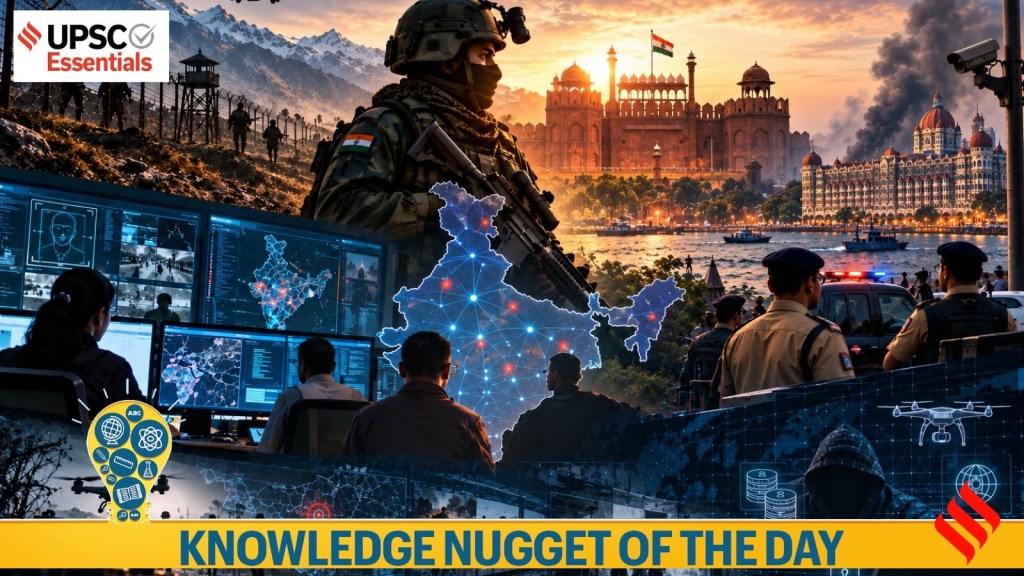 As terror threats move beyond borders into cyberspace, drones and encrypted networks, PRAHAAR seeks to strengthen India’s counter-terror response.
Take a look at the essential events, concepts, terms, quotes, or phenomena every day and brush up your knowledge. Here’s your UPSC Current Affairs knowledge nugget for today on PRAHAAR counter-terrorism strategy.
Knowledge Nugget: PRAHAAR Counter-terrorism Strategy
Subject: Internal Security
Why in the news?
Calling for a stronger, institutionalised counter-terrorism framework with a whole-of-society approach, Union Home Minister Amit Shah inaugurated a conference on ‘PRAHAAR – CT Policy and Strategy’ in New Delhi on Monday.

Key takeaways:
1. He stressed the need to strengthen the PRAHAAR strategy through continuous analysis of terror incidents and by establishing a concrete mechanism for the next 10 years.
2. Shah said the principles of PRAHAAR must reach the thana level. He also underlined the importance of coordination among all stakeholders to prevent delays in action.
3. Shah also launched a new “extradition portal”, which he said would help expedite efforts to bring back fugitives from abroad, and urged state police forces to set up teams dedicated to fugitive tracking.
4. The conference is expected to serve as a platform for coordination between Central and state agencies on counter-terror policy, operational preparedness, inter-agency response and long-term resilience against terror threats.
In this context, let’s understand in detail PRAHAAR- India’s new counter-terrorism policy and strategy.
What is PRAHAAR strategy?
1. PRAHAAR, India’s first comprehensive counter-terrorism policy and strategy was announced by the Ministry of Home Affairs (MHA) in February, 2026.
2. The document lays out a broad framework of India’s approach to terrorism, the steps already taken over the years, and the plans it envisages for the future.
3. The framework is built on “zero tolerance”, intelligence-led prevention and coordinated response to extremist violence.
4. ‘Prahaar’, literally meaning ‘strike’, lays out a multi-layered plan structured around seven pillars.
5. The document reiterates that India maintains a policy of zero tolerance against terrorism and that there can be “no justification whatsoever” for violence.
6. It also states that India does not associate terrorism with any religion, ethnicity or civilisation, even while observing that “a few countries in the region have sometimes used terrorism as an instrument of state policy”.
7. PRAHAAR notes that India has long faced cross-border sponsored terrorism and names global terror groups such as Al Qaeda and the Islamic State (ISIS) as having attempted to incite violence in the country through sleeper cells.
8. It also points to conspiracies hatched from foreign soil and the use of emerging technologies, including drones, to facilitate terror-related activities in Punjab and Jammu and Kashmir.
9. PRAHAAR seeks to deny terrorists, their financiers and supporters access to funds, weapons and safe havens, both within India and abroad, while adapting the country’s counter-terror response to emerging technological and transnational threats.
PRAHAAR: India's new national counter-terrorism strategy
What does PRAHAAR propose in response to terror threats?
10. It proposes a seven-pillar response centred on:
i) intelligence-led prevention and real-time inter-agency coordination to disrupt propaganda, sleeper cells, funding, and arms networks
ii) swift, proportionate response led by local police and backed by specialised counter-terror forces
iii) aggregation of capacities through police modernisation and standardised training
iv) firm adherence to human rights and the rule of law
v) graded de-radicalisation and community engagement with attention to youth and women
vi) alignment of international cooperation through intelligence sharing, legal assistance, extradition, and multilateral designations
vii) and recovery and resilience through a whole-of-society approach underpinned by a clear political stance of zero tolerance for terrorism without linking it to any religion or identity
11. Beyond enforcement, the document says the government engages doctors, psychologists, lawyers, NGOs and religious and community leaders to sensitise and reintegrate affected communities.
How does PRAHAAR focus on tech-enabled terror?
12. The policy underlines how drones, encrypted communications, dark web platforms, crypto-financing and cyber attacks have allowed terror groups to operate anonymously and move funds.
13. It flags concerns over attempts to access CBRNED material (chemical, biological, radiological, nuclear, explosive, digital), the misuse of drones and robotics, and cyberattacks by state and non-state actors.
14. It highlights the misuse of social media and messaging platforms for recruitment, propaganda and coordination, and speaks of proactive disruption of such online networks.
15. PRAHAAR’s focus on asymmetric and technology-enabled threats reflects this broader shift in the conception of national security.
What is ‘Perimeter Fallacy’?— On September 24 (Thursday), Defence Minister Rajnath Singh cautioned against viewing national security solely from the view of safeguarding geographical boundaries, stating that it would amount to “perimeter fallacy”. — He made this argument while pointing to the evolving nature of modern-day challenges — drones, cyberattacks, lone wolf attacks, and disinformation campaigns, in addition to the use of arms and artillery, by adversaries. — A perimeter in a security context is the physical boundary of the State in question. Traditionally, national security has placed emphasis on the prevention of the violation of such boundaries by adversaries. — This has largely been dependent upon fortifications at the border and troop deployments. While territorial borders remain geographically fixed, modern threats are highly fluid. — The Union Home Ministry had informed Parliament in 2023 that drones were being used to smuggle arms from Pakistan to India through the Punjab border. — A government statement from March 2023 said that in the three years till February 2023, there had been 28 incidents involving the recovery of drones involved in arms and narcotics smuggling. Singh’s argument, therefore, is that while territorial security remains essential, it is no longer enough to define national security. |
Does PRAHAAR signify a shift in India’s deterrence strategy?
1. According to RAND, an American policy research organisation, “deterrence by denial” operates on the logic that the aggressor shall not succeed because the defending State does not allow them to or successfully counter their actions.
2. “Deterrence by punishment”, on the other hand, is similar to the concept of negative reinforcement in psychological conditioning. The logic is that a potential aggressor should realise that any hostile action would trigger a retaliation that would impose an unacceptable cost.
3. India has largely followed a “deterrence by denial” mindset in the past, especially to manage cross-border terrorism.
4. Rather than relying on institutional improvisation or responding after an attack occurs, PRAHAAR offers a consolidated framework designed to neutralize asymmetric threats before they materialize.
5. It emphasizes eliminating the complete supply chain of the terror ecosystem and striking infrastructure at its source, closing the window between threat detection and operational response.
6. Following major kinetic operations such as Operation Sindoor in 2025, security experts highlighted that sustained cross-border military strikes are costly and carry significant risks of escalation.
7. PRAHAAR therefore places greater emphasis on deterrence-by-denial—making potential targets harder to penetrate rather than relying solely on retaliatory action.
8. By creating an interconnected and standardised anti-terror grid that links central databases directly with district-level police consoles in real time, India seeks to strengthen the resilience of domestic targets and make them significantly harder for terrorists to infiltrate or attack.
BEYOND THE NUGGET: How does India legally define terrorism?
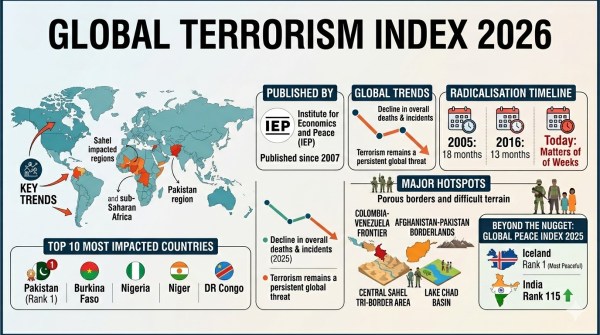
1. India ranks 13th on the Global Terrorism Index 2026 published by the Institute for Economics and Peace (IEP), with a score of 6.43.
 (AI generated)
2. It reflects an improvement and a drop in terror-related incidents and deaths by roughly 43%. India accounted for about 2 per cent of global terrorism deaths.
3. Section 15 of the stringent Unlawful Activities Prevention Act (UAPA) defines a terrorist act, as an act done with the intent, or likely to threaten, the unity, integrity, security, economic security or sovereignty of India, or with the intent, or likely, to strike terror in people or any section of people in India or abroad.
4. It covers specified acts involving weapons, hazardous substances, disruption of essential services, attacks on public functionaries and other forms of coercion.
5. Under Section 113 of the Bharatiya Nyaya Sanhita (BNS), a terrorist act is defined as an act that intends to threaten the unity, integrity, sovereignty, security, or economic security of India, or to intimidate the general public (or a section of it).
Post Read Question
Consider the following statements regarding PRAHAAR:
1. It is India’s first comprehensive National Counter-Terrorism Policy and Strategy.
2. It is based on a seven-pillar framework, including prevention, human rights and rule of law, international cooperation, and recovery and resilience.
3. There is no legal definition of terrorism adopted globally or by India.
Which of the statements given above is/are correct?
(a) 1 and 2 only
(b) 2 and 3 only
(c) 1 and 3 only
(d) 1, 2 and 3
Answer: (a)
(Sources: Amit Shah calls for 10-year PRAHAAR on terror, Surgical strikes, Op Sindoor bold examples of India’s counter-terrorism policy: PM Modi, Rajnath flags ‘perimeter fallacy’, ‘deterrence by punishment’: What do these terms mean?, Explained: What is ‘Prahaar’, India’s first counter-terrorism policy?)
🚨Click here to read the UPSC Essentials magazine for September 2026. Share your views and suggestions in the comment box or write to us at manas.srivastava@indianexpress.com.🚨
🚨Subscribe to our UPSC newsletter. Stay updated with the latest UPSC articles by joining our Telegram channel – Indian Express UPSC Hub, and follow us on Instagram and X


Raveena Baneta is a consultant with the UPSC section of The Indian Express where she writes on Ethic... Read More
 Share


