


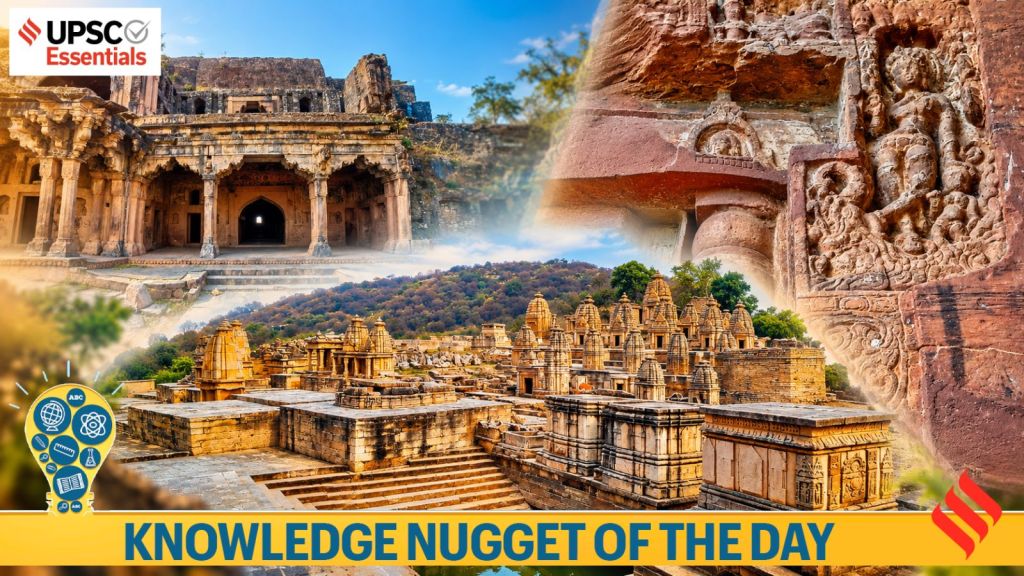
 India's UNESCO Tentative List grows by five in 2026, taking the total to 78.
Take a look at the essential events, concepts, terms, quotes, or phenomena every day and brush up your knowledge. Here’s your UPSC Current Affairs knowledge nugget for today on new heritage sites added to India’s UNESCO Tentative List.
Recently, five new sites and transnational proposals have been included in India’s UNESCO Tentative List and it increases India’s count to 78. In this context, it becomes essential to know about the newly added sites and understand what Tentative List of UNESCO’s World Heritage Sites is all about.
2. After the United Nations Educational, Scientific and Cultural Organisation (UNESCO) includes a property in the Tentative List, that country has to prepare a nomination document that will be considered by the UNESCO World Heritage Committee.
3. In India, the Indian National Commission for Co-operation with UNESCO (INCCU), and the Archaeological Survey of India (ASI) are the bodies which play a key role in this regard
4. The newly added sites include the Buddhist murals of Bagh Cave Paintings, Group of Temples of the Chambal Valley, the Gupta-era Udaigiri Caves, the tribal legacy of Ginnorgarh, and Sites of Satyagrah.
5. Group of Temples of the Chambal Valley: It is unique cluster of early medieval temples built between the 8th and 11th centuries CE, representing an important phase in the evolution of regional Nagara-style temple architecture.
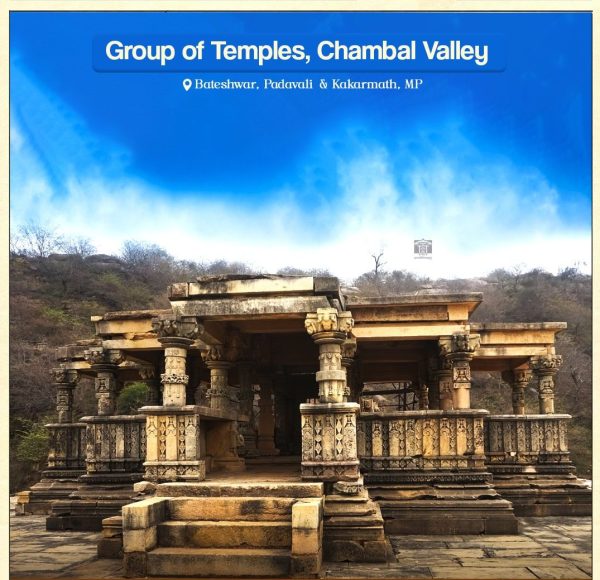 The Group of Temples of the Chambal Valley, Bateshwar, Padavali and Kakarmath, has been added to India’s UNESCO Tentative List. (Image: X/ASIGoI)
6. Udaigiri Caves: It is a rock-cut sacred ensemble developed under Gupta patronage in the 4th and 5th centuries CE. The site includes 20 caves, sculptures and inscriptions, including the Varaha form of Vishnu in Cave 5 and Anantasayana Vishnu in Cave 13.
7. The Sites of Satyagraha: It is a serial transnational proposal connecting India and South Africa. It includes nine properties across South Africa and India, including Sabarmati Ashram, Mani Bhavan Complex, Harijan Sevak Sangh Complex, Sevagram Ashram, Aga Khan Palace and Gandhi Smriti Residence in India, along with Pietermaritzburg Railway Station and Phoenix Settlement in South Africa.
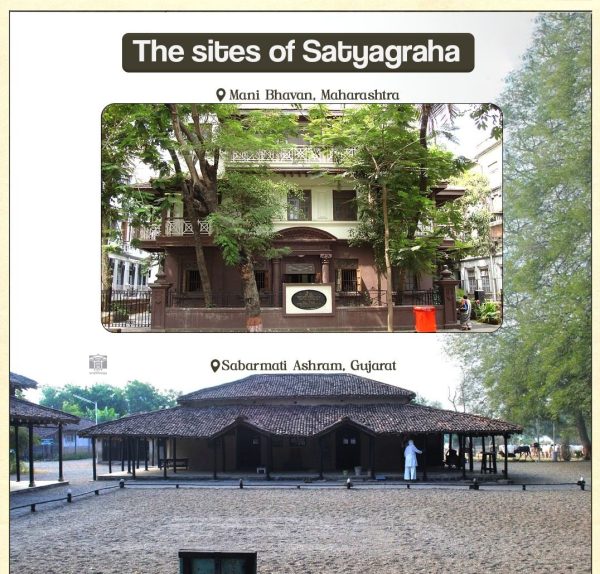 The Sites of Satyagraha includes nine properties across South Africa and India. (Image: X/ASIGoI)
8. Ginnorgarh Fort: It was a major political and administrative centre of the Gond kingdom from the early 16th to early 18th century. The fort includes palace buildings, stepwells, reservoirs, wall paintings and an ingenious water management system.
9. Bagh Cave Paintings: It is a group of nine rock-cut Buddhist caves, mainly in use from the 4th to 6th century CE. Their murals, particularly those in Cave 4, are significant examples of post-Ajanta Buddhist cave paintings.
10. UNESCO plays a vital role in safeguarding cultural and natural heritage across the globe. Its primary objective is to identify, protect, and preserve sites that hold outstanding value for humanity.
11. It is guided by the Convention Concerning the Protection of the World Cultural and Natural Heritage, an international treaty adopted by UNESCO in 1972. As of 2024, 196 States Parties have ratified the World Heritage Convention.
12. The World Heritage Site is a location recognised for its “outstanding universal value”. This signifies “cultural and/or natural significance which is so exceptional as to transcend national boundaries and to be of common importance for present and future generations of all humanity”.
13. The World Heritage Site falls into three categories: cultural heritage, natural heritage, and mixed heritage (cultural as well as natural).
14. Cultural heritage entails an Outstanding Universal Value from the point of view of history, art or science, and includes monuments, groups of buildings, and sites which are the combined work of nature and human agency. Examples include the Taj Mahal, the Statue of Liberty, and the Sydney Opera House.
15. The Sites under natural heritage are those having an Outstanding Universal Value from the point of view of science, conservation or natural beauty, such as the Sundarbans Natural Park or the Victoria Falls.
16. Notably, the concept of World Heritage is universally applicable. According to UNESCO’s website, ‘World Heritage sites belong to all the peoples of the world, irrespective of the territory on which they are located’.
17. In the 48th session of the World Heritage Committee which was held in Busan (South Korea), 25 new properties were inscribed in the World Heritage list, out of which 19 are cultural, 5 are natural, and 1 is mixed.
18. Sarnath has been inscribed on UNESCO’s World Heritage List in the 48th session of the World Heritage Committee.
19. With the inscription on UNESCO’s World Heritage List, Sarnath becomes India’s 45th and Uttar Pradesh’s fourth World Heritage Site. Sarnath is the sacred land where Lord Buddha, after attaining enlightenment, delivered his first sermon to humanity and set in motion the ‘Dharmachakra Pravartan’. Counted among the holy pilgrimage sites of Buddhism, Sarnath is described in ancient Buddhist scriptures such as Rishipattan.
20. Notably, Sarnath was included in UNESCO’s tentative list on July 3, 1998. Twenty-eight years on, it has been officially designated a World Heritage Site. Until now, the UP’s three World Heritage Sites were the Taj Mahal, Agra Fort and Fatehpur Sikri — all in the Agra region.
1. The List of World Heritage in Danger is designed to inform the international community of conditions which threaten the very characteristics for which a property was inscribed on the World Heritage List, and to encourage corrective action.
2. Dangers can be ‘ascertained’, referring to specific and proven imminent threats, or ‘potential’, when a property is faced with threats which could have negative effects on its World Heritage values.
3. At its 43rd session (Baku, 2019), the World Heritage Committee recalled that the inscription of a property on the List of World Heritage in Danger, aims to marshal international support to help the State Party effectively address the challenges faced by the property by engaging with the World Heritage Centre and the Advisory Bodies to develop a programme of corrective measures to achieve the Desired state of conservation for the property.
4. Armed conflict and war, earthquakes and other natural disasters, pollution, poaching, uncontrolled urbanization and unchecked tourist development pose major problems to World Heritage sites.
5. Some sites inscribed on the List of World Heritage in Danger are Bamiyan Valley in Afghanistan, the Historic Town of Zabid in Yemen, the Iranian city of Bam, etc.
Consider the following statements regarding UNESCO’s Tentative List of World Heritage Sites:
1. It is an inventory of properties that a country considers to have potential Outstanding Universal Value.
2. Inclusion in the Tentative List automatically grants a property UNESCO World Heritage Site status.
3. India’s UNESCO Tentative List has total 78 sites.
Which of the statements given above is/are correct?
(a) 1 and 2 only
(b) 2 and 3 only
(c) 1 and 3 only
(d) 1, 2 and 3
Answer Key
(c)
(Sources: whc.unesco.org, UPSC Issue at a Glance | India’s UNESCO World Heritage Sites — criteria, categories, and recent additions, Sarnath joins UNESCO World Heritage List: How it was ‘rediscovered’ and other facts)
Click here to read the UPSC Essentials magazine for September 2026. Subscribe to our UPSC newsletter. Stay updated with the latest UPSC articles by joining our Telegram channel – Indian Express UPSC Hub, and follow us on Instagram and X

Read UPSC Magazine