Knowledge Nugget | How does India’s first LNG-powered train work and differ from hydrogen train?
India’s railways is exploring alternative fuels beyond diesel. But how does the new LNG-diesel dual-fuel train work? How is it different from India’s first hydrogen train? What are the benefits of LNG, and how does KAVACH make train operations safer? Here's what you need to know.
The train uses a dual-fuel system, which allows the same engine to use both LNG and diesel. (Image: Railways)
Take a look at the essential events, concepts, terms, quotes, or phenomena every day and brush up your knowledge. Here’s your UPSC Current Affairs knowledge nugget for today on India’s first LNG-powered train.
Knowledge Nugget: India’s first LNG-powered train
Subject: Science and Technology
Why in the news?
After launching the country’s first hydrogen train on July 17, 2026, Indian Railways has now introduced another alternative-fuel train based on Liquefied Natural Gas (LNG). The LNG-powered train was launched from Sabarmati in Gujarat on September 27. In this context, let’s know about it and India’s first hydrogen train.
Advertisement
Key Takeaways:
1. The new LNG train follows the hydrogen train as another alternative-fuel railway project. However, there is an important difference. The LNG train is not a completely LNG-only train.
2. Developed by Chennai-based Integral Coach Factory (ICF), the new train uses an LNG-diesel dual-fuel system which allows its engine to run on both LNG and diesel. The system allows LNG to replace around 40 per cet of diesel. The move is aimed at reducing diesel consumption, fuel costs and emissions while encouraging the use of alternative fuels in railway operations.
3. The LNG-diesel dual-fuel system also gives the train flexibility because it does not have to depend entirely on LNG. Depending on fuel availability, the engine can switch between LNG and diesel. This also means that train operations can continue even if LNG is not available. Another benefit is that LNG can allow the train to cover a longer distance before refuelling.
Advertisement
4. Indian Railways expects the use of LNG to reduce diesel consumption and emissions from the engine. The technology can help reduce pollutants such as carbon dioxide (CO₂), nitrogen oxides (NOx) and particulate matter (PM). The initiative is therefore aimed at promoting cleaner and more environment-friendly rail transportation.
5. The use of LNG can also reduce fuel costs because LNG is cheaper than diesel. Based on the trial data, Indian Railways estimates savings of around Rs 11.9 lakh per year from one DPC. For an 8-coach rake, the estimated annual saving is around Rs 23.9 lakh, it said.
6. During its inaugural run, the first LNG-diesel dual-fuel DEMU train operates between Sabarmati and Mahesana Junction. The train is an 8-coach, non-AC chair car train. Its regular route has not yet been finalised and will be announced after the route is confirmed.
7. Each DPC has been fitted with an LNG tank with a capacity of around 2,200 litres. The tank can hold approximately 950–1,000 kg of usable LNG.
8. According to the approved design, a fully loaded LNG tank in one DPC can provide enough fuel for around 444 km of daily operation. This can reduce the need for frequent refuelling.
India’s first hydrogen train
9. Indian Railways flagged off its first hydrogen train between Jind and Sonipat on July 17, 2026. According to the Ministry of Railways, the hydrogen train had travelled more than 1,200 km by July 25 and saved more than 3,200 litres of diesel.
10. Unlike a conventional diesel train, the hydrogen train generates electricity onboard through a chemical reaction between hydrogen and oxygen. Its only direct by-product is water vapour, with no smoke or direct tailpipe carbon emissions.
11. The train has 10 coaches, including two Hydrogen Driving Power Cars, and delivers a total power output of 2,400 kW. It also uses lithium iron phosphate batteries and hydrogen storage cylinders.
What is the difference between hydrogen and LNG trains?
12. The two trains use different alternative-fuel technologies. The hydrogen train generates electricity onboard through a fuel-cell system using hydrogen and oxygen. Water vapour is the direct by-product.
13. The LNG train, on the other hand, uses an internal-combustion engine converted to a dual-fuel LNG-diesel system.
14. In simple terms, the hydrogen train represents a fuel-cell-based propulsion system, while the LNG train is an alternative-fuel system that works alongside diesel.
SCIENCE & TECHNOLOGY · UPSC KNOWLEDGE NUGGET
India's first LNG-powered train
Built by ICF, Chennai and launched from Sabarmati on September 27, it runs on an LNG-diesel dual-fuel system.
~40%
of diesel can be replaced by LNG in the dual-fuel system
Dual-fuel
One engine runs on both LNG and diesel
Switchable
Engine switches between LNG and diesel depending on fuel availability
FUEL FLEXIBILITY
Runs even when LNG is unavailable
The train does not depend entirely on LNG, so operations can continue without it. LNG can also let the train cover a longer distance before refuelling.
HYDROGEN TRAIN
Fuel cell
Generates electricity onboard from hydrogen and oxygen. Direct by-product: water vapour.
LNG TRAIN
Combustion
Internal-combustion engine converted to a dual-fuel LNG-diesel system.
IN SIMPLE TERMS
Two different technologies
The hydrogen train is a fuel-cell-based propulsion system. The LNG train is an alternative-fuel system that works alongside diesel.
BEYOND THE NUGGET
What is Kavach?
India's indigenous Automatic Train Protection (ATP) system, developed by RDSO with Indian industry. If a loco pilot inadvertently skips a red signal, it automatically activates the train's brakes.
1
Signal Passing at Danger (SPAD)
Guards against a red signal being skipped.
2
Head-on collisions
Detects trains approaching on the same track and alerts the loco pilot.
3
Rear-end collisions
Applies brakes automatically in critical situations.
Indian Express InfoGenIE
BEYOND THE NUGGET: What is KAVACH?
1. Kavach is India’s indigenous an Automatic Train Protection (ATP) systemdeveloped by the Research Design and Standards Organisation in collaboration with the Indian industry to prevent train collisions by automatically activating the braking system of the train.
2. This technology features an electronic device linked with radio frequency identification systems positioned at stations, trains and tracks. If a loco pilot inadvertently skips a red signal, Kavach automatically activates and controls the train’s braking systems.
3. Additionally, the system detects any trains approaching the same tracks, taking necessary actions to avert collisions and alerting the loco pilot.
4. Train Collision Avoidance System (TCAS) or Kavach includes the key elements from already existing, and tried and tested systems like the European Train Protection and Warning System, and the indigenous Anti Collision Device.
5. Some advantages of KAVACH are:
(i) Allows trains to operate at permissible speeds.
(ii) Assists loco pilots in preventing Signal Passing at Danger (SPAD).
(iii) Provides continuous speed supervision.
(iv) Displays signal aspects and movement authority in the loco pilot’s cab.
(v) Offers protection against potential collisions.
6. The Kavach makes rail operation safer by applying brakes in trains in critical situations. The system automatically protects against Signal Passing at Danger (SPAD), Head-on and rear-ends collision risks.
7. The latest version KAVACH Version 4.0 includes enhanced safety features, improved reliability and upgraded technology for train operations, and is planned for wider deployment across Indian Railways.
Post Read Question
Consider the following statements regarding India’s first LNG-powered train:
1. It uses an LNG-diesel dual-fuel system.
2. LNG can replace around 40 per cent of diesel used by the train.
3. The train uses a hydrogen fuel-cell system to generate electricity onboard.
Which of the statements given above is/are correct?

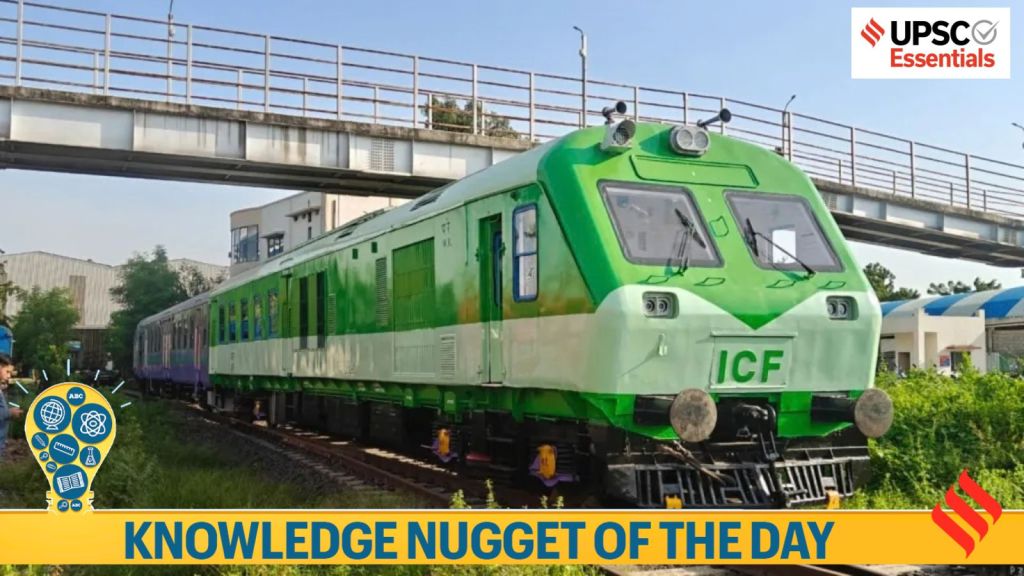 The train uses a dual-fuel system, which allows the same engine to use both LNG and diesel. (Image: Railways)


 Share


