2. The findings of the report, dated September 24, coincide with drought declarations in Maharashtra and Karnataka.
3. The CWC report has particularly painted a grim picture of water storage in 92 reservoirs located in the south, east and northern India regions. South India (Andhra Pradesh, Telangana, Karnataka, Kerala and Tamil Nadu) has the lowest water reserves this year.
4. Except for Odisha and some parts of West Bengal, east and northeast regions have seen a seasonal deficit of 25% in water reserves.
5. In northern India, water reserves in 11 dams spanning Himachal Pradesh, Punjab and Rajasthan have plummeted from 92.3% last year to 62% (12.431 BCM) of the total storage capacity this year.
Why are India’s reservoirs at a low capacity?
6. One of the factors shrouding the monsoon season is the El Nino – a naturally occurring global ocean-atmospheric phenomenon in the Pacific Ocean which results in erratic rainfall and above normal temperatures.
7. Since late August, rainfall deficit and prolonged dry spells have been linked to the strengthening of the El Nino. As of September 28, India received rainfall 12% short of the normal.
8. Deficit in rainfall was recorded during June (-35.4%) and August (-16.3%) with July recording just about 1% above normal and September 01-28 (-5%).
9. With the monsoon about to exit, there is little to no hope for any significant improvement in the reservoir stocks this season.
(For your information: Water security is an important theme for the UPSC CSE exam. In this article we will look at important freshwater sources for India and the world. We will also understand if India is water secure, water stressed or water scarce. You are encouraged to ponder upon initiatives and measures taken by the government to ensure water security in India).
Where does India’s freshwater come from?
1. India, home to 18 per cent of the world’s population and 15 per cent of its livestock, depends on just 4 per cent of global freshwater resources.
2. Southwest monsoon brings over 70 per cent of India’s annual rainfall. Lasting from June through September, this helps replenish the water reservoirs and other surface water bodies that make the primary sources of drinking water, for hydel power generation, irrigation, and other purposes.
3. The Indian Himalayan Region (IHR) (known as Water Tower of Asia) stretching approximately 2,500 km is the source of major river systems, including the Indus, Ganges, and Brahmaputra, fed by glaciers and numerous springs.
4. The Godavari, Krishna, Mahanadi, Narmada, Tapi, Cauvery and Pennar are major peninsular river systems. Unlike Himalayan rivers, they are predominantly rain-fed, with much greater dependence on the monsoon.
5. Other sources are lakes, ponds, tanks and reservoirs which also largely depend on rainwater. Moreover, India heavily relies on freshwater stored in ground for irrigation, domestic supply and industrial use.
6. The Central Ground Water Board (CGWB)’s 2024 assessment says India’s annual groundwater recharge stands at 446.90 BCM, and extraction stands at 60.47% of its annual extractable resource.
7. The World Bank states that India abstracts about 245 BCM of groundwater annually, which represents approximately 25% of global groundwater abstraction. It describes India as the world’s largest groundwater user.
How severe is India’s water stress?
8. The World Bank defines water scarcity as a situation when annual per capita water availability drops below 1000 cubic metres (m³) and when safe and usable water falls short of the total demand.
9. According to the Falkenmark Index, a region with per capita annual renewable water below 1700 m³ is considered under ‘water stress’, and if it further falls below 1000 m³, it will be chronic ‘water scarcity’.
10. CWC in its study titled ‘Assessment of Water Resources of India 2024’ estimated that India’s average annual water availability, between 1985 and 2023, stood at 2,115.95 billion cubic meters (BCM).
11. According to the Central Water Commission, India’s per capita water availability has significantly decreased from 5,177 m³ in 1951 to 1,486 in 2021 and is projected to decline further to 1,367 m³ by 2031.
12. As per a report by NITI Aayog, India’s per capita water is projected to be at 1140m³ by 2050. About 820 million people have close to or lower than 1000m³ per capita water availability, putting pressure particularly on Indian cities.
13. CWC’s latest assessment shows that live storage in 178 major reservoirs stood at 70% of their total capacity — a 10-year low.
14. According to CGWB’s 2024 assessment, 11.13% of India’s groundwater assessment units are already over-exploited, while another 13.59% are critical or semi-critical.
15. A NITI Aayod report in 2018 said that nearly 50% of springs in the IHR are either drying up or have already dried up.
16. Rapid unplanned urbanisation, encroachment of existing water bodies, extreme heat, and water shortages have become a recurring annual crisis. Shimla (2018), Chennai (2019) and recently Bengaluru (2024), all have faced ‘Day Zero’ like situations.
BEYOND THE NUGGET: UN’s Water Bankruptcy Report 2026
1. The United Nations University Institute for Water, Environment and Health (UNU-INWEH) released a new report titled “Global Water Bankruptcy: Living Beyond Our Hydrological Means in the Post-Crisis Era”.
2. As per the report, nearly 75% of the world’s population lives in countries classified as water-insecure or critically water-insecure.
3. Around 70% of the world’s major aquifers show long-term declining trends.
4. Around 3 billion people and more than half of the world’s food production are located in areas where total water storage is already declining or unstable.
5. More than 170 million hectares of irrigated cropland are under high or very high water stress.
Post Read Question
Consider the following statements:
1. Globally, the quantity of freshwater stored in ice caps, glaciers and permanent snow is greater than fresh groundwater.
2. Globally, freshwater stored as groundwater is much greater than that stored in rivers and lakes.
3. India accounts for about 50% of global groundwater abstraction.
Which of the statements given above are correct?
(a) There are two correct statements, that include statement 2.
(b) There are two correct statements, that are statements 1 and 3.
(c) There is only one correct statement.
(d) All three statements are correct.
Answer: (a)
(Sources: At 70%, India’s water reserves at 10-year low, Water crisis in India: stories of distress, gender disparities, and complex societal responses, Himalayan springs are drying. It’s a threat to India’s ecological stability and national security, Knowledge Nugget: UN’s ‘Water Bankruptcy’ Report — what UPSC aspirants must know, How much water does India have available? Here is what Central Water Commission found)
🚨Click here to read the UPSC Essentials magazine for September 2026. Share your views and suggestions in the comment box or write to us at manas.srivastava@indianexpress.com.🚨
🚨Subscribe to our UPSC newsletter. Stay updated with the latest UPSC articles by joining our Telegram channel – Indian Express UPSC Hub, and follow us on Instagram and X

 India’s freshwater resources come from diverse sources, including monsoon, Himalayan glaciers, rivers, reservoirs, lakes, ponds and groundwater. (Representational image generated by AI)

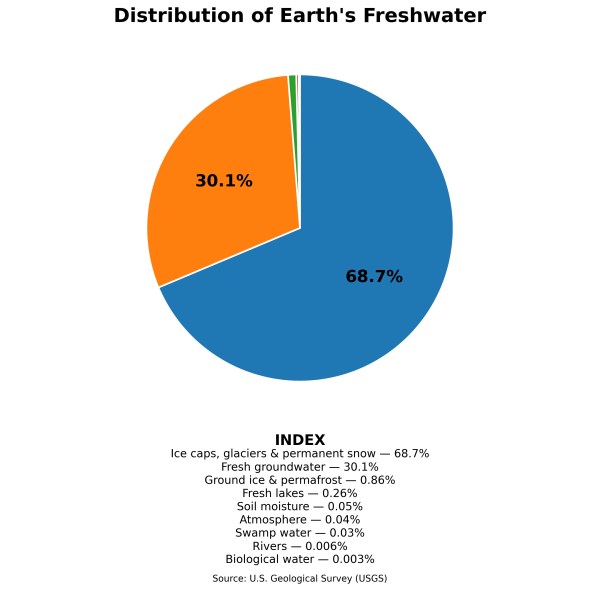 (Global freshwater distribution chart created using AI)


 Share


