


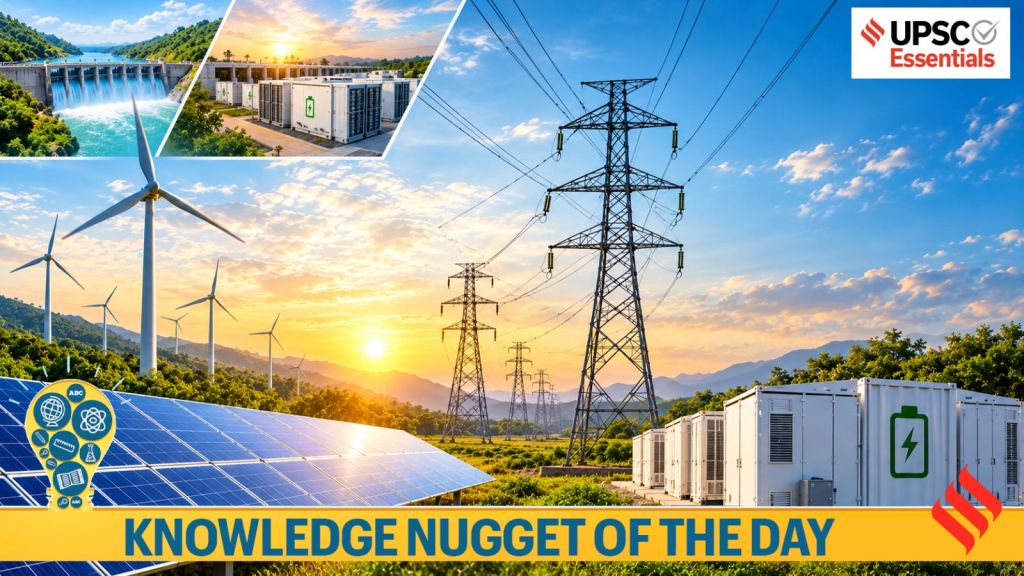
 The Ministry of New and Renewable Energy (MNRE) is implementing the Green Energy Corridor in two phases. (Image: AI-generated)
Take a look at the essential events, concepts, terms, quotes, or phenomena every day and brush up your knowledge. Here’s your UPSC Current Affairs knowledge nugget for today on Green Energy Corridor Phase-III.
The Union Cabinet on September 30 approved the Green Energy Corridor Phase-III (GEC-III) scheme, aimed at enabling the evacuation of up to 135 gigawatts (GW) of renewable energy across states. In this context, let’s know about this scheme in detail along with the challenges of the renewable energy sector.
1. With a total outlay of Rs 1,86,405 crore, the scheme is targeted for completion by FY33. The Ministry of New and Renewable Energy (MNRE) is implementing the Green Energy Corridor in two phases to augment transmission lines and transformation capacity through intra-state transmission (InSTS) and inter-state transmission (ISTS) networks.
2. The Green Energy Corridor Phase-III scheme is aimed strengthen India’s Intra-State Transmission System to enable evacuation of up to 135 Gigawatts (GW) of renewable energy across states/union territories.
3. It is aimed at tackling a festering problem in India’s power sector — even as the peak power demand has been surging to record highs, the grid operators have been forced to curtail electricity generated by solar power sources due to transmission bottlenecks.
4. The scheme also, for the first time under the Green Energy Corridor programme, includes a dedicated battery energy storage component, with provisions for deploying 50 GWh of Battery Energy Storage Systems (BESS) at renewable energy developer/generator sites or other locations of importance to the grid.
5. The inclusion of the battery component in the scheme comes as the country’s rapidly expanding renewable energy sector is grappling with a major challenge of transmission constraints.
|
Do you Know? Story continues below this ad During FY26, around 6,900 gigawatt-hour (GWh) of clean electricity faced restrictions due to a mismatch between the rapid pace of renewable energy deployment and commissioning of associated transmission infrastructure, latest government data shows. |
6. According to the government, the storage capacity is intended to address intermittency, transmission congestion and peak-hour curtailment, while helping meet demand during non-solar hours.
7. Of the total outlay, Rs 1,36,378 crore has been earmarked for developing intra-state transmission systems, while Rs 50,000 crore has been allocated for 50 GWh of BESS. The scheme will involve total Central Financial Support of Rs 54,082 crore.
8. “The Central Financial Assistance (CFA) will help in offsetting the Intra-State transmission charges and thus keep the power costs down. Thus, the government support will ultimately benefit the end users — the citizens of India,” the government said in a statement.
9. All Greenfield projects under the InSTS component will be implemented through Tariff Based Competitive Bidding (TBCB) mode, while brownfield upgradation and network strengthening works will be executed under Cost Plus Basis (CPB).
10. The State Transmission Utilities will be the overall implementing agency, and Transmission Service Providers (TSPs) will participate under TBCB on a Build-Own-Operate-Maintain (BOOM) model.
11. Under GEC Phase-II, which is being implemented in seven states — Gujarat, Himachal Pradesh, Karnataka, Kerala, Rajasthan, Tamil Nadu and Uttar Pradesh — the target is to add 7,863 ckm of transmission lines and 24,388 MVA of substation capacity.
12. The scheme is expected to help in achieving the target of 900 GW installed Non-Fossil capacity by 2035.
13. “The scheme will also contribute to long term energy security of the country and promote ecologically sustainable growth by reducing carbon footprint. It will generate large direct & indirect employment in the power sector, manufacturing, and construction industries, ” the government said in a statement.
14. Transmission bottlenecks are one of the biggest challenges faced by the renewable energy sector. During April-June, when the peak power demand touched a record high of 270 GW, the grid operators had to curtail 8,133 GWh of electricity generated by solar power sources due to transmission bottlenecks and to maintain grid security, Ministry of New and Renewable Energy (MNRE) had informed the Parliament in July.
15. Curtailment — when grid operators ask renewable energy plants to reduce generation to maintain system stability — translates into a substantial loss of clean electricity at a time when India plans to expands renewable energy capacity to meet its clean energy targets of 500 GW by 2030 from the present 295 GW.
1. As India rapidly scales up its renewable energy capacity to meet its climate goals, a key challenge is emerging for its power system — electricity supply that is abundant in some hours but insufficient in others. The mismatch between when electricity is generated and when it is needed presents a big challenge. This is where deploying systems that “store” energy becomes critical.
2. Energy storage refers to systems that can store excess renewable electricity during periods of high generation and discharge it when demand rises but power generation remains low.
3. At its core, energy storage systems convert electricity from renewable sources such as solar and wind, when it is available, into forms that can be stored. Later, it converts these back into electricity when need arises.

4. A range of energy storage technologies are being deployed globally. Among them, pumped hydro storage (PHS) and battery energy storage systems are currently the most widely used.
5. PHS uses surplus electricity to pump water from a lower reservoir to a higher one. When electricity demand peaks, it releases the stored water downhill through turbines to generate power.
6. BESS technology stores electricity chemically and discharges it when needed. Lithium-ion batteries, particularly lithium iron phosphate (LFP) batteries, are currently the dominant technology for grid-scale storage because of their falling costs, high efficiency and long operational life.
7. Concentrating solar-thermal storage systems: This technology uses mirrors that capture and focus sunlight onto a receiver. As the receiver gets heated, materials such as molten salt are circulated inside the receiver to store the heat. The stored heat can later be used to produce steam. This steam is converted into mechanical energy in a turbine, which powers a generator to produce electricity.
8. Compressed-air energy storage systems use excess electricity to compress air and store it in underground caverns or tanks. When power demand rises, the compressed air is released to drive turbines and generate electricity.
9. Flywheel energy storage systems store electricity as rotational energy by spinning a rotor at extremely high speeds. Because they can inject power into the grid almost instantly, they are particularly useful for maintaining grid stability and managing short-term fluctuations.
10. Gravity energy storage systems use electricity to lift heavy weights to higher elevations. When electricity is needed, the weights are lowered, converting gravitational energy back into electricity through generators.
Consider the following statements regarding the Green Energy Corridor Phase-III scheme:
1. The Ministry of New and Renewable Energy is implementing this scheme.
2. It is aimed strengthen India’s Intra-State Transmission System to enable evacuation of up to 135 Gigawatt (GW) of renewable energy.
3. The Scheme involves a Central Financial Support.
How many of the statements given above is/are correct?
(a) Only one
(b) Only two
(c) All three
(d) None
Answer key
(c)
(Sources: India clears Rs 1.86 lakh crore green energy corridor scheme with battery storage, UPSC Weekly Concepts Snapshot: Energy storage technologies, Bond Yield and ENSO)
Click here to read the UPSC Essentials magazine for September 2026. Share your views and suggestions in the comment box or write to us at manas.srivastava@indianexpress.com.🚨
Subscribe to our UPSC newsletter. Stay updated with the latest UPSC articles by joining our Telegram channel – Indian Express UPSC Hub, and follow us on Instagram and X

Read UPSC Magazine