
Key Takeaways:
1. The two notified offshore mineral blocks are West Sewell Ridge-01, off Great Nicobar Island, covering 1,000 square kilometres, and Sewell Rise-01, in the southern part of Sewell Rise near Great Nicobar Island, covering 632 square kilometres.
2. Situated at the southern tip of the Andaman and Nicobar Island group in the Bay of Bengal, the Great Nicobar Island is also the site of the central government’s Rs 72,000 crore mega infrastructure project, which includes a transshipment port, an airport, a gas and solar power plant, and two greenfield coastal cities.
3. The project has faced criticism over its potential environmental impact, including potential harm to coral reefs, leatherback turtle nesting sites, Nicobar megapode nesting mounds, and the ancestral lands of the Great Nicobarese Scheduled Tribe community.
4. The government, however, has maintained that the Offshore Areas Mineral (Development and Regulation) Act, 2002, which governs offshore mining, contains adequate safeguards to protect ecological balance, biodiversity and the interests of fishermen.
What are Polymetallic nodules?
5. Polymetallic nodules are seabed mineral deposits containing metals such as nickel, cobalt, manganese, copper and rare earth elements.
6. They are product of autogenetic crystallization, created around a crystalline nucleus in the zones of the deep ocean floor.
7. Deep-sea polymetallic nodules are an important source of critical minerals, which are essential for electric vehicles, renewable energy systems, advanced batteries, and high-technology manufacturing.
8. As per International Seabed Authority (ISA) wesbite, polymetallic nodules are more abundant in areas off the west coast of Mexico in the Pacific (known as the Clarion-Clipperton Fracture Zone), the Central Indian Ocean Basin, and the Peru basin.
Why is deep ocean exploration crucial?
9. With India’s 11,098 km-long coastline, the government has long pushed for a blue economy policy — harnessing ocean resources for economic growth.
10. The deep ocean is home to several unexplored minerals, food, fuels, gas hydrates and biodiversity resources like fish and nutraceuticals.
11. It is also where a crucial medium of modern global telecommunications is found in the form of undersea cables, which are laid on the ocean floor.
12. Thus, it is essential to harness these resources to maximise India’s blue economy potential by supporting fisheries and aquaculture, tourism, livelihoods and blue trade.
13. Considering the importance of the oceans on sustainability, the United Nations (UN) has declared the decade, 2021-2030 as the Decade of Ocean Science for Sustainable Development.
14. Beyond exploiting the oceans’ resources, mapping of the deep sea and maintaining a high degree of underwater domain awareness is critical for safeguarding maritime and security interests.
How is deep ocean exploration regulated?
15. Countries manage their own maritime territory and exclusive economic zones, while the high seas and the international ocean floor are governed by the United Nations Convention on the Law of the Seas (UNCLOS). It is considered to apply to states regardless of whether or not they have signed or ratified it.
16. Under the treaty, the seabed and its mineral resources are considered the “common heritage of mankind” that must be managed in a way that protects the interests of humanity through the sharing of economic benefits, support for marine scientific research, and protecting marine environments.
17. According to the UNCLOS, the Exclusive Economic Zone (EEZ) of a country extends from the baseline of its coast to 200 nautical miles (about 370 km) into the sea. A nation has exclusive rights to living and non-living resources in the waters and on the seabed within its EEZ.
BEYOND THE NUGGET: What is Samudra Manthan Scheme?
1. The Union Cabinet in August this year gave its nod to a Rs 84,084-crore scheme aimed at boosting oil and gas exploration and production from the country’s offshore basins, and reducing the dependence on imported energy.
2. The ambitious ‘Samudra Manthan’ scheme, or the National Offshore Exploration Scheme is a Central Sector Scheme of the Ministry of Petroleum & Natural Gas.
3. It will provide financial support for exploratory drilling in deep-sea and ultra-deep-sea areas and support building of common infrastructure for production of discovered hydrocarbons in offshore areas, apart from funding offshore data acquisition and developing hydrocarbon manufacturing and services zones. The outlay is for implementation till financial year 2030-31.
4. The Centre expects the Samudra Manthan scheme to catalyse reserve accretion of over 600 million tonnes of oil and oil equivalent gas (mtoe), while stimulating significant investments across the oil and gas exploration and production value chain.
5. Subject to exploration success, the scheme aims to increase India’s domestic oil and gas production from around 62 mtoe to 80 mtoe annually and expand the country’s hydrocarbon resource base from 1,600 mtoe to 2,2oo mtoe.
6. The scheme will provide support of up to 50% of drilling cost or Rs 675 crore, whichever is lower, for every well drilled in deep-sea and ultra-deep-sea areas.
7. The scheme comprises four key components:
(i) acquisition and processing of modern offshore seismic data with an outlay of ₹28,534 crore;
(ii) drilling of 60 deepwater exploration wells with an allocation of ₹43,200 crore, including Government support of up to 50% of eligible drilling cost or ₹675 crore per well, whichever is lower;
(iii) development of common offshore infrastructure hubs with an outlay of ₹10,000 crore to facilitate commercialisation of discoveries; and
(iv) establishment of Oil and Gas Manufacturing and Services Zones with an outlay of ₹2,000 crore to promote domestic manufacturing and localisation of critical equipment and services
Post Read Question
The offshore mineral blocks – West Sewell Ridge-01 and Sewell Rise-01 are located in:
(a) The Arabian Sea, off the coast of Gujarat
(b) The Lakshadweep Sea, off the coast of Lakshadweep
(c) Great Nicobar Island in the Andaman Sea
(d) The Bay of Bengal, off the coast of Odisha
Answer Key
(c)
(Sources: Government notifies 2 more offshore mineral blocks for licensing near Great Nicobar Island, ‘Samudra Manthan’ Scheme)
Click here to read the UPSC Essentials magazine for September 2026. Share your views and suggestions in the comment box or write to us at manas.srivastava@indianexpress.com.🚨
Subscribe to our UPSC newsletter. Stay updated with the latest UPSC articles by joining our Telegram channel – Indian Express UPSC Hub, and follow us on Instagram and X

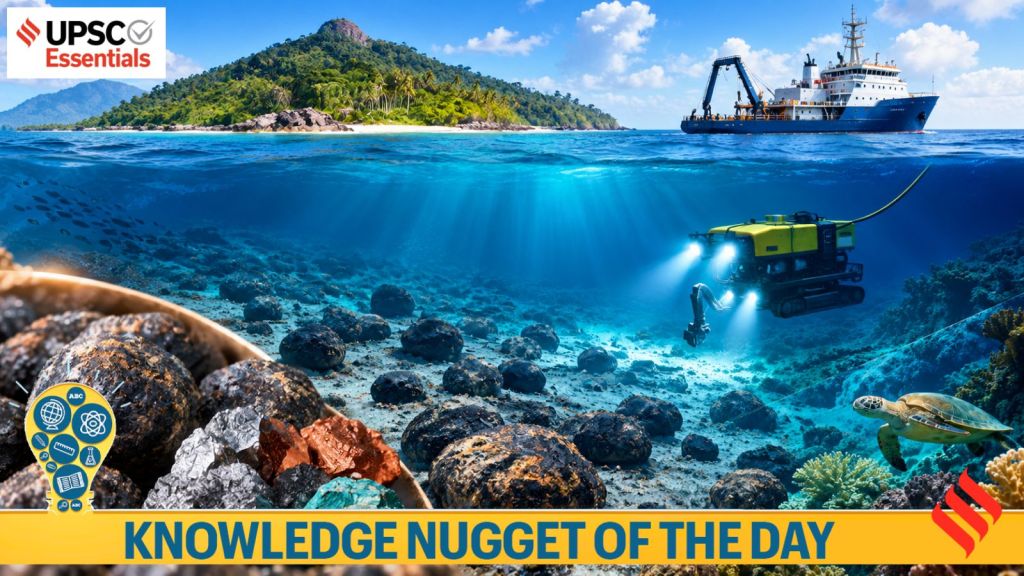 Deep-sea polymetallic nodules are an important source of critical minerals.(Image: AI-generated)


 Share


