
Knowledge Nugget | From Chandrayaan 1 to Chandrayaan 3: What has India discovered on the Moon?
Chandrayaan-1 data has helped scientists confirm the existence of a hidden impact crater on the lunar surface. How has India’s Moon mission journey unfolded, and what have Chandrayaan-1, 2 and 3 revealed about the Moon? Here's all you need to know. Also go beyond the nugget to explore the planned Chandrayaan-4 mission.
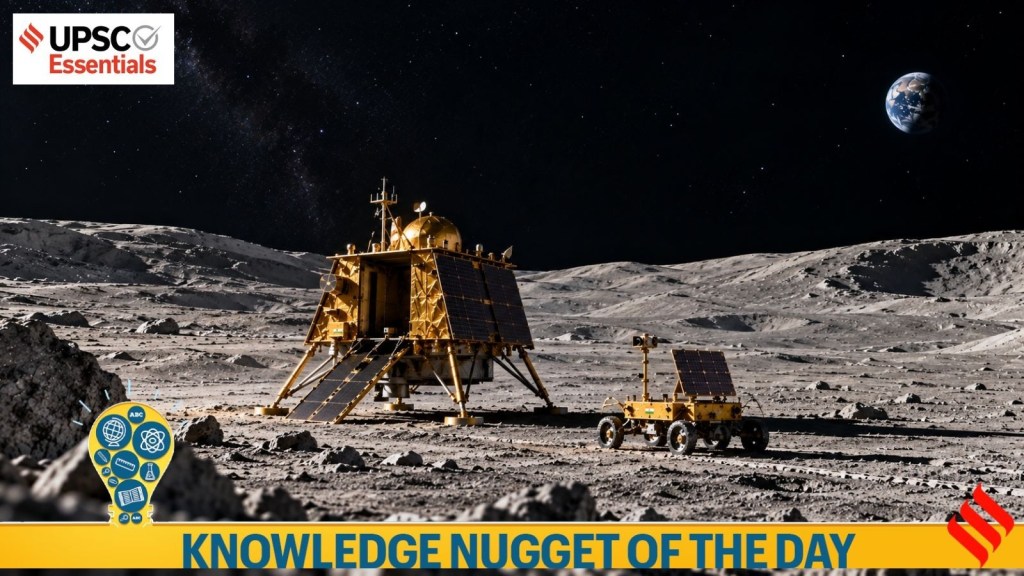 From Chandrayaan-1’s launch in 2008 to the planned Chandrayaan-4 mission, discover how India’s lunar journey has revealed water on the Moon, explored its surface and paved the way for bringing lunar samples back to Earth. (AI generated image)
Take a look at the essential events, concepts, terms, quotes, or phenomena every day and brush up your knowledge. Here’s your UPSC Current Affairs knowledge nugget for today on India’s moon missions and their major findings.
🚨As we mark the 3rd anniversary of the UPSC Essentials Magazine, we thank our readers for being part of this journey. Your trust, feedback and continued support have shaped the magazine and encouraged us to keep improving with every edition. Click Here to read the UPSC Essentials magazine for September 2026. Share your views and suggestions in the comment box or write to us at manas.srivastava@indianexpress.com.🚨

Knowledge Nugget: India’s moon missions
Subject: Science and Technology (Space)
Why in the news?
For the first time, planetary scientists have confirmed the existence of a hidden impact crater on the lunar surface using mineralogical data obtained from Chandrayaan-1 and it could predate the oldest known impact craters on the moon.
Key takeaways:
1. A team of researchers from the Physical Research Laboratory (PRL), Ahmedabad, have identified the Australe Basin, which had remained untraced as this ancient basin had suffered erosion along its rims making it extremely difficult even for modern-day imaging techniques to detect.
2. Scientists believe that there are approximately 300 impact basins present on the moon. Of these, only 74 have been detected so far.
What are impact basins?— Impact basins are formed over the lunar surface due to various violent space activities, like asteroid or meteorite hits. — These are large craters, often several hundreds of kilometres in diameters, and can have distinct outer rims. Due to the space hits, these craters are often found with remnants of volcanic activities. |
3. This new study, published in the The Planetary Science Journal, has now shed light on one such impact basin confirmed to be located along the southeastern hemisphere of the moon. It has distinct morphology and gravity signatures and some unique mineralogical compositions.
4. PRL scientists are also of the opinion that this basin could well be older than and largest and the oldest known South Pole Aitken Basin (formed over 4 billion years ago) on the Moon.
How was the Australe Basin traced ?
5. Out of 11 scientific payloads onboard the Chandrayaan-1, six were contributions from international space agencies including National Aeronautics Space Administration (NASA) and the European Space Agency.
6. The mineralogy of the Australe Basin was detected using data gathered by the Moon Mineralogy Mapper of NASA.
7. It is an imaging spectrometer that was designed to create the mineralogical map of the lunar surface. It operates between the 405 and 3000 nanometer wavelength range.
8. Scientists studied the absorption bands exhibited by some of the key lunar minerals, such as pyroxenes, olivine, and plagioclase.
9. The current study could offer detailed mineralogical insights of the region, particularly given the renewed interests shown by many countries with the proposed Moon Base mission by NASA and India’s Chandrayaan-4, a lunar sample return mission.
Let us know about India’s moon missions and their major findings in this context.
Why is Chandrayaan-1 (C-1), India’s first moon probe, significant?
1. Chandrayaan-1 was launched on October 22, 2008 by the Indian Space Research Organisation (ISRO), and communication with the spacecraft was lost on August 29, 2009, bringing the mission to an end.
2. During its roughly 10-month operational period in 2008-09, Chandrayaan-1 provided evidence of water and hydroxyl molecules on the Moon. Its data also contributed to the later confirmation of water ice in permanently shadowed regions near the lunar poles.
3. Scientists created the first map of water trapped in the uppermost layer of the Moon’s soil, using data from NASA’s Moon Mineralogy Mapper aboard C-1.
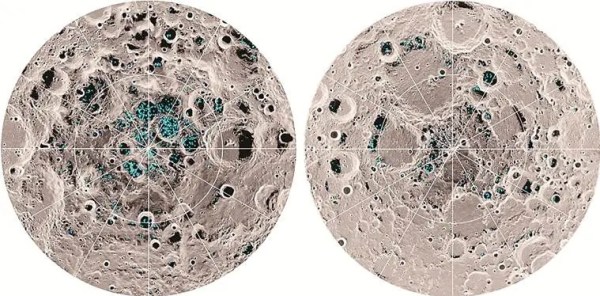 Distribution of surface ice (blue) at Moon’s south (left) and north poles, detected by NASA’s M3 instrument on board Chandrayaan-1. (Source: NASA)
4. Researchers had then said that the way the water is distributed across the Moon gives clues about its source. The distribution is largely uniform rather than splotchy, with concentrations gradually decreasing toward the equator.
5. That pattern is consistent with implantation via solar wind – the constant bombardment of protons from the Sun, which can form hydroxyl and molecular water once emplaced.
6. While most lunar water mapped in the study likely originated from solar wind, researchers found unusually high concentrations in some equatorial volcanic deposits. These may have originated deep within the Moon’s mantle and been brought to the surface by lunar magma.
What did Chandrayaan-2 (C-2) achieve?
1. The C-2 mission was successfully launched on 22nd July 2019 by GSLV MkIII-M1 from Satish Dhawan Space Centre (SDSC), Sriharikota. Subsequently, communication with lander and ground station was lost while the orbiter performed as intended with all its payloads operational.
2. Scientists have discovered new evidence suggesting the presence of subsurface water ice in permanently shadowed regions near the Moon’s south pole using data from Chandrayaan-2.
3. Previously, water was known to be present mainly in the polar regions of the Moon. C-2 found signatures of water at all latitudes, although its abundance varies from place to place.
4. The Imaging Infra-Red Spectrometer (IIRS) on board C-2 has also been able to distinguish between hydroxyl and water molecules, and found unique signatures of both.
5. Moreover, the X-ray spectrometer ‘CLASS’ on the Chandrayaan-2 Orbiter has mapped an abundance of sodium on the moon for the first time, according to ISRO.
6. The orbiter’s advanced instruments have also mapped minor and major minerals, studied surface chemical compositions, and analyzed thermo-physical characteristics of the lunar regolith.
7. Significantly, Chandrayaan-2, using its Chandra’s Atmospheric Composition Explorer-2 (CHACE-2) payload, became the first mission to directly observe the impact of solar Coronal Mass Ejections (CMEs) on the dayside lunar exosphere.
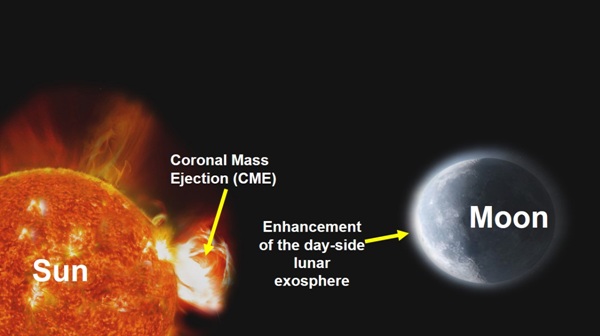 Artistic rendition of the CME hurled by the Sun towards the Moon, and its effect on the day-side lunar exosphere (for visualisation only; not up to the scale) Source: ISRO
8. The Moon’s exosphere, found close to its surface, is made up of molecules released through processes such as solar radiation, solar wind, and meteorite impacts.
9. During a CME — when the Sun ejects a burst of plasma from its outer layer — more molecules are knocked off the lunar surface, raising the density of the exosphere. Unlike Earth, the Moon lacks a magnetic field to shield it from these solar blasts, making it especially vulnerable.
What are the major findings of Chandrayaan-3 (C-3)?
1. Chandrayaan-3 became the first mission to achieve a successful soft landing near the Moon’s south pole in August 2023. India became the first country to achieve a soft landing in this region and the fourth to soft-land on the Moon.
2. Its Vikram lander and Pragyan rover conducted in-situ studies of the lunar surface, analysing rocks, soil composition, temperature variations and elemental abundance and recorded, for the first time, lunar ground vibrations in the Southern polar regions.
3. Researchers also discovered that soil at C-3’s landing site (Shiv Shakti point) is closely linked to the first lunar meteorite ever discovered on Earth.
4. Payloads onboard the Pragyan rover confirmed the unambiguous presence of Sulphur (S) on the lunar surface, alongside aluminum, iron, calcium, magnesium and silicon.
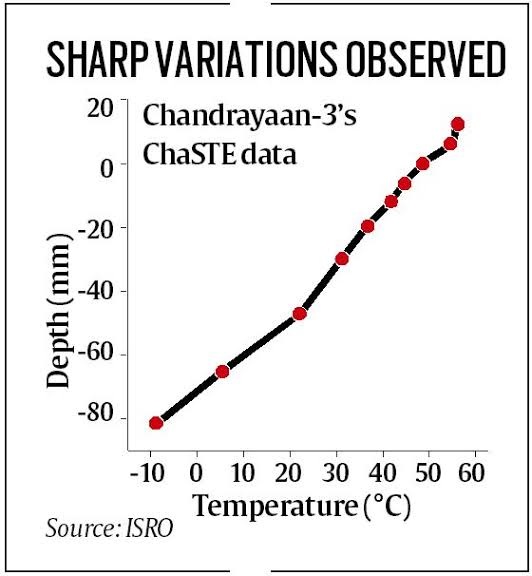
5. The Chandra’s Surface Thermophysical Experiment, or ChaSTE, an instrument onboard the lander module, has measured a sharp drop in temperatures in the lunar topsoil. At just about 10 cm below the surface, the temperature dropped to nearly -10 degrees Celsius while it was about 45 degrees Celsius on the surface, ISRO said.
6. As per ISRO, C-3’s RAMBHA-LP experiment confirmed that the lunar near-surface plasma is dynamically modulated by daytime solar wind interactions and charged particles streaming through Earth’s geomagnetic tail.
7. According to ISRO, Chandrayaan-1 and 2 have studied the Moon’s surface, sub-surface and exosphere on a global scale, from orbiter platforms. Chandrayaan-3 has been the first-ever successful lunar soft-landing and robotic exploration in the Southern polar region of the Moon.
From Chandrayaan-1 to 3: What India found on the Moon
BEYOND THE NUGGET: Chandrayaan-4 (C-4) mission
1. It will be India’s fourth mission to the Moon, planned for lunar sample return from the Southern polar region. It will have five modules as per ISRO– Ascender Module (AM), Descender Module (DM), Re-entry Module (RM), Transfer Module (TM), and Propulsion Module (PM).
2. The Chandrayaan-4 sample return mission would be a complex mission involving several stages. After getting into lunar orbit, two of the modules will detach from the main spacecraft and make a landing on the Moon.
3. They will help each other in collecting samples from the lunar surface. One of the modules will launch itself from the Moon’s surface and travel back to the main spacecraft in the lunar orbit.
4. The samples will be transferred, and then flown back to an Earth re-entry vehicle that will be launched separately from the ground. The samples will be transferred again, and it is this re-entry vehicle that will bring them back to the Earth.
5. The mission was approved by the Union Cabinet in September 2024, with an initial launch target of 2027.
Post Read Questions
(1) Consider the following statements: (HPSC HCS, 2022)
1. Statement I: Chandrayaan-2 was launched on July 22, 2019, from Sriharikota by a Geosynchronous Satellite Launch Vehicle Mark III (GSLV Mk III). The spacecraft consisted of an orbiter, a lander, and a rover.
2. Statement II: The orbiter will circle the moon in a polar orbit at a height of 100 km (62 miles).
In the light of above statements, choose the most appropriate answer from the options given below:
(a) Both Statement-I and Statement-II are correct.
(b) Both Statement-I and Statement-II are incorrect.
(c) Statement-I is correct but Statement-II is incorrect.
(d) Statement-I is incorrect but Statement-II is correct.
(2) Consider the following space missions: (UPSC CSE, 2025)
1. Axiom-4
2. SpaDeX
3. Gaganyaan
How many of the space missions given above encourage and support microgravity research?
(a) Only one
(b) Only two
(c) All three
(d) None
Answer key: 1.(a) 2.(b)
(Sources: isro.gov.in, nasa.gov, Chandrayaan-1 may have just detected oldest impact basin on moon, Chandrayaan-2 detects first proof of solar storms stirring Moon’s atmosphere, Isro’s Chandrayaan-3 reveals link to Earth’s first lunar meteorite, ISRO: Chandrayaan-4 design final, samples from Moon by 2027, What the first findings from ISRO’s Chandrayaan 3 mission tell us about the Moon)
Subscribe to our UPSC newsletter. Stay updated with the latest UPSC articles by joining our Telegram channel – Indian Express UPSC Hub, and follow us on Instagram and X


Raveena Baneta is a consultant with the UPSC section of The Indian Express where she writes on Ethic... Read More
 Share


