3. Memory chips are foundational to the digital economy and technological progress. Many consumer electronics goods like fridges, washing machines, air conditioners, electric batteries, smartphones, laptops, televisions, earphones, and pen-drives — over the last few months, have seen their prices rise from one month to the next, to varying degrees.
 Image generated by AI
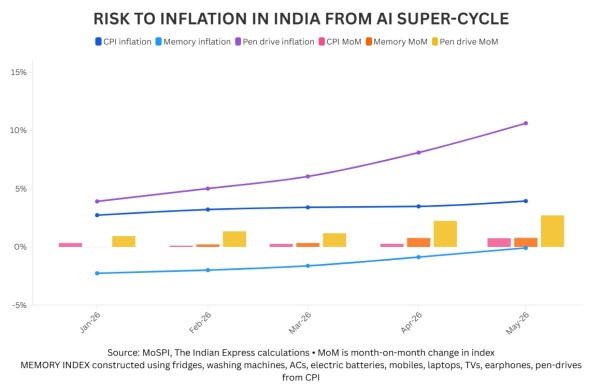
4. This is because of one minuscule component that is common to them all: memory chips. Together, these nine items make up just 1% of India’s entire Consumer Price Index (CPI) basket of goods and services.
5. But they are increasingly exerting upward pressure on headline retail inflation and may continue to do so for years. For example:
(a) Smartphones: Compared to a 4% rise from January 2026 to July 2026, the same period in 2025 had seen its CPI price index decline by 0.7%.
(b) Air conditioners: While they normally do see higher prices in the summer, the extent of the increase this year has been 4.8% compared to 1.1% between January-July 2025.
(c) TVs: Since January 2026, the CPI index of TVs is up 3.5%. If one counts back from December 2025, matching this magnitude of increase took 54 months, or four-and-a-half years.
6. The numbers are similarly large for other consumer electronics: 46 for ACs, 45 for fridges, 41 for mobile phones, 32 for washing machines, and 31 for computers and laptops.
7. The increase in price indices over 2026 of the aforementioned six consumer electronics is calculated as per the new CPI series.
8. For the period prior to 2026, price index changes are computed using the old CPI series which had 2012 as the base year. Only consumer electronic items present in both the old and new CPI baskets have been compared.
What is ‘chipflation’?
9. Back in June, analysts at American investment bank Morgan Stanley had coined the term ‘chipflation’ to describe how “AI’s appetite for memory chips is boosting the cost of everything from data centers to smartphones, with consequences that may reach far beyond the tech industry.”
10. In simple terms, chipflation is when memory chips, instead of getting cheaper over time, continue to get more expensive and difficult to find.
11. As per David Elliott’s article for the World Economic Forum, “Chipflation: What to know about ‘AI’s hidden price tag’”, there is currently no replacement for these silicon chips in mass-market computing. This makes them both vital for future progress and strategically important to businesses and economies.
12. According to Elliott, the US’s five biggest AI companies expect to spend more than $650 billion this year, largely on data centres, and nearly double what they spent in 2025 – this demand is creating a risk of what is known as ‘chipflation’.
Why is chipflation occurring?
13. The global AI boom has led to key chipmakers such as TSMC, Samsung, and SK Hynix making the more in-demand and advanced chips used in data centres sprouting up all over the world.
14. What is being sacrificed are DRAM (Dynamic Random Access Memory) and other chips used in everyday electronics goods such as refrigerators, washing machines, ACs, smartphones, laptops, TVs, and earphones.
15. The result of the supply shortage of the chips essential to consumer electronics is a massive rise in their prices, with JPMorgan Global Research estimating DRAM prices will have risen more than 400% from the start of 2024 to the end of 2026.
16. This is in stark contrast to the Moore’s Law driven cost reduction seen over the second half of the 20th century and the first 20 or so years of the 21st century: DRAM prices fell 90% every five years over this period.
17. As per David Elliott, some of the core drivers behind chipflation include:
(i) AI data centre investment: AI systems and data centres need huge numbers of chips, leading big tech companies to buy more than the industry can easily supply.
(ii) Prioritization of high-margin chips: AI chips can carry significantly higher margins, leaving chip manufacturers to focus on these instead of chips for everyday products, including phones, laptops and cars.
(iii) Long manufacturing lead times: Building and operationalizing new semiconductor fabrication plants takes years and creates a supply bottleneck that cannot be quickly rectified.
(iv) Constrained supply chains: Geopolitical tensions, export restrictions and fragmented supply chains continue to limit availability of components and drive up production costs.
BEYOND THE NUGGET: What are memory chips and semiconductors?
1. A chip (also called an integrated circuit or microchip) is the finished electronic product built out of semiconductor materials (like silicon).
2. Most modern-day semiconductors are integrated circuits, also referred to as semiconductor ‘chips’ — essentially a set of minute electronic circuits comprising transistors, diodes, capacitors, and resistors, and the myriad interconnections between them, layered on a wafer sheet of silicon.
3. Semiconductors occupy a unique position between conductors and insulators. While conductors like copper allow electric current to flow and insulators like glass block it, semiconductors exhibit controlled conductivity.
4. Semiconductors in their natural state are weak conductors of electricity. When certain materials are added to them and an electric field is applied, current can start to flow. Adding phosphorus to semiconducting materials, such as silicon and germanium, for example, allows the flow of a negative current.
5. Semiconductors are an essential component of electronic devices, enabling advances in communications, computing, healthcare, military systems, transportation, clean energy, and countless other applications.
6. They are highly complex products to design and manufacture, that provide the essential functionality for electronic devices to process, store and transmit data.
7. The Centre’s new Semicon 2.0 programme outlines a three-part push to build domestic chip-design companies, support the development of strategic semiconductor technologies and commercially viable chips, and deploy those products in the market.
Post Read Questions
(1) Which of the following statements about DHRUV64 is/are correct? (UPSC CSE, 2026)
1. It is the third chip fabricated under the DIR-V Program with an overall aim to enable the creation of microprocessors for India.
2. It is India’s first homegrown 1.0 GHz, 64-bit dual-core microprocessor.
Select the answer using the code given below:
(a) 1 only
(b) 2 only
(c) Both 1 and 2
(d) Neither 1 nor 2
(2) Vikram 3201 is a:
(a) Human-rated launch vehicle developed by ISRO
(b) Indigenous microprocessor developed for strategic and space applications
(c) Semi-cryogenic rocket engine used in LVM3
(d) Satellite-based navigation system
Answer key: 1. (c) 2. (b)
(Sources: ‘Chipflation’: Electronics see years of price hikes replicated in 6 months, How a tiny electronic component is slowly driving up inflation in India, Semicon 2.0: What is India’s new Rs 1.27 lakh-crore push for chip design?, Knowledge Nugget: India’s First 3D Chip Packaging Plant — Technology and Semiconductors Explained)
🚨 Click Here to read the UPSC Essentials magazine for August 2026. Share your views and suggestions in the comment box or at manas.srivastava@indianexpress.com🚨
Subscribe to our UPSC newsletter. Stay updated with the latest UPSC articles by joining our Telegram channel – Indian Express UPSC Hub, and follow us on Instagram and X

 Rising memory chip costs are adding to price pressures across India’s consumer electronics market. (Image generated by AI)

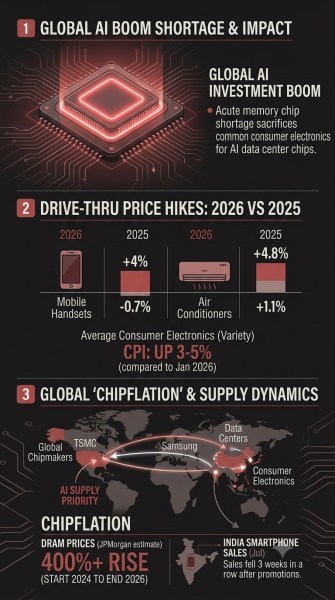 Image generated by AI


 Share


