2. The report was compiled by the global consultancy Systemiq, in partnership with Integrated Mountain Initiative, and supported by the International Centre for Integrated Mountain Development (ICIMOD), Nepal, and GB Pant National Institute of Himalayan Environment, Uttarakhand.
3. Other experts agree with the dangers of black carbon. “Black carbon has a real, major, and measurable effect on the Himalaya. When it lands on snow, it darkens the surface, so the snow absorbs more sunlight instead of reflecting it.”
4. “Modelling shows this ‘snow darkening’ effect alone adds about 40 watts/m² of surface heating in the spring season across the Himalaya,” as per Nimish Singh, President and Director, Gateway Research, the India arm of the Institute for Governance and Sustainable Development.
5. The report proposes a targeted fund to modernise brickmaking, upgrade viable kilns, retire the worst-performing ones and reduce demand for fired bricks.
6. Nimish Singh, however, added that, “Real progress needs kilns, cookstoves, transport, and crop-residue burning to be tackled together, coordinated at the airshed scale rather than kiln by kiln or city by city.”
In this context, let us understand black carbon in detail.
What is black carbon?
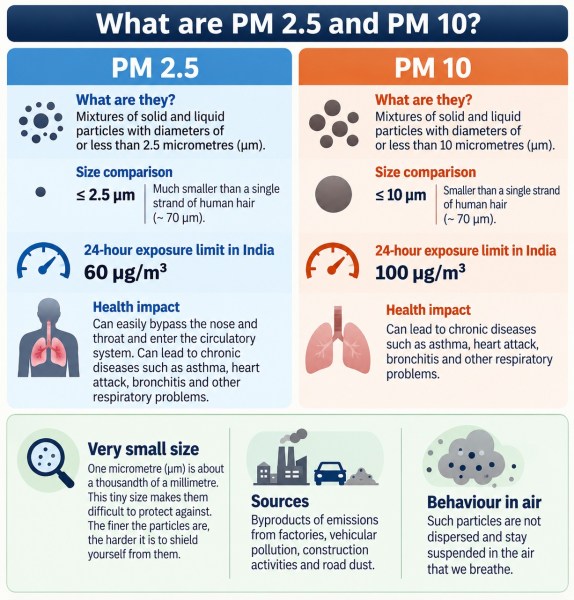
1. Black carbon is a dark sooty material emitted during both natural and anthropogenic activities. It results from incomplete combustion of fossil fuels, biofuels and biomass. It is a component of PM 2.5.
2. Primary sources of black carbon include coal-fired power plants, cookstoves, diesel engines, and the burning of biomass fuels such as wood, other fossil fuels, forest fires, crop-residue burning, and brick kilns.
Why is high concentration of black carbon a concern?
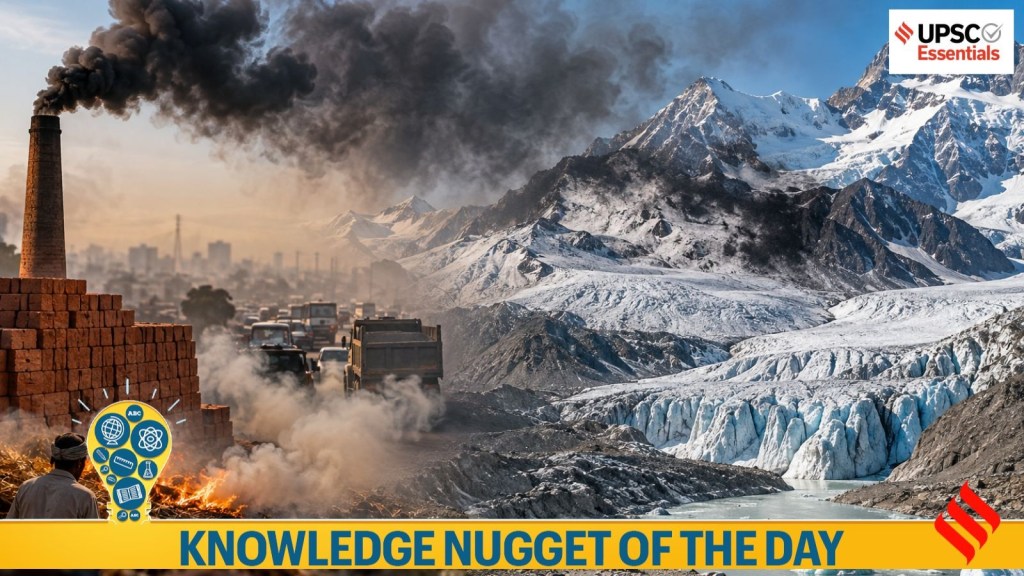
3. Black carbon adversely affects human health, climate, agriculture, and ecosystems. It can alter rainfall patterns, regional atmospheric circulation, and cloud formation, accelerate glacier melting, influence freshwater supplies for millions, and contribute to rising sea levels.
4. High global warming potential: Black carbon is a short-lived climate pollutant (SLCP) due to its atmospheric lifetime of only a few days to weeks, yet it has a substantial impact on global warming.
— After CO₂ black carbon is the second most significant contributor to global warming. Unlike CO₂, it is a particle, not a greenhouse gas.
— According to a paper titled ‘Retrieval of satellite-derived black carbon concentration and mitigation approaches for Karnataka, India’ by Narayan Kayet and team, published in Science Direct “On a per-unit-mass basis, black carbon’s warming effect is 460–1500 times greater than that of CO2, enhancing solar radiation absorption and surface temperatures”.
5. An airshed problem: Black carbon does not remain confined to its source region. Atmospheric transport can carry pollution across state and national boundaries.
— For instance, some studies have shown that biomass-burning emissions from neighbouring regions can contribute substantially to Delhi’s winter pollution, while pollution plumes from the Indo-Gangetic Plain can reach the Himalayas.
6. Responsible for glacial melt: Black carbon particles deposited on snow and ice darken the surface, reduce its albedo, and cause it to absorb more solar radiation. This can accelerate snow and ice melt. Research has identified black carbon as an important contributor to Himalayan glacier melt.
— A 2025 Climate Trends analysis titled ‘Impact of Black Carbon on Himalayan Glaciers: A 23-Year Trends Analysis’, based on NASA satellite data from 2000–2023, reported that average snow-surface temperatures in the Himalayan region increased by more than 4°C over the two-decade period. It also found higher snow-surface temperatures and lower snow depth in areas with greater black carbon deposition, particularly in the Eastern and Central Himalayas.
7. Disrupts Himalayan hydrology: By accelerating snow and ice melt, Black carbon can alter the timing and volume of meltwater and contribute to glacier retreat. This has implications for downstream water availability and increases risks associated with unstable glacial lakes and GLOFs.
8. Affects human health: A study supported by the Department of Science and Technology (DST) in 2021 revealed that black carbon has a significant adverse effect on human health and leads to premature mortality.
9. Regional atmospheric heating: Black carbon remains in the atmosphere for only days to weeks, but during that period it strongly absorbs sunlight and can produce substantial atmospheric heating. This makes its impacts particularly important at the regional scale, including over South Asia and the Himalayas.
10. Influences monsoon and precipitation patterns: Black carbon scatters and absorbs incoming solar radiation and heats the atmosphere while reducing the amount of solar radiation reaching the surface, known as solar dimming.
— A UNEP–WMO assessment explicitly says black carbon can change the vertical temperature structure by heating the mid-atmosphere and cooling the surface, increasing atmospheric stability.
— This suppresses upward convection (the rising of warm, moist air), which is necessary for cloud formation and precipitation. It can change wind patterns by altering regional temperature contrasts.
— However, the effect of aerosols on rainfall is complex and can vary depending on regional meteorological conditions and atmospheric feedback.
BEYOND THE NUGGET: What are Short Lived Climate Pollutants (SLCPs)?
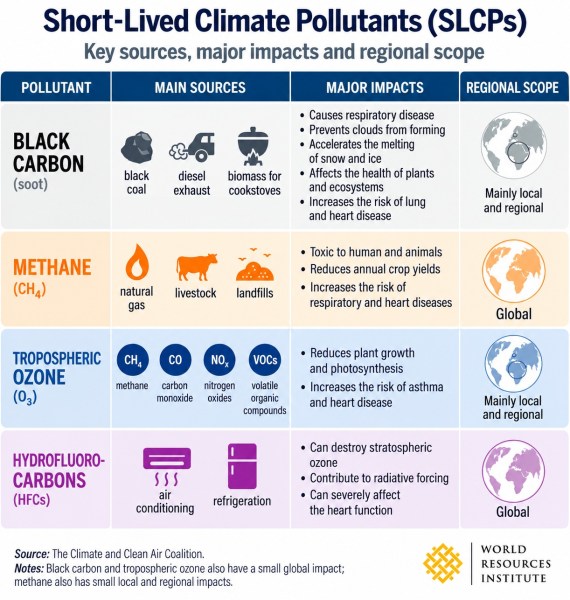
1. As per World Resource Institute and Climate and Clean Air Coalition, SLCPs are methane, black carbon, tropospheric ozone and hydrofluorocarbons (HFCs), which are also sometimes known as “super pollutants”.
2. They can remain in the atmosphere for less time than carbon dioxide but have a potent impact on near-term global warming.
3.They are responsible for nearly half of warming today— tens to thousands of times more powerful than carbon dioxide (CO2) at warming the planet.
4. For example, methane has more than 80 times the warming power of CO2 in its first 20 years in the atmosphere.
5. As per UNEP, Methane has accounted for nearly 30 per cent of global warming since pre-industrial times and is proliferating faster than at any other time since record keeping began in the 1980s.
6. Moreover, methane is also a precursor for another powerful driver of climate change: tropospheric (ground-level) ozone.
 (Infographic from WRI, enhanced using AI)
7. Reaching net-zero emissions by mid-century requires deep cuts in short-lived climate pollutants, including methane, which the IPCC said must be cut 34% below 2019 levels by 2030.
8. Since these pollutants are fast-paced in causing climate change despite having a short lifespan, action to significantly reduce short-lived climate pollutants can also be the fastest way to slow temperature rise.
Post Read Question
With reference to black carbon, consider the following statements:
1. It is produced primarily through incomplete combustion.
2. It is a component of PM2.5.
3. Unlike carbon dioxide, it is a particulate pollutant.
4. It remains in the atmosphere for several decades.
Which of the statement/s given above is/are correct?
(a) 1 and 2 only
(b) 1, 2 and 3 only
(c) 2 and 3 only
(d) 1, 2, 3 and 4
Answer: (b)
(Sources: aaqr.org, Retrieval of satellite-derived black carbon concentration and mitigation approaches for Karnataka, India, Why melting glaciers could ‘put 20% of India’s GDP at risk’, and one change that can help, Crop residue burning main culprit behind Delhi air pollution: Study, New study suggests COVID-19 virus piggybacks only black carbon emission)
🚨Click Here to read the UPSC Essentials magazine for September 2026. Share your views and suggestions in the comment box or at raveena.baneta@indianexpress.com🚨
Subscribe to our UPSC newsletter. Stay updated with the latest UPSC articles by joining our Telegram channel – Indian Express UPSC Hub, and follow us on Instagram and X

 Though short-lived in the atmosphere, black carbon can have a substantial impact on global warming and glacier melt (Representational image generated by AI)

 (Infographic created by AI based on Indian Express reporting).
 (Infographic from WRI, enhanced using AI)


 Share


