
Get Inspired : Kerala’s former Chief Secretary, IAS K. Jayakumar’s journey from Calicut’s rain to ‘God’s Own Country’
Expert Talk : Veteran IAS officer K. Jayakumar Nair, former Chief Secretary of Kerala, reflects on his journey, his first posting in Calicut, and why he calls the IAS a “detour” from writing. He also shares his views on political leadership, Gen Z protests, technology and AI.
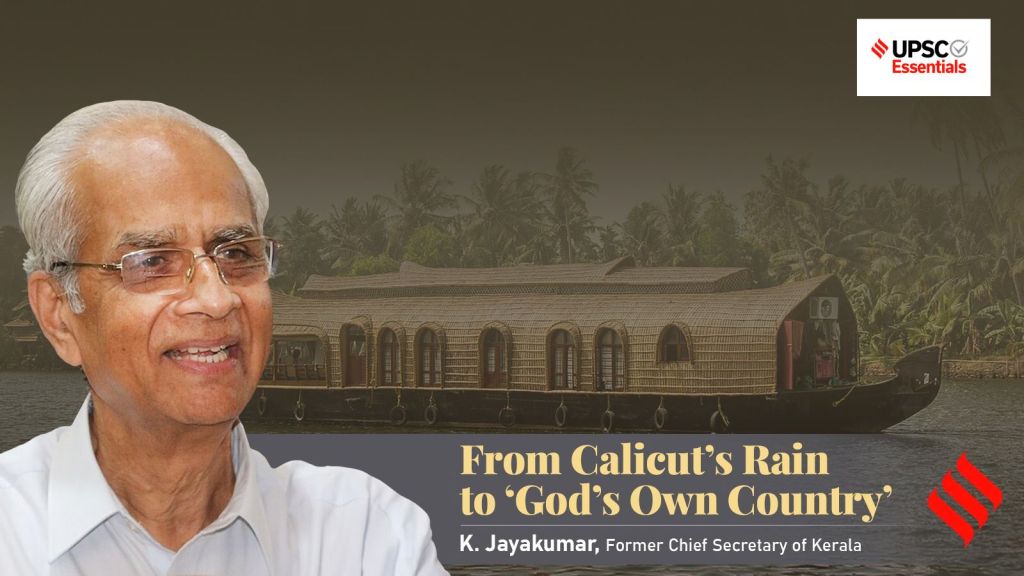 "The idea was to transform Kerala Tourism from what was essentially a housekeeping department of the government into a high-profile, marketing-oriented tourism department," says veteran IAS K Jayakumar.
In 1980, on his first posting as Sub-Collector in Calicut (Kozhikode), K. Jayakumar Nair found himself caught in the rain, taking shelter under the veranda of a shop alongside an old man and some stray dogs. As he stood there, he remembers thinking, “Do you know who I am standing here? I am the Sub-Collector.” But the moment also brought home a deeper realisation that the real value of the civil services lay not in the power, status or authority of a designation, but in the opportunity to remain connected to the people one was meant to serve. It was a simple lesson that stayed with him throughout his career.
In the early years of his career, Jayakumar also found himself in an unusual situation when his political boss almost suspected him of being a Naxal. He recalls the episode with a laugh, offering a glimpse into the political and administrative world he encountered as a young civil servant.

Four decades later, Jayakumar looks back on a career that took him to the position of Chief Secretary of Kerala, while also pursuing a parallel life as a poet, writer and lyricist. For Kerala Tourism, he helped drive a transformation that changed how the state presented itself to the world and shaped the evolution of the phrase that would become synonymous with its tourism identity, “God’s Own Country”.
“Positions and titles are temporary, but your values endure,” he says. The line captures a philosophy that runs through his reflections on public service, that authority must be accompanied by integrity, humility and humanity.
In this special interview marking the 3rd anniversary of UPSC Essentials magazine, K. Jayakumar Nair reflects on the changing civil services, social media, political leadership, public protests, technology and AI, and what young aspirants should remember before choosing a career in public service.
Here is an excerpt from the conversation:
Q. You joined the civil services in the late 1970s. What, according to you, has changed since then, and how has it affected the civil services?
Jayakumar: When we entered the service in the late 1970s, society was very different and technology was still rudimentary. The primary responsibility of a civil servant was to work for the government. We were essentially the executors and implementers of government policies.
At that time, the government had a monopoly in many sectors. In the post-Emergency period, in particular, the role of the government was seen as increasingly important. Since then, the nature of governance and government policy has changed significantly. Liberalisation and privatisation have brought private players to the centre stage, and this has altered the challenges before the bureaucracy.
However, this has not diminished the significance of the civil services. In fact, the role has become more complex. The skills, attitudes and tools required of civil servants must evolve with changing times to remain relevant. The context may have changed, but the need for an effective and responsive civil service remains as important as ever.
Q. On social media, civil servants are often associated with power, authority, respect and the opportunity to change society. Is there something about the reality of being a civil servant that young aspirants and their parents should know, which is different from what they see on social media?
Jayakumar: Social media is a new temptation, and I have seen many young civil servants, including IAS and IPS officers, fall prey to it.
Social media can be a useful platform for artists, influencers, writers and social reformers. But a civil servant works within an institutional framework. We are not policymakers; we are responsible for implementing government policies. When you speak in your official capacity, there are certain limitations. There is a fundamental difference between a politician and a civil servant, and that distinction should also be reflected in how civil servants use social media.
That does not mean civil servants should shy away from social media or remain anonymous forever. If you have a talent in a field such as art or writing, there is no harm in sharing it on social media in your personal capacity. You should not be deprived of the benefits of these platforms simply because you are a civil servant.
However, in your official capacity, social media must be used with restraint, responsibility and, most importantly, a sense of public purpose. It should not become a platform for personal glorification. As a civil servant, you are bound by certain rules and regulations. That is a small compromise you make for the privilege and responsibility that come with the power and position of the service.
Q. When you look back at your first posting as a young IAS officer, what is the first memory that comes to mind?
Jayakumar: My first posting was as Sub-Collector in Calicut (Kozhikode) in 1980. One Sunday evening, I was caught in the rain and took shelter under the veranda of a shop. There were some stray dogs around me and an old man standing nearby.
I remember thinking to myself, “Do you know who I am standing here? I am the Sub-Collector.”
That moment has stayed with me because it was a very simple introduction to the reality of public service. The designation may sound powerful, but at the end of the day, you are still a person standing in the rain, among ordinary people. That experience stayed with me throughout my career.
Over time, Calicut itself gave me many good memories, and I developed a close connection with the city.
There was another incident during my early days of career involving Naxalite detainees. After they had been in custody for 15 days, I discharged them because the police had failed to file charge sheets against them. They began raising slogans of “Zindabad Jayakumar”, and the decision created quite a stir. The Home Minister even suspected that I might be a former Naxalite.
When I explained the case to my superior and pointed out that there were no charge sheets, the matter was resolved. I might have approached the situation differently if I had been a more experienced officer. But I was only 27, and at that age, I did what I believed was right.
Q. Did you have a mentor during your career?
Jayakumar: I did not have a mentor in the conventional sense. However, I have had what I call “negative mentors”, people who taught me through their example what not to become.
They taught me some important lessons. Do not become elitist in your attitude. Do not become so carried away by recognition or fame in other fields that you begin to neglect your official responsibilities. Throughout my career, I have never compromised on my official duties for anything else.
Q. You have often spoken about your interest in literature and writing. How did that part of your personality influence your career as a civil servant?
Jayakumar: Essentially, I am a writer. Getting into the IAS was a detour.
The poet in me has guided me throughout my career. I kept the two tracks parallel, and they benefited each other. I made sure to avoid the “creative trap.” I observed “negative mentors”—brilliant officers whose artistic or literary fame caused them to neglect their core administrative duties. I consistently gave first priority to my official responsibilities.
At the same time, the writer and poet within me preserved my empathy, keeping me connected to the ordinary public and preventing the cold insensitivity that power can bring. My interest in literature helped me understand people and their emotions, while my administrative experience gave me a deeper understanding of society.
I believe that staying connected with people is important. Even when I returned in 2012 to home after retirement, people recognised me because I had continued to remain connected with them.
Q. You were Director of Kerala Tourism in 1989, when the department underwent a major transformation. What was the thinking behind that change?
Jayakumar: The idea was to transform Kerala Tourism from what was essentially a housekeeping department of the government into a high-profile, marketing-oriented tourism department. At the time, the leading tourism states were Jammu and Kashmir, Uttar Pradesh and Rajasthan. Kerala was hardly noticed. I set myself the task of ensuring that within two years, Kerala would be in the front row and that Kerala Tourism would be redefined.
Somebody came up with the slogan “Kerala, God’s Country”. I felt it was incomplete and suggested that Kerala should be called “God’s Own Country”. I personally cleared the tagline with my CPI (Left) minister, who approved it despite being known as an atheist.
We then began using “God’s Own Country” extensively in our tourism promotion. The campaign focused on aggressive marketing, participation in international tourism fairs and pioneering public-private partnerships. Within three or four years, Kerala Tourism had become one of the front-runners at tourism conferences in Delhi.
I laid the foundation for this transformation, but the credit for its success also goes to the many people who contributed to it, both then and in the years that followed.
The larger lesson was that government departments also need to think about communication, branding and how they present themselves to the world. The civil services gives you an opportunity to take on difficult challenges and turn them into reality.
Q. What should be the relationship between a civil servant and political leadership?
Jayakumar: Do not dabble in party politics. That is not our area at all. We are a professional entity. We are not trained and paid simply to do “what the minister wants”; we are trained and paid to uphold professional standards. The political preferences of your political boss should not be your concern.
Your integrity should speak louder than your words. In the first seven years of your service, your reputation for integrity has to be meticulously cultivated, built and established.
You should also develop a sense of non-attachment to your position. Posts come and go. Your notings should be legally sound and unassailable from both a moral and legal point of view.
I believe there are four key pillars that a civil servant should follow:
1. Impeccable Integrity: High personal ethics act as a protective shield. A corrupt politician will hesitate to demand illegal acts from an officer with an unquestionable reputation.
2. Non-Attachment (Nishkama Karma): Officers should not become attached to any particular post. Being prepared to be transferred at any moment reduces the leverage that political leaders may have over you.
3. Professional Advice: Write on files what ought to be written from a legal and ethical standpoint, not merely what pleases the minister.
4. Adherence to Rules: Even if some rules seem archaic, follow them carefully. This helps you avoid technical errors that can later be used against you by your opponents.
Q. Young people today, including Gen Z, are increasingly protesting and questioning institutions. How should the state respond when there is a conflict between citizens and the state?
Jayakumar: Civil servants and police officers responsible for maintaining law and order must remember that they are serving the public, not waging war against an enemy country. Protests and public anger must be handled with a sense of duty and responsibility. Any use of force during public unrest should always be legal, fair and kept to the absolute minimum necessary.
Political decision-making may operate on a different wavelength, but the values of the civil services should guide officers in influencing state action to a considerable extent. The underlying principle should always be that enforcing law and order does not mean treating citizens as enemies.
Q. Technology and AI are changing the way governance and even competitive examinations work. How much should we trust technology in public administration
Jayakumar: My answer might be a bit unfashionable. Technology is very useful, but we should not trust it beyond the limits of human judgment.
Institutional capacity-building has suffered in many institutions in recent years. Technology can strengthen governance and improve decision-making, but it cannot substitute for the responsibility of human beings to exercise judgment, apply caution and conduct thorough checks.
Over-reliance on third-party commercial firms or automated algorithms can weaken this institutional responsibility. Some of the recent controversies surrounding examinations are also a reflection of the erosion of internal institutional capacity. If we want to rebuild long-term public trust, we must strengthen that capacity rather than rely entirely on technology.
Even with the coming of AI, the human brain remains superior in many ways. Those entering the civil services, in particular, should remember that.
Q. After such a long career, what do you think is the most important lesson about success in public service?
Jayakumar: Your glory in service is short-lived unless the person you are is worthy of that glory. It is not the positions that you occupy, but the kind of person you are, that makes all the difference. Be as humane as possible. Be as simple as possible.
Positions and titles are temporary, but your values endure—staying simple, unpretentious, and humane is the key to both personal fulfillment and effective governance.
Q. If a sixteen year old student came to you today and said, “Sir, I want to become an IAS officer,” what would you tell them?
Jayakumar: I would first ask him, “Why do you want to become an IAS officer?”
If you have the personality and attitude to be part of the government, to do good things on behalf of the government and to feel proud about that work, then by all means choose the service. But do not choose it merely because of the power, money, status or glamour associated with the position.
As a student, select subjects that you can study with passion. Go slightly beyond the prescribed syllabus. Develop a wider understanding of the subjects you study. And when you eventually have to write an answer, remember that your answer has to be different. You have to bring your own understanding and perspective to it.
Note: The next post in this anniversary series will take us to another remarkable journey, a conversation with Meeran Chadha Borwankar, Maharashtra’s first Woman Commisioner and author of Madam Commissioner.
🚨As we mark the 3rd anniversary of the UPSC Essentials magazine, we thank our readers for being part of this journey. Your trust, feedback and continued support have shaped the magazine and encouraged us to keep improving with every edition. Click Here to read the UPSC Essentials magazine for September 2026. Share your views and suggestions in the comment box or write to us at manas.srivastava@indianexpress.com.🚨
Have a thought, suggestion or feedback to share? Write to Manas Srivastava at manas.srivastava@indianexpress.com. We would love to hear from you.
Subscribe to our UPSC newsletter and stay updated with the news cues from the past week.
Stay updated with the latest UPSC articles by joining our Telegram channel – IndianExpress UPSC Hub, and follow us on Instagram and X

Manas Srivastava is an Assistant Editor at The Indian Express Read More
 Share


