
Is innovation the only way out of the middle-income trap?
Over 100 countries, including India, face challenges in escaping the middle-income trap. Is it simply about innovating and moving closer to the technological frontier? Or is it about identifying pathways of structural transformation capable of generating productive and remunerative employment at scale? See infographics.
 A middle-income trap is a growth slowdown at the middle-income levels (File)
— Ritwika Patgiri
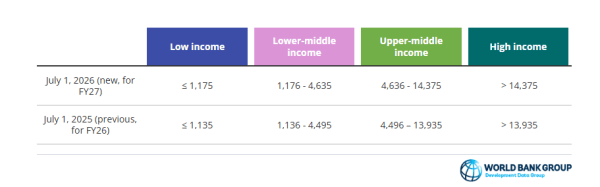
In the World Bank’s classification of global economies, five countries moved from lower-middle to upper-middle income category this year. The World Bank’s classification is updated based on gross national income (GNI) per capita estimates from the previous calendar year.

India’s economy grew at 7.8% in the April-June quarter of 2026-27. But the country’s per capita income stood around US$ 2671 in the FY 2024-25. Where does India stand in the World Bank’s latest classification of global economies?
Income classification of countries
The World Bank assigns the world’s economies to four income groups:
The World Development Report 2024: The Middle-Income Trap identified a total of 108 countries, including India, facing challenges in moving away from the trap. Compared with the US, the report noted, these countries are trapped at modest income levels.
Using estimates based on the Solow-Swan model of growth, the report projects that these countries are likely to experience a significant slowdown between 2024 and 2100 if the drivers of growth remain as per their current and historic trends. The drivers of growth in this model are investment in human capital, total factor productivity, labour force participation, and the share of economic output accrued to public and private investment.
India and the Middle-Income Trap
What is the middle-income trap?
According to economic literature, a middle-income trap is a growth slowdown at the middle-income levels. In 1980, economist Arthur Lewis argued that countries tend to experience a slowdown in their growth as they approach high-income status. This is because of a diminishing benefit of labour transfer from the traditional or non-capitalist to the modern industrial or capitalist sector.
In the neoclassical growth theory, which stresses capital accumulation, population growth and technical progress, growth slows as countries reach the technological frontier. Scholars like Pritish Behuria and Andy Sumner note that moving beyond the trap requires adopting trade and market liberalisation, privatisation, and strong enforcement of intellectual property rights.
Economists identify two primary constraints faced by middle-income countries. First, these countries become unable to compete with low-wage economies in the labour-intensive sectors. Second, they lack the capacity to compete with high-income countries in high-technology sectors.
What the experiences of Argentina, China, South Korea reveal
The cases of Argentina, China, and South Korea can be used to understand this. Till the 1930s, Argentina saw a sustained and rapid growth rate as a result of the development of large-scale agriculture. The economy required the import of machinery and foreign capital to finance the necessary infrastructure.
During the Great Depression of the 1930s, specialisation of production and export of agricultural products made the Argentine economy vulnerable to shocks. This marked the decline of the per capita GDP of Argentina relative to the US.
China, on the other hand, has focused heavily on manufacturing and education. According to the United Nations, 78.6% of the Chinese population over the age of 25 has completed secondary education from 1990 to 2019 (compared to 51.6% Indians). Finally, South Korea has avoided the middle-income trap through the creation of large industrial and financial conglomerates, known as chaebols.
Nobel laureate Philippe Aghion, in his co-authored book The Power of Creative Destruction (2021), notes that Argentina saw a reversal of growth of per capita GDP as it was unable to move away from agriculture through an innovation-based industrial economy. The authors had also argued that China risked being trapped if it failed to transition to frontier innovation.
Finally, Aghion et al. pointed out that South Korea would have remained an agricultural economy had it not deliberately created a national industry through protection of chaebols. The 1997 Asian financial crisis then saw South Korea liberalise foreign direct investments.
Hindrances in India’s growth
In India, the middle-income trap has manifested in modest per capita income, service-led growth that could not generate enough employment opportunities, a large informal labour force, and a manufacturing sector that has not been able to create jobs at the scale required.
The WDR 2024 notes that if a firm operates for 40 years in countries like India and Mexico, it will more likely double in size. However, a similar firm in the US is likely to grow sevenfold. Thus, firms in India are more likely to remain microenterprises, with fewer than five employees, informal in nature, smaller in size, and large in numbers.
According to Aghion and others, the management in most Indian firms remains within the family. The firm stops growing when the founding family is unable to find reliable managers to run the establishment. Thus, they attribute the thin managerial market, which is a result of low educational levels, infrastructure, and imperfections of the credit market as the main reasons for the hindrance of India’s growth.
How can India avoid middle-income trap
Economist Arvind Panagariya has argued that India can, however, avoid a middle-income trap through its advantages in demography, infrastructure, governance, and recent trade agreements. According to him, India has largely sustained its market-friendly reforms.
Further, India’s large youth population implies a large workforce and a high savings rate, which is essential for maintaining a high level of investment. India’s public sector capacity to undertake large infrastructure projects shows signs of an optimistic future growth prospect. Finally, India’s trade policies have shown resilience despite global economic turmoil.
However, there remain important caveats. Recent trends show that despite the rise in the share of India’s workforce, household savings have declined. India’s large informal workforce (around 90% of India’s workforce) is marked by lower wages and precarity.
For instance, the median worker in a formal salaried job earns Rs 26,000 per month, while the median worker in an informal salaried job earns around Rs 11,000 per month. The wages of formal sector salaried employees are likely to be 2-3 times the salary of informal sector salaried employees.
Finally, India’s growth structure has not been able to create enough jobs. While services are more skill-intensive than manufacturing, they are also less labour-intensive and capital-intensive than manufacturing. According to the Bank of America’s recent estimates, India’s manufacturing sector has to grow at a rate of 10% for India to become an advanced country by 2047.
Growth in developing and developed countries
Many heterodox economists also argue that the understanding of many developing countries that have witnessed a slowdown in growth also needs to look at the long-term effects of market-oriented domestic reforms through structural adjustment programmes of the 1980s and the 90s.
The limitations of bilateral and multilateral trade agreements, financial liberalisation, growing multinational corporations, and constrained support for domestic market development also need to be taken into account.
In the case of India, too, labour reforms and industrial policies need to be examined alongside the quality and distribution of employment that the growth process generates. This raises a larger question: how have high-income countries become high-income?
Economist Ha-Joon Chang, in his important work Kicking Away the Ladder: Development Strategy in Historical Perspective (2002), argued that developed countries themselves developed by using policies like tariff protection and subsidies for the progress of their industrial sectors. Thus, it was not free trade and laissez-faire industrial policies that helped them in their “catching up” phase of growth.
Pathways to sustained growth
The WDR 2024 identifies pathways to avoid the middle-income trap. The report emphasises both investment and infusion, in which a country brings technologies from abroad and diffuses them domestically, and later on, adds innovation to the mix of investment and infusion.
However, such recommendations may overlook the changing structural conditions of global production. As global value chains have intensified competition among developing countries, opportunities for labour-intensive industrialisation and upgrading have become increasingly constrained.
The challenge for countries such as India, therefore, is not simply to innovate and move closer to the technological frontier, but to identify pathways of structural transformation capable of generating productive and remunerative employment at scale.
While India’s current growth rate has been decent, the country needs to grow at least 9% annually to become an advanced economy by 2047. Initiatives such as Semiconductor Mission, India AI Mission, Quantum Mission, and Green Hydrogen Mission are steps further in this direction. However, India also needs to create better quality jobs, increase the percentage of GDP spent on Research and Development, along with sufficient attention in areas like health, education, and infrastructure development.
Post read questions
1. What is the middle-income trap? Discuss the structural factors that may cause an economy to experience a prolonged slowdown after achieving middle-income status.
2. India’s growth has been increasingly services-led, while manufacturing has struggled to generate employment at scale. Examine the implications of this growth pattern for India’s transition to a high-income economy.
3. How does the transition from investment-led growth to innovation-led growth affect the development strategy of middle-income economies?
4. Explain the role of human capital, technological diffusion and total factor productivity in enabling middle-income countries to sustain long-term economic growth.
5. There is no single policy prescription for escaping the middle-income trap. Discuss in the light of the contrasting experiences of Argentina, China and South Korea.
(Ritwika Patgiri is a doctoral candidate at the Faculty of Economics, South Asian University.)
Share your thoughts and ideas on UPSC Special articles with ashiya.parveen@indianexpress.com.
Click Here to read the UPSC Essentials magazine for August 2026. Subscribe to our UPSC newsletter and stay updated with the news cues from the past week.
Stay updated with the latest UPSC articles by joining our Telegram channel – IndianExpress UPSC Hub, and follow us on Instagram and X.

 Share


