India’s “strategic multi-engagement”
The recent improvement in India–China ties, from the eight-point consensus on the boundary issue and the resumption of direct flights to Prime Minister Modi’s active participation in the last two Shanghai Cooperation Organisation (SCO) summits, signals a possible new phase in bilateral relations. The rapidly evolving dynamics in West Asia, including the Mecca Accord, are, however, adding further complexity to India’s strategic calculations.
In the last three decades, New Delhi has tried to reposition itself as an important global actor. India has transitioned from a policy of non-alignment to what many analysts, including Brahma Chellaney, C Raja Mohan, and Shashi Tharoor, have described as “multi-alignment”. However, a more appropriate term to describe India’s approach would be “strategic multi-engagement,” as it engages with multiple partners without formally aligning with any single major power or bloc.
This strategy of multi-engagement also reflects a departure from India’s earlier inward-looking economic approach and its pronounced anti-Western stance. Key elements of this evolving strategy include the expansion of strategic partnerships, the strengthening of external economic ties—particularly through trade agreements, a sharper focus on connectivity initiatives, and an enhanced emphasis on development partnerships. Taken together, these trends reflect the strategic consequences of India’s robust economic growth over the past three decades.
The strategy also reflects some kind of “soft balancing,” enabling it to avoid formal alliances while cultivating diverse strategic partnerships to hedge against uncertainty in an increasingly multipolar world.
The evolving practice of “neo-strategic autonomy”
India’s long-standing commitment to strategic autonomy, rooted in the ideas of Jawaharlal Nehru, has undergone a significant transformation, particularly over the past decade. During the Cold War, non-alignment implied maintaining distance from both the US and the Soviet Union.
In the contemporary context, however, strategic autonomy no longer signifies equidistance; rather, it denotes the ability to engage with all major powers without being constrained by formal alliance commitments. This evolving practice of “neo-strategic autonomy” has been further refined under Prime Minister Modi and articulated effectively by External Affairs Minister S Jaishankar through his speeches and writings.
New Delhi now engages in overlapping institutional arrangements, seeking to maximise the benefits of each while avoiding binding commitments to any single bloc or framework. Within many of these platforms, India adopts a selective approach, participating in areas that serve its interests while opting out of others. For instance, India chose not to join the trade pillar of the Indo-Pacific Economic Framework (IPEF).
Beyond its long-standing engagement with multilateral institutions such as the UN, this approach is reflected in its active participation in platforms such as BRICS, IBSA, SCO, and Russia-India-China (RIC), alongside newer minilateral initiatives like the Quadrilateral Security Dialogue (Quad), I2U2 Group, and trilateral formats such as the India–France–UAE and India–Australia–France formats.
Expanding global engagement
At the same time, the expansion of strategic partnerships with a diverse set of countries, along with the upgrading of several existing ones to reflect evolving priorities and capabilities, has been a key feature of India’s emerging strategy of strategic multi-engagement. Beginning with South Africa in 1997, India has since established strategic partnerships with over 45 countries and regional groupings, including the Association of Southeast Asian Nations, the European Union, and other key partners.
The drivers of these partnerships vary according to India’s strategic interests. Many have a strong political and security dimension, while others are also shaped by economic considerations, particularly those with the US, European partners, and Japan. Some partnerships are critical for India’s energy security, notably those with Russia as well as partners in West Asia and Central Asia. A few are underpinned by civilisational linkages, such as those with Iran and countries in Southeast Asia.
After many years of caution, India has adopted a more proactive approach to trade agreements, particularly since 2021. India also seeks to deepen its engagement with major economic partners through trade agreements not only in Asia but also in Europe and other parts of the world.
New Delhi has also concluded more than 20 trade agreements with partners such as Australia, ASEAN, the EFTA countries, Japan, South Korea, the UK, and the UAE. Negotiations with the European Union have been concluded. Several other deals, including with the US, are also at an advanced stage.
As India-China dynamics evolve, New Delhi may also revisit its approach to the Regional Comprehensive Economic Partnership (RCEP). India may also consider joining the Comprehensive and Progressive Agreement for Trans Pacific Partnership (CPTPP).
Amplifying the voice of the Global South
Championing the cause of the Global South has also become an important element of India’s strategic multi-engagement, particularly since its G20 Presidency in 2023, during which it successfully secured permanent membership for the African Union in the grouping.
India has also convened multiple editions of the Voice of the Global South Summit to amplify the concerns and priorities of developing countries. The Global South outreach is linked with Indian development activities consisting of Lines of Credit (LoCs), grant assistance projects, and capacity-building programmes.
This ambition is further reflected in its role in establishing new multilateral initiatives from the Global South, such as the International Solar Alliance (ISA) and the Coalition for Disaster Resilient Infrastructure (CDRI). Although India has long called for reforms in global governance institutions, its voice has gained strength due to its economic rise and the ongoing global power reordering.
Development, defence and connectivity
Several partnerships across the Global South carry a strong development cooperation component and play an important role in advancing broader South–South Cooperation. As the Indian defence industry matures, defence partnerships are also becoming increasingly important, both for joint production and for expanding defence exports.
India is also trying to build a connectivity narrative, although it has not announced any connectivity strategy. This narrative is based on the many strategic partnerships, FTA, development partnerships and regional policies like Act East, India-Central Asia Dialogue, India-Africa Dialogues, etc.
These are linked with the International North-South Trade Corridor (INSTC), the Asia-Africa Growth Corridor, the Security and Growth for All in the Region (SAGAR)/MAHASAGAR framework, the India–Middle East–Europe Economic Corridor (IMEC), etc.
BRICS, a key indicator to India’s strategic direction?
Strategic multi-engagement remains an appropriate choice for India as it navigates an increasingly complex geopolitical landscape. China’s assertive rise drew India closer to Western powers, particularly within the Indo-Pacific framework.
At the same time, India is carefully managing its continental interests in Eurasia, maintaining its special relationship with Russia, seeking to build a stable working relationship with China, and navigating partnerships with major West Asian actors, including Iran and Israel. However, as a new economic and security architecture evolves in West Asia, India’s close ties with Israel may present certain diplomatic challenges not only in the region but also across the wider Global South.
Given the significant asymmetry and competing interests in Asia, India-China relations pose a serious dilemma for India’s strategy of multi-engagement. This dilemma has been particularly evident during India’s BRICS presidency. President Trump’s sceptical view of BRICS and his perception of the grouping as a challenge to US economic and strategic interests are well known. India’s presidency has also coincided with growing difficulties in India-US relations and an escalating crisis in West Asia.
After a relatively low-key affair, however, the presidency has gained considerable momentum in recent weeks. How India manages the BRICS summit will provide important indications of its foreign policy priorities and strategic direction in the coming years.
Post read questions
1. What is strategic multi-engagement? How does it differ from the traditional concept of non-alignment and contemporary multi-alignment?
2. Strategic autonomy no longer implies equidistance from major powers. Examine this statement in the context of India’s contemporary foreign policy.
3. India’s strategic multi-engagement is an attempt to maximise strategic space without entering into formal alliances. Discuss with suitable examples.
4. India’s participation in BRICS, SCO, Quad and I2U2 reflects the operationalisation of strategic multi-engagement. Discuss.
5. BRICS acts as a powerful counterweight in global governance, actively amplifying the voice and influence of the Global South. Explain the role of BRICS in projecting itself as an alternative to other groupings.
(Gulshan Sachdeva is Professor and Jean Monnet Chair at the Centre for European Studies, Jawaharlal Nehru University)
Share your thoughts and ideas on UPSC Special articles with ashiya.parveen@indianexpress.com.
Click Here to read the UPSC Essentials magazine for August 2026. Subscribe to our UPSC newsletter and stay updated with the news cues from the past week.
Stay updated with the latest UPSC articles by joining our Telegram channel – IndianExpress UPSC Hub, and follow us on Instagram and X.

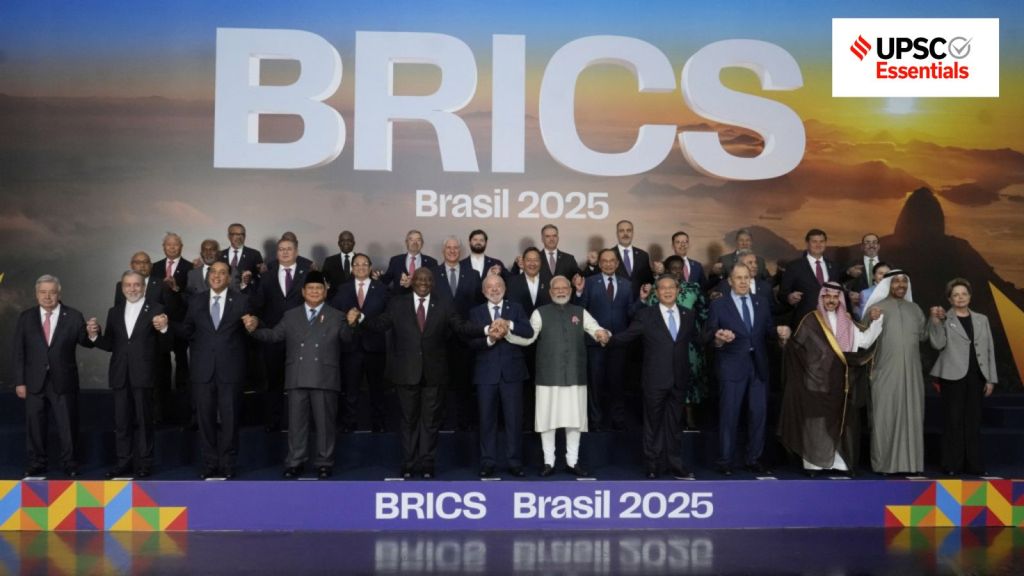 Prime Minister Narendra Modi during a group photograph with BRICS members, partners and outreach invitees in Rio de Janeiro, Brazil, in 2025. (PTI)


 Share


