Sculptures of the Indus civilisation
The earliest extant collection of sculptures is associated with the mature phase of the Indus Civilisation (2600-1900 BCE). They were produced in both stone and metal. One of the examples is the hoard of terracotta figurines carved with fan-shaped headdresses, layered necklaces, and wide girdles from clay pellets, termed as ‘mother-goddesses’ and identified with votive offerings. There were other objects recognised as ‘toys’. But the ‘priest-king’ and ‘dancing girl’ became synonymous with the period under discussion.
The priest king
The ‘priest-king’, named so by Mortimer Wheeler and John Marshall, is an 18*11 cm steatite bust of a bearded male, excavated by K N Dikshit in 1925-26 from Mohenjodaro. Other attributes of the sculpture include full lips, a sharp nose, and partially closed eyes that were once inlaid with shell. A textured floral robe, originally filled with red pigment, makes this sculpture stand out among its peers. A ribbon around their head and indents on the neck for holding a precious neckpiece are unique to the sculpture.
The tradition of embellishing stone and metal sculptures continued in the later period and was prevalent among bronze images. The inscriptions on the base moulding of the Thanjavur Brihadeshvara temple mention 65 distinct varieties of ornaments donated to the bronzes by Chola royalty and other privileged individuals.
Today, the ‘priest-king’ is safely preserved in a vault in the Pakistan National Museum, while a replica of the artefact is displayed for public viewing. It was handed over to Pakistan by India in 1972 under the Simla Agreement, making it one of the earliest repatriated artefacts.
The dancing girl
Another significant sculpture from the Indus Civilisation is the much-debated bronze image of a nude and slender female figurine, labelled as the ‘dancing girl’. The name was given by the British Archaeologist John Marshall. Discovered in 1926 at Mohenjodaro by Ernest Mackay, it is now displayed in the Harappa Gallery of the National Museum in New Delhi.
It was made using the lost-wax casting technique, a method also employed in producing the famous Chola bronzes. The method involved creating clay moulds around a wax model for each figure (made from hard beeswax and resin). The clay moulds were fired in a kiln to melt out the wax and pour in the molten bronze. The clay mould was broken to release each bronze image, making each piece unique.
The only known stylistic parallel of the ‘dancing girl’ is the recently discovered Bhirrana statuette (2004-5). Iconographically, the figurine stands with its weight on one leg. Its tilted head highlights its large eyes, flat nose, and full lips. Its hair is braided into a tight plait. The figurine’s one hand rests on its waist, while the other hangs loosely on the side and is heavily bangled. Its aesthetic, nomenclature, and identity are highly debated among scholars, who particularly condemn the Orientalist labels and recent episodes of misinterpreted identities.
Sculptures associated with ‘Mauryan art’
The high-polish Ashokan pillar capitals and non-sectarian sculptures associated with ‘Mauryan art’ characterise the art of the early historic period (ca. 3rd century BCE). The lustrous-monolithic, Chunar sandstone pillars with bell, lotus, and animal capitals – elephants at Sankissa, lions at Vaishali and Sarnath, bulls at Rampurva, etc.- have been fiercely debated for their ‘Indianness’. Their use of honeysuckle and acanthus motifs, and sophisticated naturalism, however, exhibits West Asian and ‘Hellenistic’ bearing.
Four free-standing sculptures – the ‘Didarganj Yakshi’, a celebrated ‘Mauryan masterpiece’, two fly-whisk bearers from the Patna Museum, and the Lohanipur nude torso – are also associated with the Mauryan period on the basis of their naturalism and fine polish.
The ‘Didarganj Yakshi’, dated to the 1st-2nd centuries BCE, was discovered in 1917 on the banks of the Ganga in Patna. A tall, voluptuous female figurine, the sculpture is stylistically similar to its peers. She holds a chauri/chamara in one hand, while the other is broken. Her nose is chipped off. She bears a serene and enigmatic smile. Yakshis are semi-divine figures, in this case, perhaps carved alongside a central deity, performing a service or veneration.
The work of Frederick Asher and Walter Spink on Mauryan sculptures, based on several stone images from eastern India, particularly Rajendranagar, has suggested a later date in the 1st-2nd centuries CE. They argue that the polish, which affiliates these works to the Mauryan period, was not exclusive to the dynasty and localised in the region. Their study provides a consistent and plausible evolution of human figurines from Bharhut and Sanchi.
The iconic representation of Buddha
One of the most interesting and discussed sculptural developments is the iconic representation of Buddha. The discourse began with the discovery of a Buddha image in Gandhara in north-western India, which European scholars associated with the Indo-Greeks, that is, Kushanas, and dated to the 1st century BCE.
The human image of Buddha led A Foucher to attribute its development and invention to the Greeks, grounded in the coeval aniconic developments in early Buddhist sites in India. Challenging Foucher’s assertion, A K Coomaraswamy argued for an Indian origin of Buddha’s image based on the flourishing Yaksha cult in the Mathura region.
Thus, despite flourishing in the same temporal, spatial, and political milieu, the Gandhara and Mathura traditions are regarded as culturally inimical.
Nevertheless, standard iconographic conventions for both Buddha and Bodhisattva images were established during the Kushana period (1st-3rd centuries CE). Western conventions, such as natural drapery, curly hair, inward-looking meditative countenance, and a muscular physique, characterised the Gandhara Buddha.
In contrast, the Mathura images were carved with monastic robes (sanghati) over one shoulder, tightly coiled coiffure (dakshinavarta kesha), a direct gaze, and fleshy physiques. Cranial protuberance (ushnisha) and sacred dot on the forehead (urna) were rendered differently in the two traditions.
Buddha’s physical attributes in his iconographies likened him to a great being (Mahapurusha). A softer version of the Mathura tradition: cascading robes covering both shoulders, coiled hair, and deep eyes, governed the production of later Buddha images.
Shifting identities of sculptures
The dispersal of such artefacts across museums worldwide complicates the study of sculpture. Many of these works were originally crafted as cultic objects, raising the question of what becomes of them in exile. Their subsequent trajectories invite consideration of their changing lives, or “social biographies,” to use Richard Davis’s term, and the shifting identities they acquire over time.
Should such sculptures continue to be understood primarily as objects of veneration, in keeping with their original function, or should they be approached through what Davis describes as an “exhibitional frame”? Alternatively, might there be a third possibility—a “liminal frame” situated between the cultic and the exhibitional, in which these objects retain traces of sacred significance even as they are recontextualised within museum spaces?
Post read questions
1. Trace the evolution of sculptural representation from the Indus Civilisation to the Kushana period, highlighting major continuities and transformations.
2. An artefact changes its meaning when it moves from its original context to a museum. Discuss with reference to Indian sculptures and concepts of the ‘cultic’ and ‘exhibitional’ frames.
3. What are the major characteristics of Mauryan stone sculpture? Discuss with reference to Ashokan pillars and associated sculptures.
4. Explain the role of Yaksha and Yakshi traditions in the emergence of anthropomorphic representations of the Buddha.
5. What is meant by the ‘social biography’ of an artefact? Explain its relevance to the study of sculptures displayed in museums.
(Ajeya holds a PhD in History from the University of Delhi. Her research focuses on the art historical traditions of India and South Asia.)
Share your thoughts and ideas on UPSC Special articles with ashiya.parveen@indianexpress.com.
Click Here to read the UPSC Essentials magazine for August 2026. Subscribe to our UPSC newsletter and stay updated with the news cues from the past week.
Stay updated with the latest UPSC articles by joining our Telegram channel – IndianExpress UPSC Hub, and follow us on Instagram and X.

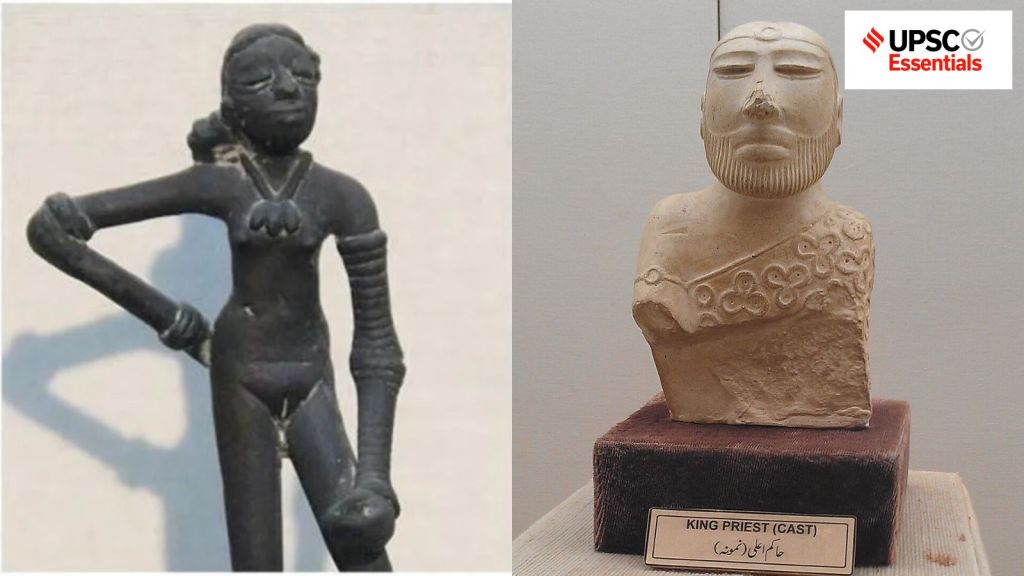 ‘Priest-king’ and ‘dancing girl’ became synonymous with sculpture traditions of the Indus civilisation. (Wikimedia Commons)


 Share


