
How digital transformation of protests is changing the nature of crowd management
The hybrid and decentralised nature of public protests is creating new challenges for governments and prompting law enforcement agencies to adopt technology-enabled approaches to crowd management. How does this create tension between the democratic right to protest and the state’s obligation to maintain public order and safety? What is the possible way forward? See infographics.
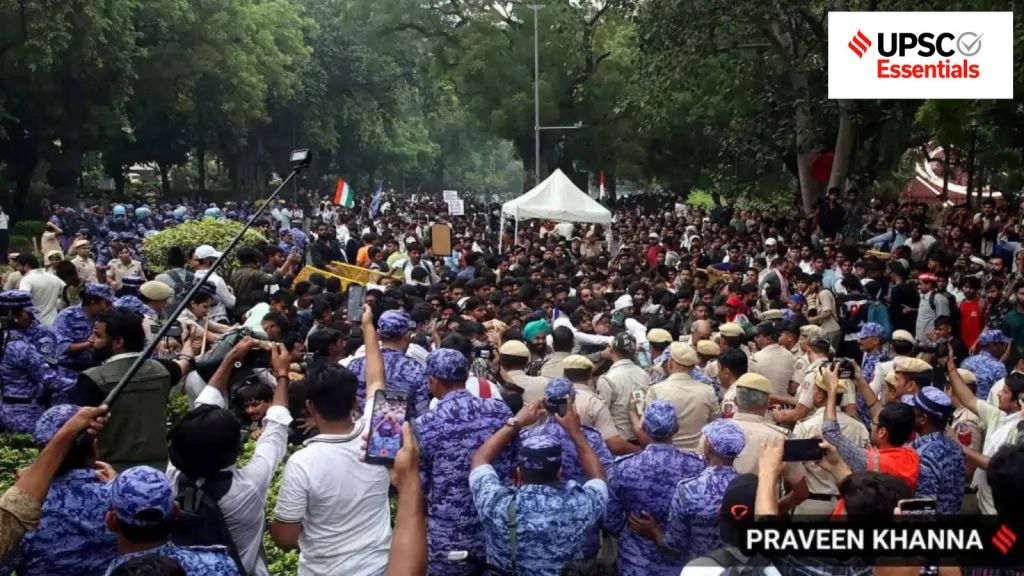 Cockroach Janta Party supporters during the march in July 2026. (Express Photo: Praveen Khanna)
— Dileep P Chandran
Political protests, especially those led by the youth, have become prominent expressions of democratic dissent across the world. The youth are increasingly using digital networks to mobilise support for demanding political accountability, social justice, climate responsibility, employment opportunities, educational reforms, transparency in public recruitment, and economic reforms, among others.

Recently, the Supreme Court quashed FIRs against NEET paper leak protesters following allegations of the use of excessive force by the Delhi Police. The court reminded that the right to peaceful assembly originates from the Constitution, not from the police’s power to regulate or grant permission for public assembly.
These contemporary political mobilisations raise important questions for democratic governance: Is there any constitutional tension between citizens’ right to protest and the government’s obligation to maintain security and public order? How can a state manage large-scale public gatherings democratically and peacefully while safeguarding fundamental rights?
Protest In The Digital Age: Rights, Surveillance & The Law
The right to protest and public order
Although the right to protest is not explicitly written in the Constitution of India, it is protected through the fundamental rights such as the right to freedom of speech and expression under Article 19(1)(a) and the right to assemble peaceably and without arms under Article 19(1)(b). Together, these rights form the constitutional foundation of democratic participation, enabling citizens to express dissent, articulate grievances, and influence public policies. However, like any other entitlement, the right to protest is not absolute.
Article 19(3) permits the state to impose reasonable restrictions on the exercise of the right to assemble peaceably in the interests of sovereignty and integrity of the nation or public order. Similarly, the freedom of speech and expression is subject to the restrictions specified in Article 19(2). These constitutional restraints can also be read along with fundamental duties such as the duty to abjure violence, safeguard public property, as well as laws governing public order and safety.
Nevertheless, the state does not possess the absolute authority to suppress or prohibit protests. In Himat Lal K. Shah vs Commissioner Of Police, Ahmedabad & Anr (1972), the Supreme Court held that the state is not conferred with arbitrary powers to ban public assemblies. The state’s right to regulate peaceable assembly to maintain public order does not amount to blanket restrictions on the exercise of fundamental rights.
International human rights instruments like the International Covenant on Civil and Political Rights (ICCPR) recognise the right to peaceful assembly and require the state to safeguard its exercise. Similarly, the UN Code of Conduct for Law Enforcement Officials and the Office of the UN High Commissioner for Human Rights set standards of human rights and practice for law enforcement agencies to protect human life and dignity. Thus, there is often a tension between people’s right to protest and the state’s obligation to maintain safety and public order.
Evolution of political protest in India
But the tension is not new, as it has accompanied the evolution of political protests and the state’s responses. The history of organised political protests in India can be traced back to the colonial era. The early anti-colonial nationalists, broadly divided into moderates and extremists, differed deeply over the methods of challenging British colonial rule.
Subsequently, Mahatma Gandhi transformed the anti-colonial struggle into a highly disciplined, organised, and largely peaceful mass movement, rooted in his philosophy of ahimsa and satyagraha.
In post-independent India, protests acquired a constitutional character and were largely led by organised political parties, trade unions, and social movements. The response of the government also evolved within the democratic framework, although the nature of such responses often varies across political contexts.
Today, protests, especially those led by the youth, are decentralised, issue-based, and are facilitated by digitally connected networks. The leaderless, fluid and informal structures of these large-scale political gatherings are seen as posing a challenge to democratic governments in managing them peacefully.
Crowd control techniques
Depending on the nature, scale, and degree of protests, law enforcement agencies may employ a range of measures to manage public assembly and maintain public order and safety. Law enforcement agencies in India use a graduated approach to crowd management and employ various techniques in proportion to the nature and level of escalation.
The legal frameworks, including the Bharatiya Nagarik Suraksha Sanhita (BNSS), provide authorities with powers to regulate public gatherings, including their route, location, and timing, issue lawful directions, and take action against those who commit cognisable offences during the protests.
The law enforcement agencies are expected to use civil force against the protesters only as a last resort and in proportion to the real threat of violence. Before the use of civil force, they may seek to engage in dialogue with protest organisers, issue proper legal warning, and employ preventive measures such as barricading to control or disperse the crowd.
Non-lethal and lethal methods
When a gathering becomes unlawful or violent, the police may use non-lethal techniques of de-escalation such as water cannons, grenades, or tear gas. Lathi charge, though not legally defined, is one of the common means of exerting force against an unlawful assembly. These forceful methods of dispersal of crowds are often resorted to when verbal warning, persuasion, advice, negotiation, and barricading are found insufficient to restore public order.
As a measure of absolute last resort, law enforcement agencies may use firearms and pellet guns to disperse crowds. However, the deployment of lethal methods involves risks of death and serious injury and raises questions concerning necessity, accountability and compliance with constitutional and certain international human rights standards.
Apart from these crowd dispersal techniques, the government may use preventive measures to minimise the possibility of violence. For instance, similar to the erstwhile 144 of CrPC, Section 163 of BNSS empowers concerned authorities to issue orders directing persons to abstain from certain acts.
Digital transformation of protests and state response
Contemporary youth mobilisation is increasingly facilitated by digitally interconnected networks, especially through social media platforms. Political mobilisation often begins with social media trends, hashtags, networked discussions, and viral content that subsequently translate to physical demonstrations.
These new hybrid and decentralised movements are often leaderless, informal, non-ideological, unorganised, and anomic (a kind of disorder or violence potential) in character. The rapid expansion of hybrid movements, in contrast to traditional political protests, poses new challenges to governments, including the spread of misinformation, misuse of anonymity, lack of accountability, cyber-attacks, threat of lone-actor attacks, deep fakes, etc.
The digital transformation of protests, in turn, persuaded governments and law-enforcement agencies to adopt new technological approaches to crowd management. These include internet shutdown, biometrics identification, social media regulation, real-time monitoring, body-worn camera, GIS-based mapping, drone surveillance, and AI assisted surveillance. But the deployment of such technologies has also generated concerns over expanded scope of state surveillance and suppression of civil rights.
Therefore, the digital transformation of protests and the growing use of technology for protest management also hint at regulatory gaps and underline the need for clear standards that safeguard citizens’ rights in the digital sphere and the state’s regulatory powers to maintain public order.
A rights-based approach to digital protest management needs to address issues such as freedom of speech and expression, right to privacy and data protection, right against arbitrary ‘censorship’ and excessive surveillance, access to open internet, transparent use of algorithmic transparency, and safeguards governing the collection and processing of biometric data.
Towards a rights-based crowd management
Democratic governments need to move beyond the crowd control techniques that rely primarily on coercion and instead emphasise prevention, communication, and persuasion. Effective crowd management begins before a public protest or even starts and may include communication with organisers, information gathering, risk assessment, personnel training, establishment of a unified incident-command system, issuance of permits, and traffic management.
The response of law enforcement agencies needs to be guided by the principles of legality, proportionality, necessity and non-discrimination. Under no circumstances use of force should be punitive.
The crowd management measures should involve clear regulations, standard operating procedures, independent review and transparent decision making. Communication with transparency, use of technology with accountability, and non-discrimination need to be the preconditions for a democratic crowd management strategy.
To implement these democratic principles effectively, law enforcement agencies may be required to modernise their crowd management techniques. For instance, the Delhi Police used Long Range Acoustic Devices during the 2023 G20 Summit in India to communicate over large distances.
Need to prioritise persuasive strategies
To ensure accountability and transparency, law enforcement officers need to be identifiable through appropriate mechanisms. Where violence is committed by only a small section among protesters, enforcement action can, where feasible, target only those responsible for unlawful conduct rather than treating the entire assembly as a homogenous threat.
As facilitators of lawful public assembly, law enforcement officers need to abide by international human rights standards. The Supreme Court, in various judgements, acknowledged the civil rights of protesters to safeguard their dignity and safety. For instance, in Ramlila Maidan Incident vs Home Secretary, Union of India (2012), the Supreme Court observed that to disturb the sleep of protesters amounts to torture, which is accepted as a violation of human rights. Therefore, law enforcement agencies are expected to function as the facilitators of peaceful public assemblies, not mere controllers of public gatherings.
Ethical and community-oriented policing form the foundations of rights-based and technology-enabled crowd management in India. Strengthening statutory institutions such as the Human Rights Commission, establishing effective grievance redressal mechanisms for allegations of police excesses, ensuring restrained and proportional use of non-local force (such as paramilitary forces), and modernising crowd-management techniques can help reconcile the democratic rights to protest with the state’s obligation to maintain public order and safety. In sum, persuasive strategies of crowd management should be prioritised over coercive methods of crowd control.
Post read questions
1. How has the nature of political protests in India evolved from the colonial period to the age of digitally networked mobilisation? Discuss the implications of this transformation for democratic governance.
2. The decentralised and leaderless character of contemporary protests has altered the traditional relationship between protest organisers and the state. Examine the challenges this creates for public-order management.
3. Digitally enabled protests have created a new paradigm of public-order management. Discuss the opportunities and risks associated with the use of AI, drones, biometrics and real-time surveillance by law-enforcement agencies.
4. Deepfakes, misinformation and anonymous online networks can accelerate mobilisation during political protests. What measures can governments adopt without unduly restricting freedom of expression?
5. What ethical issues arise from the use of facial recognition, biometric identification and AI-assisted surveillance during political protests? Discuss.
(Dileep P Chandran is an Assistant Professor at the Department of Political Science in P M Government College, Chalakudy, Kerala.)
Share your thoughts and ideas on UPSC Special articles with ashiya.parveen@indianexpress.com.
Click Here to read the UPSC Essentials magazine for September 2026. Subscribe to our UPSC newsletter and stay updated with the news cues from the past week.
Stay updated with the latest UPSC articles by joining our Telegram channel – IndianExpress UPSC Hub, and follow us on Instagram and X.

 Share


