
How BRICS seeks reform of global economic governance
Despite extensive networks of bilateral, regional, and plurilateral arrangements, BRICS has yet to move towards a comprehensive trade agreement among its members. Could positive developments in India–China relations pave the way for deeper intra-BRICS economic integration and enhance the grouping’s influence in shaping the global trading system?
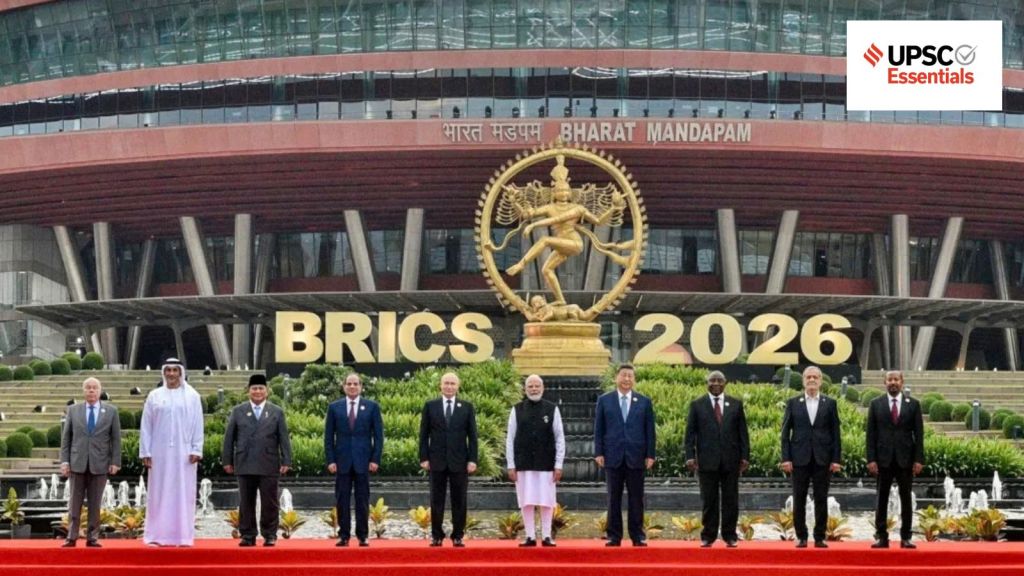 India’s support would be important for deepening economic integration within BRICS, with potential benefits extending across the Global South. (PTI)
Although BRICS is increasingly viewed as a major geopolitical grouping amid a changing global environment, its primary focus has remained economic. Apart from reaffirming its commitment to the 2030 Agenda for Sustainable Development and to preserving and revitalising the multilateral trading system, the Delhi Declaration of the recently concluded 18th BRICS Summit emphasised that “reform of global economic governance remains a consistent BRICS priority.”
It also condemned the imposition of unilateral coercive measures, including unilateral economic sanctions and secondary sanctions. The Declaration further highlighted cooperation on the new industrial revolution, investment platform, digital transformation, resilient global value chains and efficient cross-border payment mechanisms.

Under the Indian presidency, a BRICS Task Force on Growth and Development was also established. As New Delhi focused on an outcome-oriented presidency, the government highlighted more than 60 outcomes across four pillars: resilience, innovation, cooperation and sustainability. A clear focus of the political statements issued by BRICS leaders, as well as the more than 400 official meetings held during the presidency, was also on the concerns and priorities of the Global South.
BRICS at the core of the Global South
The emphasis on the Global South is important against the backdrop of the repeated economic crises experienced by the Global North, including the subprime and Eurozone crises, and the remarkable resurgence of the Global South. The South has emerged as a major force in the global economy, carrying increasing economic, political, strategic, technological and intellectual weight.
The region is home to around 85% of the world’s population and, from just 17% of global income in the 1970s, the economies of Asia, Africa and Latin America now account for more than 42%. Nearly 65% of global inward investment flows to the Global South, while around one-third of global outward investment originates there, compared with just 5% in the 1990s.
South-South trade has expanded dramatically, from around $500 billion in 1995 to approximately $7 trillion in 2025. Global South countries also account for around 20% of global services exports. Beyond trade and finance, the South is also becoming an important force in renewable energy, electric vehicles, artificial intelligence, and digital public infrastructure.
Economic performance of BRICS
Although the economic performance of BRICS members has been uneven, collectively they have significantly outperformed the global average. Between 2003 and 2024, BRICS economies grew at an average annual rate of about 6.2%, compared with around 3% for the world economy. According to a recent UNCTAD report, the ten BRICS members accounted for 28% of global GDP in 2024, up from less than 16% in 2003. Their combined share rises to nearly 40% on a purchasing power parity (PPP) basis.
They accounted for around 24% of global merchandise exports and more than $331 billion in FDI inflows in 2024, equivalent to about 22% of global inflows. Collectively, eleven BRICS members now account for nearly 70% of the Global South’s GDP and around 53% of its trade. A substantial share of this economic weight, of course, comes from China and India, which together constitute the core of the grouping.
So far, BRICS has established two concrete financial institutions: the New Development Bank (NDB) and the Contingent Reserve Arrangement (CRA), each initially endowed with $100 billion. Since its establishment in 2015, the NDB has approved 139 projects worth around $43 billion. The CRA, designed to provide liquidity support during balance-of-payments crises, has not yet been activated as no member has faced a crisis requiring its use.
The NDB has demonstrated that an alternative governance structure is possible. Given the enormous financing needs of the Global South, however, its capital base needs to be expanded substantially.
Moving towards trade integration
Despite their growing economic size and trade capacity, intra-BRICS trade remains relatively modest compared with the group’s overall economic weight. In 2024, intra-BRICS trade accounted for only about 5% of global trade and 20% of South-South trade. While Brazil, China, Russia, and Indonesia have increased the share of intra-BRICS markets in their total exports, other members, including India, the UAE, and Iran, remain relatively less dependent on BRICS markets for their exports.
The Jaipur Consensus during the BRICS Trade Ministers meeting sought to advance balanced trade, digital services, and sustainable economic partnerships among BRICS members. It established a work plan to diversify global value chains and endorsed principles for cross-border trade in digital services.
To facilitate MSME exports, ministers adopted credit assessment principles aimed at addressing gaps in trade finance. Its members are connected through several bilateral trade corridors, including China–Russia, India–China, India–Russia, Brazil–China, China–Indonesia, India–UAE, and India–Saudi Arabia.
They are further linked through a range of trade agreements. For instance, China and Indonesia are connected through China–ASEAN and RCEP (China and Indonesia are connected through China–ASEAN and RCEP frameworks) frameworks; India and Indonesia through the India–ASEAN agreement; India and Brazil through India–MERCOSUR PTA; Brazil and South Africa through MERCOSUR–SACU; India and the UAE through their bilateral CEPA; and Egypt and Ethiopia through COMESA.
Need for deeper trade agreement
Despite these extensive networks of bilateral, regional, and plurilateral arrangements, as well as the broad non-binding commitments made within BRICS, the grouping has yet to move towards a comprehensive trade agreement among its members. BRICS cooperation therefore remains largely focused on soft commitments and sector-specific initiatives rather than deeper trade liberalisation and binding market-access commitments.
Given their combined economic weight and substantial trade potential, BRICS cannot indefinitely avoid serious discussions on a deeper trade agreement if the grouping is to play a meaningful role in shaping global economic governance. A key prerequisite for transforming BRICS into a more cohesive trading bloc will be the development of a common understanding on trade-related issues between India and China.
Moreover, BRICS also holds considerable collective leverage in energy markets, and most of its members play an important role in international development cooperation. A key question is whether the grouping can translate its economic weight into an alternative financial architecture for energy transactions, and develop alternative mechanisms for development cooperation.
Alternative financial architecture and development framework
In 2025, six out of ten top oil producers in the world were from BRICS. Members of the grouping also have huge crude processing capacity. Moreover, many countries, including China, India, Iran, Russia, and the UAE, are already doing some of their energy transactions in local currencies. At the moment, most of these transactions are bilateral. India has also used UAE Dirham and Chinese Yuan to pay for Russian oil imports.
The creation of a single BRICS currency is unlikely to materialise in the foreseeable future. However, BRICS countries may develop an alternative payment mechanism based on their national currencies, at least for trade in key commodities such as energy.
In terms of development, the international development architecture has traditionally been dominated by the 34 members of the OECD’s Development Assistance Committee (DAC). Most BRICS members now play an important role in international development cooperation.
Drawing on the principles of South-South Cooperation (SSC), BRICS could develop an alternative development framework with its own definitions, modalities and evaluation mechanisms for development cooperation. The potential for genuine SSC and greater BRICS solidarity could also be demonstrated through joint projects undertaken by BRICS members in third countries.
Synergies among connectivity projects
Connectivity may be seen as offering an avenue to materialise such cooperation, especially in view of the growing number of connectivity projects involving BRICS countries. BRICS members and partner countries are already involved in several major connectivity initiatives, including China’s Belt and Road Initiative (BRI), the International North-South Transport Corridor (INSTC), the India–Middle East–Europe Economic Corridor (IMEC), and transport connectivity projects under the Eurasian Economic Union (EAEU).
India has serious reservations about some BRI projects, particularly the China-Pakistan Economic Corridor (CPEC), but participates in the INSTC and IMEC and has also announced its own MAHASAGAR initiative.
The key challenge is to create synergies among these different initiatives so that connectivity projects become more economically viable and mutually beneficial. Russia has sought greater alignment between the EAEU and the BRI. Developing a set of common principles for connectivity projects could provide the basis for a broader BRICS connectivity strategy.
India-China: central to BRICS integration
Nonetheless, positive developments in India–China relations could lay the groundwork for deeper intra-BRICS economic integration and enhance the grouping’s collective influence in shaping the global trading system.
The last few key meetings during India’s 2026 BRICS presidency suggest that New Delhi remains strongly invested in the grouping. This was evident not only in Prime Minister Narendra Modi’s interventions during the summit sessions but also in his bilateral meetings with key leaders, including those of China, Iran and Russia.
Since the Kazan Summit, both India and China have repeatedly described themselves as development partners. The recent improvement in bilateral ties, including the eight-point consensus on the boundary issue, signals a new phase in their relationship. If the two countries genuinely embrace the partnership approach articulated by their leaders since Kazan, it could also alter the trajectory of economic integration within BRICS.
The forthcoming Chinese presidency is likely to be ambitious in pursuing integration measures. India’s support would be important for deepening economic integration within BRICS, with potential benefits extending across the Global South.
Post read questions
1. The Global South has emerged as a major force in the global economy, carrying increasing economic, political, strategic, technological and intellectual weight. Discuss the role of BRICS as an institutional expression of Global South agency.
2. BRICS acts as a powerful counterweight in global governance, actively amplifying the voice and influence of the Global South. Explain the role of BRICS in projecting itself as an alternative to other groupings.
3. The New Development Bank (NDB) and the Contingent Reserve Arrangement (CRA) represent two concrete financial institutions established by BRICS. Discuss the significance of these institutions for the Global South. What are the major challenges faced by the two institutions?
4. China’s Belt and Road Initiative (BRI) has transformed South Asia from a regional space into a theatre of great power competition. Analyse the strategic implications of the BRI for India’s security and regional influence in South Asia.
5. If India and China genuinely embrace the partnership approach articulated by their leaders since the Kazan Summit, it could also alter the trajectory of economic integration within BRICS. Comment.
(Gulshan Sachdeva is Professor and Jean Monnet Chair at Centre for European Studies, Jawaharlal Nehru University)
Share your thoughts and ideas on UPSC Special articles with ashiya.parveen@indianexpress.com.
Click Here to read the UPSC Essentials magazine for September 2026. Subscribe to our UPSC newsletter and stay updated with the news cues from the past week.
Stay updated with the latest UPSC articles by joining our Telegram channel – IndianExpress UPSC Hub, and follow us on Instagram and X.

 Share


