
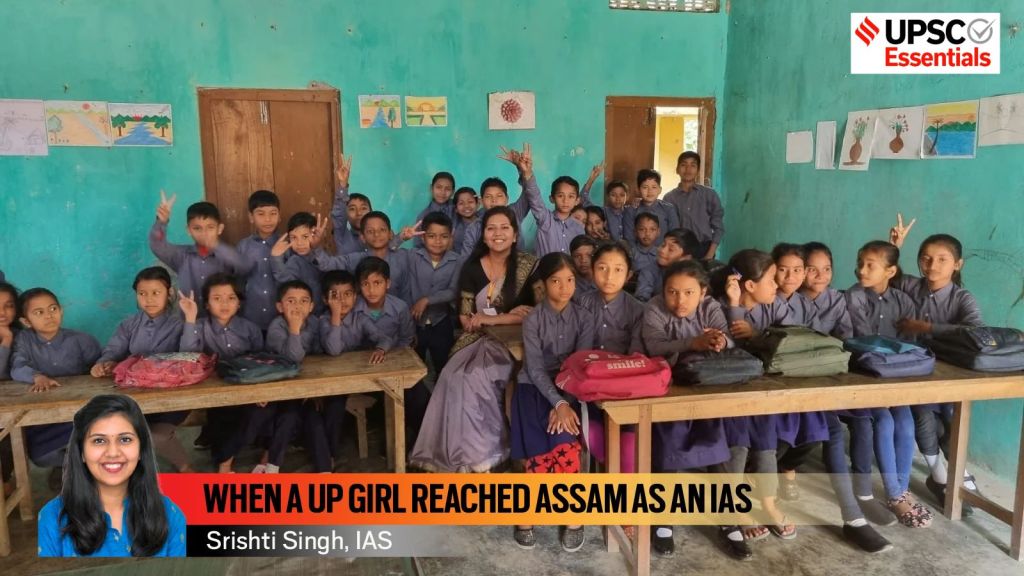
(Cadre allocation is not new to civil servants, but what does it take to adapt to an unfamiliar language, culture and way of life? How did Srishti Singh, IAS, turn her first year in Assam into a journey of self-discovery, resilience and learning?)
Written by Srishti Singh, IAS
Some of the most important lessons of my IAS training began when I realised I did not understand a word being spoken around me.

In the monsoon of 2022, I arrived in Assam after nine months at the Lal Bahadur Shastri National Academy of Administration, Mussoorie, India’s premier training institution for civil servants, ready to begin my year-long district training. I had prepared for the responsibilities of the service, but I was unprepared for the loneliness of an unfamiliar place, the struggle of learning a new language, and the small everyday challenges of living on my own for the first time.
What followed was a year of discovering Assam, its people and, in the process, a version of myself I had not known before.
After countless, excruciating discussions with seniors, batchmates, and anyone who had some knowledge of the region about what life in the Northeast was like, the day finally arrived. One eventful evening, I landed amidst the lush greenery of Guwahati.
For someone who had never moved out of Uttar Pradesh for anything, barring a few tough months in Old Rajinder Nagar, Delhi’s UPSC coaching hub, the moist air of Assam felt fresh. Guwahati, a bustling and vibrant city warmly called the ‘Gateway to the Northeast’, felt intimidating. I was soon to discover what a year-long district training meant for an IAS officer.
I completed my initial training at the State Training Institute and familiarised myself with Assam’s diverse society. Even during those classes, it was almost comical to think how little the rest of the country knew about the region.
Now came the real challenge: a journey to the district that would be my ‘home’ for an entire year.
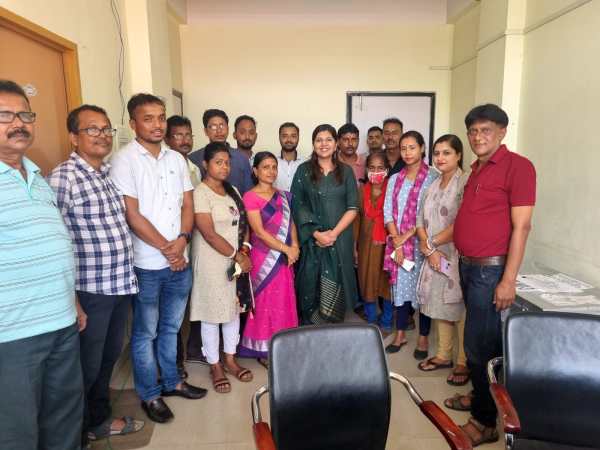 IAS Srishti Singh in Assam.
The first days: A new place, a new language
With shaky hands, I remember opening the door to my room in the District Circuit House. Using the little Assamese I had learnt during our lectures in Mussoorie, I told the cook to prepare breakfast at 8.30 sharp. He didn’t understand a thing, and neither did I when he replied.
Dressed in the best saree I had in my bag, I got ready for my first day at work. Despite the lack of instructions, Das Da, my cook, managed to prepare something I liked after much deliberation with the rest of the staff. Somehow, he kept me fed throughout that year, with very few words understood between us.
On my first morning at the office, I stood at the door 30 minutes early, having memorised my introduction in Assamese. Yet, once again, I couldn’t even convince the office chowkidar, who understood only ‘DC office’ in everything I had to say. He took me to the district commissioner’s PA for assistance.
The PA stood up abruptly on seeing the first IAS probationer in a long time in the district, but he was as clueless about the protocol. After sheepishly waiting to be called in, I gathered the courage to open the DC’s chamber, only to find that sir was already waiting for me.
After a warm three-minute welcome, he asked me to accompany him to the monthly review meeting with the departments scheduled for that day.
Enthusiastically, I thought, this is it! My first meeting. So much to learn.
But then, it was like watching a movie without subtitles for three hours, give or take.
After a brief introduction, DC Sir soon began discussing pertinent subjects, and I slowly dissolved into my chair.
Over the months, my learning curve felt slower than that of my colleagues posted in cadres where they could communicate in the local language. I struggled with my MTS (multi-tasking staff) for months to learn Assamese. This meant that the monthly Assamese assignments sent from the Academy were completed on time. But the real, spoken Assamese came much later.
Learning to live alone
On the domestic front, evenings felt long, with no friends or colleagues to talk to. Unlike most districts, there were no non-native officers in my district at that time. And then came the homesickness, when nothing Das Da cooked felt like home.
An only daughter who had never lived alone, I was now in a town where I knew nothing about the culture, cuisine, or language. But I was not raised a quitter, so there was no option but to adapt. And adapt I did.
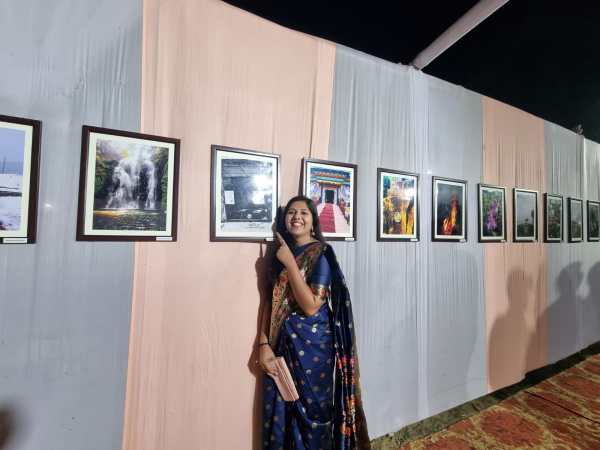 In the early days of her posting, Srishti says it was her hobbies that helped her stay strong.
Initially, my hobbies kept me going. During my preparations, I had picked up mandala art and leisure photography. Writing poetry had always been a remedy after a tough day.
Friends were harder to make, so I stopped staying inside my Circuit House room all the time. Early mornings became gym time, and all my time after work was devoted to anything new I could find.
I read books in libraries and discussed world cinema with my circle officer. Who knew there were moving theatres in Assamese villages or that the Orion Nebula was waiting to be captured in a field during a night of astrophotography?
I became really creative once I let go of the robe of my service.
Beyond duty: Discovering people and stories
I began planning my own office days, taking the liberty afforded by my probationary powers to visit various offices. Officers in the district found it amusing to accompany an IAS officer eager to absorb the mundane routines of their offices.
But the mundane was only the surface. The deeper I ventured, the more stories I discovered.
Every single person I met, whether an assistant, a social worker, a media person, a teacher, or a villager, offered something new to see and learn.
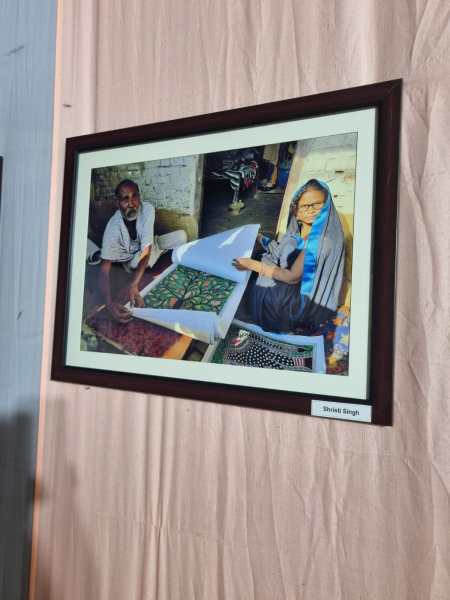 Srishti Singh shares photographs of the people she met, each offering her something new to see, learn and draw inspiration from.
Having lived in Uttar Pradesh, I had grown up shielded from the vagaries of real village life and the hardships of running a business in a mid-tier town. But the beauty of my service is that I could meet and speak to both the most influential and the most destitute people in a place, sometimes in a single day.
I ended up finding more inspiration than the gloominess I had been stuck in.
Food, friendships and the joy of trying something new
When it came to food, my experimentation in Uttar Pradesh had meant switching from tur dal to masoor dal. In Assam, this became another journey of discovery.
I was a born vegetarian, with little to no experience of eating non-vegetarian delicacies, barring a few adventurous encounters with my batchmates in college. But here, food was a love language spoken by everyone.
Wherever I went, people wanted to feed me. And no meal in Assam could end without ‘Maankho’ (meat).
In my initial days, when I was trying to break barriers with other officers, they graciously invited me to their picnics. Those who have lived here know very well how seriously these picnics are taken.
The floodgates of non-vegetarian delicacies opened, and everyone took turns introducing me to new dishes once I started trying them. Before I knew it, I had become a fan of Maansor Tenga and Aloo Pitika, among many others.
Finding freedom, one drive at a time
I had always wanted to drive a car. I tried learning at home, but somehow, my father’s protectiveness meant I never fully took to the driving seat.
My driver, Nabeen Da, became the person who taught me. He was a good teacher, but what really helped was the sense of liberation I felt. In a way, I was also driving my life into the unknown and having the best time.
As difficult as the initial three months were, the rest of the year passed by remarkably quickly.
I still have friends from that gym in my district. My staff still call me on some days to ask if I am doing fine. And nothing since my probation has felt more complete.
The year that changed me
I have had the fortune of heading some noteworthy offices in my short tenure, but none of that would have been possible without this pivotal learning experience.
Had I left in those initial months, I would never have discovered the thrill of speaking to a crowd of thousands, the joy of making a new language my own, or the excitement of eating a local fish for the first time.
I would have missed the warmth of being accepted by a community, not because of any shared culture or sense of belonging, but because of my work and conduct.
My first year in Assam was my metamorphosis: a journey of self-discovery for a young woman stepping into the real world, and for an officer finding her place in the system, one experience at a time.
(The writer is an Indian Administrative Service (IAS) officer of the 2021 batch from the Assam-Meghalaya cadre.)
Do you have an experience from your UPSC journey that you think fellow aspirants should know about? Share your story in the comments or write to us at manas.srivastava@indianexpress.com. Your experience could offer a valuable lesson to others on the same journey.
Subscribe to our UPSC newsletter. Stay updated with the latest UPSC articles by joining our Telegram channel – IndianExpress UPSC Hub, and follow us on Instagram and X.
🚨 Click Here to read the UPSC Essentials magazine for October 2026🚨

 Share


