
— Renuka
Citing concerns over water storage, drought-like conditions, and the possibility of El Niño-related water stress extending into next year, the Maharashtra government has imposed a minimum 10 per cent water cut from October 16.

In its monthly climate update, the World Meteorological Organization (WMO) also warned that this year’s El Niño will intensify before peaking in December and is nearly 100 per cent certain to last until February 2027. The UN climate body said this is likely to bring above-average temperatures to much of the globe and shift rainfall patterns in ways that can increase the risk of droughts and floods in different regions.
The India Meteorological Department (IMD) expects El Niño to strengthen and bring below normal rain over most of the country from October to December, while the 2026 southwest monsoon already ended with a 12.6 per cent rainfall deficit.
These factors could aggravate stress on farms, forests and oceans, and could have cascading effects on people’s lives and livelihoods. How prepared is India to deal with this?
El Niño 2026: What the warning means for India
El Niño’s impact on India’s monsoon
El Niño is the warm phase of the naturally occurring El Niño-Southern Oscillation cycle, a climate pattern that influences winds, pressure and rainfall patterns worldwide. It warms surface temperatures in the central and eastern equatorial Pacific Ocean, and happens when the trade winds that normally blow from east to west weaken. El Niño occurs every two to seven years, though not at regular intervals, and no two events are exactly alike.
Because it changes how air moves in the atmosphere, El Niño can affect weather in many parts of the world, including the Indian monsoon. For India, its significance lies in how a warming of the tropical Pacific can interact with the monsoon and increase stress on water, agriculture, energy, and livelihoods.
The 2026 southwest monsoon (June-September) is a recent example, which ended with about a 13 per cent deficit in rainfall, making it the driest in 11 years, the fourth driest in this century, and the 13th driest since 1901. The last time rainfall fell below 90 per cent of the long-term average was in 2015, another year marked by a strong El Niño.
The shortfall was uneven. East and Northeast India recorded 26 per cent below normal and the South Peninsula 24 per cent below, while Northwest and Central India were 6 per cent and 3 per cent below, respectively. Most of the deficit came in June, which received 65 per cent of the average, and in August, which received 84 per cent.
How broader climate pattern shapes localised conditions
As El Niño generally weakens the Indian summer monsoon, one of its most important environmental implications for India is increased pressure on water resources. While a deficient or uneven monsoon affects the replenishment of reservoirs, groundwater provides an important buffer against rainfall variability. However, greater dependence on groundwater during a weak monsoon can also raise concerns about its long-term sustainability.
The Central Water Commission’s bulletin of September 24 put storage in 178 major reservoirs at about 70 per cent of capacity. This was below the 10-year average of 76.62 per cent and last year’s level of 79 per cent. Southern reservoirs were at about 50 per cent, compared with 87.25 per cent a year earlier. In northern India, water reserves in 11 dams spanning Himachal Pradesh, Punjab and Rajasthan have plummeted from 92.3% last year to 62% of the total storage capacity this year.
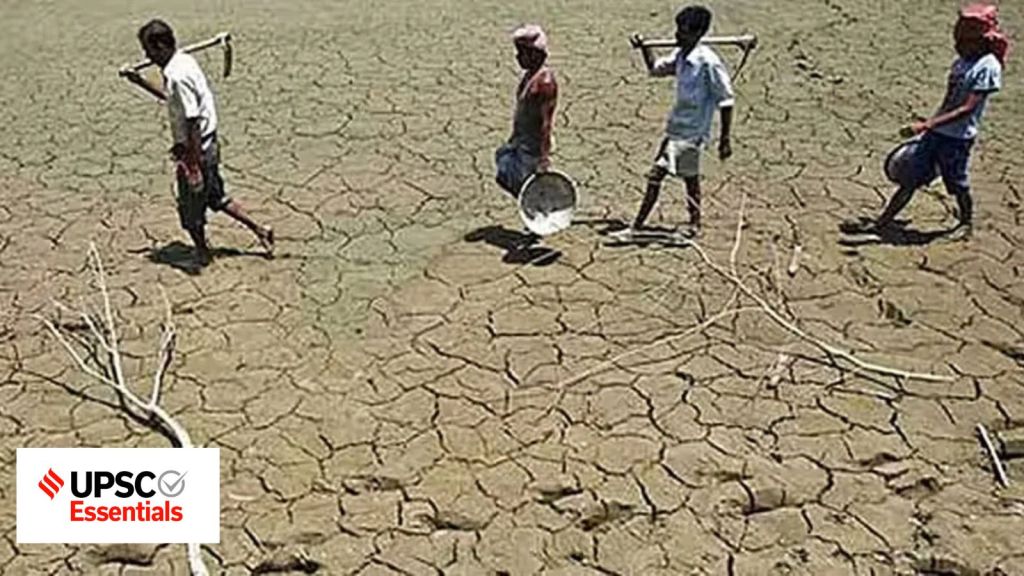
El Niño can also bring higher temperatures and prolonged dry conditions, further increasing evaporation and soil-moisture loss and raising the risk of drought as the monsoon weakens. The situation is already visible across several states: Karnataka has declared 217 talukas drought-affected, while Maharashtra has declared drought in 265 talukas and Andhra Pradesh in 388 mandals across 21 districts. These declarations highlight how deficient rainfall, heat and water stress can translate the broader effects of El Niño into localised drought conditions.
Socio-economic concerns
The socio-economic effects of El Niño are likely to be felt most directly through agriculture, alongside fisheries and coastal livelihoods, and energy.
Agriculture
The Finance Ministry’s May 2026 Monthly Economic Review noted that pulses and oilseeds, which are largely rain-fed, have historically recorded lower acreage, yields and production during El Niño years. Livestock and dairy can also face fodder shortages, lower milk yields and higher feed costs.
These concerns are already visible in 2026, with drought conditions affecting several states and the Centre lowering its 2026-27 foodgrain production target to 373.93 million tonnes. This makes food inflation and food security an important policy concern, particularly if lower domestic production affects the supply of pulses, oilseeds and other essential commodities. India’s substantial foodgrain buffer stocks, however, provide some cushion against supply shocks.
Fisheries and coastal livelihoods
The impact of El Niño also extends to fisheries and coastal livelihoods. The ICAR-Central Marine Fisheries Research Institute has warned that El Niño-related warming could produce marine heatwaves in the northern Indian Ocean in 2027, affecting vulnerable species such as oil sardines and potentially reducing marine fish production. This could affect the incomes of fishing communities and coastal fish farmers.
Energy
Energy is another link. Lower reservoir levels can constrain hydropower generation, while higher temperatures increase electricity demand for cooling. India recorded an all-time peak demand of about 270.8 GW in May 2026, although this cannot be attributed to El Niño alone. The Centre for Research on Energy and Clean Air (CREA) estimates that under its central scenario, India could face an additional 17.7 TWh (terrawatt hour) generation gap from July 2026–June 2027, potentially increasing reliance on coal-fired power.
Heat exposure can also reduce the productivity of outdoor workers and increase health risks. Thus, El Niño is not merely an agricultural or weather concern. It can simultaneously affect food prices, livelihoods, energy demand, and public health.
Is India prepared?
India has several institutions and mechanisms to deal with climate-related risks. The bigger question is whether these mechanisms work together early enough to prevent a climate warning from becoming a crisis.
Forecasting is one area where India has strengthened its capacity. The India Meteorological Department (IMD) issued its first-stage monsoon forecast in April, followed by an updated forecast in May. The 2026 monsoon ultimately recorded about 87 per cent of the long-period average, close to the lower end of IMD’s forecast range.
Agriculture also has mechanisms to respond to rainfall uncertainty. A review at the Prime Minister’s Office on July 7 was told that District Agriculture Contingency Plans had been updated for 262 vulnerable districts, that ICAR had issued standard operating procedures for Krishi Vigyan Kendras, and that weekly Crop Weather Watch meetings were tracking rainfall, reservoirs, sowing and markets.
Preparedness has also moved beyond agriculture. In July, more than 15 ministries, including agriculture, power, health, rural development, drinking water and consumer affairs, met to review El Niño preparedness and develop local strategies.
In addition to this, the Agriculture Ministry identified 315 districts as potentially affected, of which 111 are high-priority because less than 25 per cent of their area is irrigated. These measures show that India has many building blocks of preparedness. The challenge is turning these separate mechanisms into a coordinated system that can act before risks become crises.
Addressing forecast-to-action gap
India has sophisticated forecasts, advisories and contingency plans, but their value depends on whether they change decisions on the ground. The central challenge seems to be the forecast-to-action gap. El Niño affects regions differently, yet national forecasts do not always translate into district-level action on crops, water, health and livelihoods. Governance is also fragmented, with water, agriculture, power, food, and health handled by different departments despite being closely interconnected during a climate event.
India, therefore, needs to move from preparedness based mainly on guidelines and advisories towards anticipatory implementation. First, water security needs to be strengthened by reviving ponds, tanks and other local water bodies, expanding rainwater harvesting and groundwater recharge, and integrating surface- and ground-water management.
Second, agriculture should shift towards climate-resilient crops, including drought- and heat-tolerant varieties, along with suitable pulses, oilseeds and millets. This will require timely access to seeds, irrigation, procurement and price support.
Third, El Niño warnings should trigger pre-agreed district-level actions on drinking water, fodder, agricultural inputs, reservoirs, health preparedness and electricity demand. Gram Panchayats can have a defined role in identifying vulnerable households and water sources, monitoring drinking-water availability, supporting water-body restoration and communicating advisories to farmers.
Finally, preparedness must extend beyond the monsoon to the rabi season and following summer. The objective should be to reduce vulnerability before losses occur, rather than rely primarily on relief after a climate shock has already become a crisis.
Post read questions
1. What is El Niño? Discuss the ocean-atmosphere processes underlying the phenomenon and explain its significance for the Indian monsoon.
2. El Niño is a global climate phenomenon, but its impacts are mediated by regional climatic and socio-economic conditions. Explain its influence on the Indian monsoon and examine why its consequences vary across India.
3. India’s increasing capacity to forecast extreme climate events has not eliminated the risks arising from them. Examine the institutional and governance challenges involved in translating climate forecasts into timely action.
4. How can India make its agricultural systems more resilient to El Niño-induced rainfall variability? Suggest measures at the national, state and district levels.
5. Climate risks cut across administrative boundaries, while governance remains largely sectoral. Examine the challenges this creates for managing events such as El Niño and suggest an institutional framework for integrated climate-risk management.
(Dr. Renuka holds a PhD in environmental law from Himachal Pradesh National Law University, Shimla.)
Share your thoughts and ideas on UPSC Special articles with ashiya.parveen@indianexpress.com.
Click Here to read the UPSC Essentials magazine for September 2026. Subscribe to our UPSC newsletter and stay updated with the news cues from the past week.
Stay updated with the latest UPSC articles by joining our Telegram channel – IndianExpress UPSC Hub, and follow us on Instagram and X.

 Share


