
This long evolution is often missing from discussions today. Many people speak of Buddhism as if it had remained unchanged since the Buddha’s lifetime. In reality, Buddhism had always adapted to different societies and historical conditions. Ambedkar’s Navayana became another stage in this long history of change.
Why Ambedkar chose Buddhism
Ambedkar represented communities that had suffered under the caste system for centuries. Dalits, then called untouchables, faced severe discrimination. They were denied access to temples, schools, wells, and many public spaces. Even if they worked hard or became educated, caste often prevented them from being treated as equals. Ambedkar believed that legal reforms alone would not remove this deep social prejudice. As long as Dalits remained within the Hindu social order, caste would continue to define their lives.
He therefore concluded that liberation required leaving Hinduism altogether. In 1935, he famously declared, “I was born a Hindu, but I will not die a Hindu.” The question then became: which religion should replace it?
Ambedkar studied many religions before making his decision. He examined Christianity, Islam, Sikhism, and Buddhism. Buddhism attracted him because it had originated in India, rejected the authority of the Vedas, and questioned the caste system. The Buddha had accepted people from different social backgrounds into the Sangha and had emphasised morality over birth.
How Navayana reinterpreted Buddha’s message
Yet traditional Buddhism also contained ideas that did not align with Ambedkar’s goals. Much of Buddhist philosophy centred on karma, rebirth, and the search for nirvana. The highest ideal was often to leave behind worldly attachments and escape the cycle of birth and death. Monastic life occupied an important place in Buddhist tradition. Some texts also reflected social attitudes of their own time, including limitations placed on women.
Ambedkar believed that these ideas were not enough to solve the problems facing Dalits in modern India. His followers needed education, employment, political rights, and social equality in this life. They could not wait for better rebirths in future lives. Religion, in his view, should help people transform society rather than withdraw from it.
This is why he created Navayana Buddhism. Navayana did not reject the Buddha himself. Instead, it reinterpreted the Buddha’s message for a modern democratic society. Ambedkar gave less importance to karma, rebirth, miracles, and nirvana. Instead, he focused on reason, equality, compassion, liberty, and social justice. He saw Buddhism as a guide for building a fair society rather than simply achieving personal salvation.
Ambedkar also rejected practices that he believed reinforced caste divisions. He opposed the idea that vegetarianism was a measure of purity because such ideas had often been used to separate communities. He strongly supported gender equality and argued that women should enjoy the same rights as men. In his interpretation, Buddhism became a religion of active citizens rather than isolated monks.
Responding to realities of twentieth-century India
Ambedkar’s decision also came at a time when many groups were trying to claim the Buddha for their own purposes. Mahatma Gandhi admired the Buddha’s emphasis on non-violence and compassion. Jawaharlal Nehru celebrated Emperor Ashoka, who had spread Buddhism after the Kalinga War, as an example of peaceful leadership.
Some Hindu thinkers argued that the Buddha was simply another great teacher within the broader Hindu tradition. Others criticised Buddhism for weakening India’s military strength in ancient times. Ambedkar rejected all these interpretations. By leading a mass conversion, he transformed Buddhism into a movement for social equality.
Navayana Buddhism remains different from older Buddhist traditions, and some Buddhist scholars disagree with Ambedkar’s interpretation. However, this should not surprise us. Buddhism had changed many times before, from early Buddhism to Theravada, Mahayana, and Vajrayana. Navayana was another stage in this long process of adaptation. It responded to the realities of twentieth-century India instead of repeating every idea found in ancient texts.
Ambedkar understood that religion could shape society as much as laws could. The Constitution gave Dalits legal equality, but he believed they also needed a moral and spiritual identity that affirmed their dignity. By reimagining Buddhism, he created a movement that offered millions of people hope, self-respect, and a sense of belonging. Whether one agrees with every aspect of Navayana or not, it remains one of the most important examples of how an ancient religion was reshaped to meet the challenges of a modern democratic society.
(Devdutt is a renowned mythologist who writes on art, culture and heritage.)
Post read questions
1. Why did Dr BR Ambedkar create Navayana Buddhism? Did it reject the Buddha himself, or reinterpret his message?
2. Buddhism’s historical adaptability created the intellectual space for Ambedkar to reinterpret it according to the needs of modern India. Elaborate.
3. Examine the relationship between religion, social reform and political emancipation in Ambedkar’s thought. How did Navayana reflect this relationship?
4. Compare Ambedkar’s interpretation of Buddhism with the traditional Buddhist emphasis on individual spiritual liberation. How did his reinterpretation serve the cause of social justice?
Share your thoughts and ideas on UPSC Special articles with ashiya.parveen@indianexpress.com.
Click Here to read the UPSC Essentials magazine for September 2026. Subscribe to our UPSC newsletter and stay updated with the news cues from the past week.
Stay updated with the latest UPSC articles by joining our Telegram channel – IndianExpress UPSC Hub, and follow us on Instagram and X.

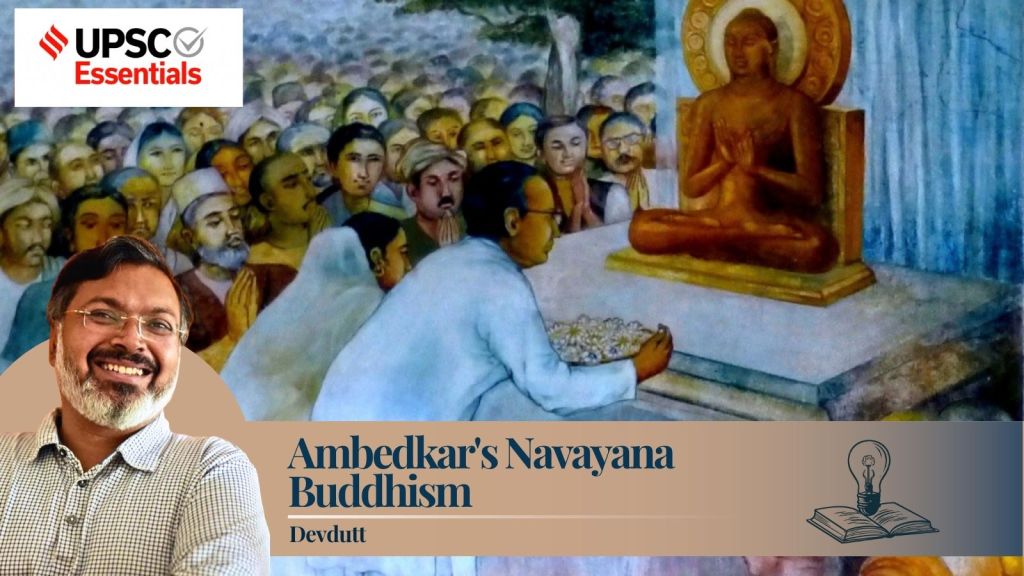 An artistic representation of Dr Ambedkar and his wife, Savita, embracing Buddhism in 1956. (Wikimedia Commons)


 Share


