
Conflicts in West Asia: Post-Assad Syria grapples with deep divides
Post-Assad Syria faces a daunting path ahead, marked by deep societal divisions, polarisation, and institutional collapse. How might ethnic, sectarian, and ideological divisions among the rebels and opposition affect efforts for national reconciliation in the country?
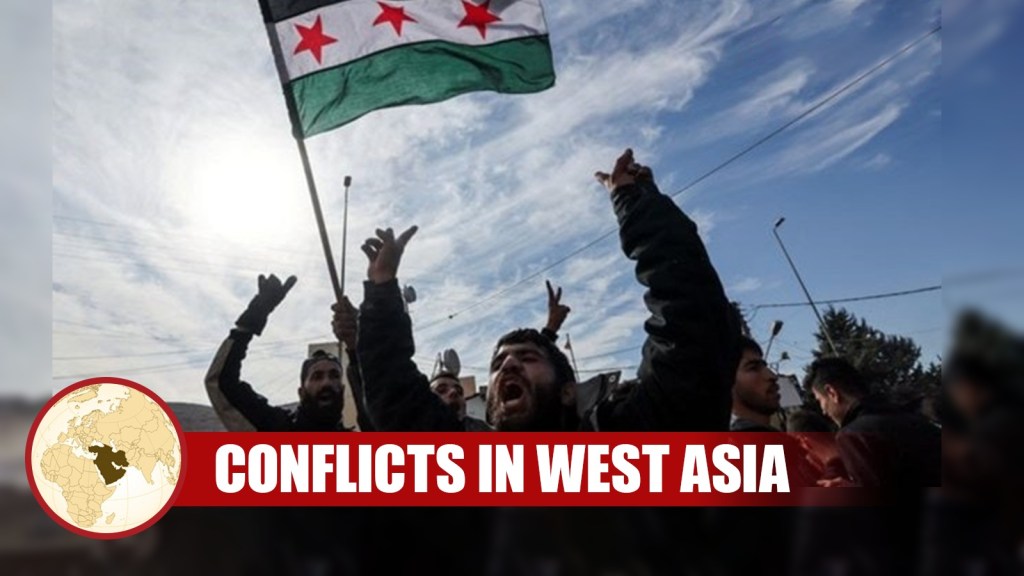 A man waves a Syrian opposition flag as people celebrate at Masnaa Border Crossing, after Syrian rebels announced that they have ousted President Bashar al-Assad, Lebanon, December 8, 2024. REUTERS/Amr Abdallah Dalsh
(There are areas in the world that remain beset by conflicts. West Asia is one such region that has been in the grip of conflicts at least since the mid-20th century. The escalation after the outbreak of the Israel-Hamas war further upended the political landscape of the region. What are the prospects for containing the conflicts? How does regional instability affect India’s interests? We will feature a series of articles on major conflicts in West Asia, exploring the root cause of the conflicts, the reasons behind the recent escalation, and its effect on India’s interests.)
On November 8, the news emerged of Bashar al-Assad fleeing Syria, and soon, the Hayat Tahrir al-Sham (HTS) announced its entry into the capital Damascus. The events were indeed historic, bringing curtains on the 24-year rule of Bashar al-Assad, the 50-year rule of the Assad family, and the 57-year Ba’athist rule in Syria.

The end of Assad’s rule in Syria, however, does not guarantee peace and stability. The road ahead is full of challenges. Society is divided and polarised, the political system and security apparatus are destroyed, and the economy and infrastructure are in shambles. On top of it, the rebels and the opposition are divided into factions and are largely organised on ethnic, sectarian and ideological divisions.
Moreover, the remnants of the Assad family rule and the minority Alawite community remain skeptical of the future. The situation is accentuated by the fact that the HTS, the group that has emerged on top in post-Assad Syria, has a Salafi-Jihadist ideology known for intolerance, violence and fundamentalism.
But why are the remnants of the Assad family rule and the Alawite community skeptical about the future? How do ethnic, sectarian, and ideological divisions within the opposition hinder Syria’s path to peace and stability?
Syria’s turbulent origins: From Ottoman ashes to French rule
Syria has historically suffered from political instability since its inception. The country emerged from the ashes of the Ottoman Empire. After the initial hope of being the bastion of a unified Arab nation under the leadership of King Faisal, the son of Sharif Hussein of Mecca, in 1919-20, the country came under French colonial rule. The turn of events was the culmination of a few watershed historical developments, i.e. World War I, the 1916 Arab Revolt, the Hussein-McMohan Correspondence and the Sykes-Picot Agreement.
Syria remained under French rule from 1920 to 1946, when it was divided into two separate political entities – Syria and Lebanon. Under the French mandate, Syria suffered political instability, demographic divisions and economic decline. However, French rule was also instrumental in instilling a sense of Syrian nationalism among the intelligentsia and the masses.
Many Syrian nationalists, inspired by the intellectual ideas of scholars such as Jurji Zayda, Butrus al-Bustani and Abd al-Rahman al-Kawakibi, began to propagate the concept of a modern and independent Syria. The dream was realised in 1946 under the leadership of Shukri al-Quwatli. However, the country and its leadership could not bridge the serious political, demographic, religious and sectarian divides that had taken root under the French mandate.
The Ba’ath Party and the Assad family’s rule in Syria
After several coups and counter-coups, Syria was taken over by the Arab Ba’ath Party in 1963, but the political and ideological divisions continued to afflict the country. Hafez al-Assad, a soldier from the Alawite lineage who had risen through the party hierarchy to become Defence Minister of Syria in 1966, eventually took over the state through an intra-party rebellion and became the Prime Minister in 1970 and President in 1971.
Assad gradually consolidated power under him, eliminated any dissenting voices within the Ba’ath Party, and cracked down on all opposition.
Thus began the Assad family rule with the support base mainly among the minority Alawite community that filled the bureaucracy and military of Syria.
Notwithstanding the autocratic nature of Hafez al-Assad’s rule, the country witnessed a phase of political stability, economic development and social progress, especially as education and women’s rights were prioritised. The Ba’ath Party rule also meant that Syria became an ally of the Soviet Union and remained steadfast in its support of the Palestinian cause.
Simmering discontent and Syria’s uprising
The disintegration of the Soviet Union pushed Syria into isolation. When Bashar al-Assad, Hafez’s son, succeeded him in 2000, he chose the path of gradual economic opening. He brought reforms to end Syria’s isolation from the West and the neighbourhood. Relations with Türkiye, Europe and Gulf Arab states improved between 2000 and 2010, and a phase of relative stability and development ensued.
Nonetheless, beyond the surface, social inequality, marginalisation of the majority communities, youth unemployment and the lack of political freedom and rights remained a serious problem. Therefore, despite the improved economic situation, a large section of Syrians remained on the margins as the wealth and power were appropriated by the Assad family, its close aides and the Alawite community.
More importantly, the continuation of a police state apparatus that had been established under Hafez and that Bashar had inherited meant that the discontent among the majority of Syrians continued to simmer. Hence, the trigger ignited by the uprising in Tunisia soon engulfed Syria.
Syria between 2011 and 2014
As the 2011 protests against his rule began in Dera’a city in southern Syria and spread to other parts of the country, Bashar al-Assad employed the military to crush the uprising. But the protests soon turned into a mass rebellion, with demands for regime change echoing through the streets. The Syrian opposition groups began to organise themselves into an armed resistance movement. They secured regional and international support from Türkiye, Saudi Arabia, Qatar, Jordan, the United States, France and Germany.
The regime nonetheless continued to use military power to crush the rebellion. Consequently, Syria devolved into a civil war, leading to one of the worst phases of violence and bloodshed in its modern history. According to conservative estimates, over half a million Syrians were killed between 2011 and 2024, while another 7-8 million became either internally displaced or fled the country to seek refuge in the neighborhood and beyond.
The Assad regime, after facing serious reverses against groups such as the Free Syrian Army (FSA), Ahrar al-Sham, Jabhat al-Nusra, and the People’s Protection Unit (YPG), sought and secured support from Iran, Hezbollah and Russia. The Russian military intervention that came in September 2015 proved decisive in preventing the fall of Assad at the time.
Civil war’s endgame
The Syrian civil war began to wind down by late 2018 as the combined military power of Russia, Iran, Hezbollah and Syrian Armed Forces nearly decimated the rebel groups. Only a few pockets of opposition strongholds remained, most notably of the HTS in the northwest (Idlib) and the Syrian Democratic Forces (SDF) in the north and northeast (Rojava).
The changing realities on the ground meant that the regional countries adjusted their positions, and Syria and Assad were welcomed back into the Arab League in 2023. The UAE, Egypt, Saudi Arabia, and Jordan were at the forefront of bringing Syria back into the Arab mainstream.
However, as Russia invaded Ukraine in March 2022 and got embroiled in a prolonged and ongoing conflict and Iran and Hezbollah got mired into a war with Israel triggered by the 7 October 2023, attacks by Hamas and Palestinian Islamic Jihad (PIJ), Syria no longer remained a priority for them.
The end of the road for Assad
The HTS, an armed Islamist group led by Abu Mohammed al-Golani, a former Al-Qaeda and Islamic State in Iraq operative, sensed an opportunity and began an offensive against the Syrian regime forces on 27 November 2024. It first took Aleppo and started a march towards Hama and Homs, and as the regime forces capitulated without much resistance, Assaad rushed to Moscow to secure military support.
Russia, busy in its war in Ukraine, was not forthcoming. Moreover, Hezbollah, severely weakened due to the Israeli onslaught, and Iran, under immense pressure due to the conflict with Israel, were in no position to offer support. Hence, within a matter of 10 days, the course of Syrian history changed as Assad found himself isolated and without the external support that had saved his regime once after the 2011 uprising.
The HTS emerged in 2017 after the merger of several Islamist factions with the largest group, the Jabhat Fateh al-Sham (JFS). The JFS was a reincarnation of Jabhat al-Nusra after Golani had decided to break off ties with al-Qaeda in 2016 and focus the group’s energies on securing and governing Idlib instead of pursuing a global jihadist agenda. The developments in Idlib were a culmination of Türkiye’s efforts to gain a foothold in northern Syria to neutralise the SDF, an umbrella organisation led by Kurdish nationalists and militants that Ankara views as a national security threat.
Challenges ahead
Post-Assad Syria faces a daunting path ahead, marked by deep societal divisions, polarisation, and the collapse of both its political framework and security institutions. Compounding these challenges is an economy in ruins and infrastructure devastated by years of conflict. Consequently, a commitment by all groups, factions and communities to work together and avoid violence and appropriation of power will be the first step towards a brighter future for Syria.
It would entail a guarantee not to let Syria turn into a hub of terrorism that can destabilize the country and the region. Thirdly, the new political dispensation will have to work with all groups and communities to evolve a political system that recognizes and respects the identities, cultures and practices of all individuals and groups. Finally, the country will have to work with all the neighbors to focus on the developmental needs of the people and avoid contentious issues.
Undoubtedly, these are the early days of post-Assad Syria. The challenges ahead are numerous and humungous. The euphoria seen on the streets of Syria, if not channelized to build a collective and prosperous future, will not take much time to devolve into anger and discontent, the consequences of which could be more devastating than what Syria has witnessed until now.
Post Read Questions
Why does the end of Assad’s rule in Syria not necessarily guarantee peace and stability?
Although the Hayat Tahrir al-Sham (HTS) has struck a more liberal, conciliatory note towards minorities recently, what are the implications of its Salafi-Jihadist ideology on Syria’s prospects for stability and peace?
How do ethnic, sectarian, and ideological divisions among the rebels and opposition hinder Syria’s path to peace?
In what ways might international actors play a role in addressing the challenges faced by post-Assad Syria?
What strategic opportunities and challenges does a post-Assad West Asia present for India? What role should India play in the reconstruction of the post-Assad Syria?
(The author is an Associate Professor of Middle East studies at Jawaharlal Nehru University, New Delhi. Views are personal. @MuddassirQuamar )
Read other articles from the series on Conflicts in West Asia:
Conflicts in West Asia: India’s trade and diaspora at risk amid prolonged Gaza War
Conflicts in West Asia: Implications of escalating Gaza war for India
Conflicts in West Asia: Israel-Iran war of abrasion
Conflicts in West Asia: A brief history of the Israel-Palestine conflict
Conflicts in West Asia: Iraq in disarray
Conflicts in West Asia: Israel-Hamas war and the Yemen quagmire
Conflicts in West Asia: Kurds and their struggle with statelessness
Share your thoughts and ideas on UPSC Special articles with ashiya.parveen@indianexpress.com.
Subscribe to our UPSC newsletter and stay updated with the news cues from the past week.
Stay updated with the latest UPSC articles by joining our Telegram channel – IndianExpress UPSC Hub, and follow us on Instagram and X.


(The author is an Associate Professor of Middle East studies at Jawaharlal Nehru University, N... Read More
 Share


