
Can small loans change women’s lives?
Microfinance has assumed vital significance for women’s economic empowerment and development. Why is this seen as a potential pathway through which women may improve their bargaining power and agency? What more is needed for small loans to bring about lasting change? See infographics for key insights.
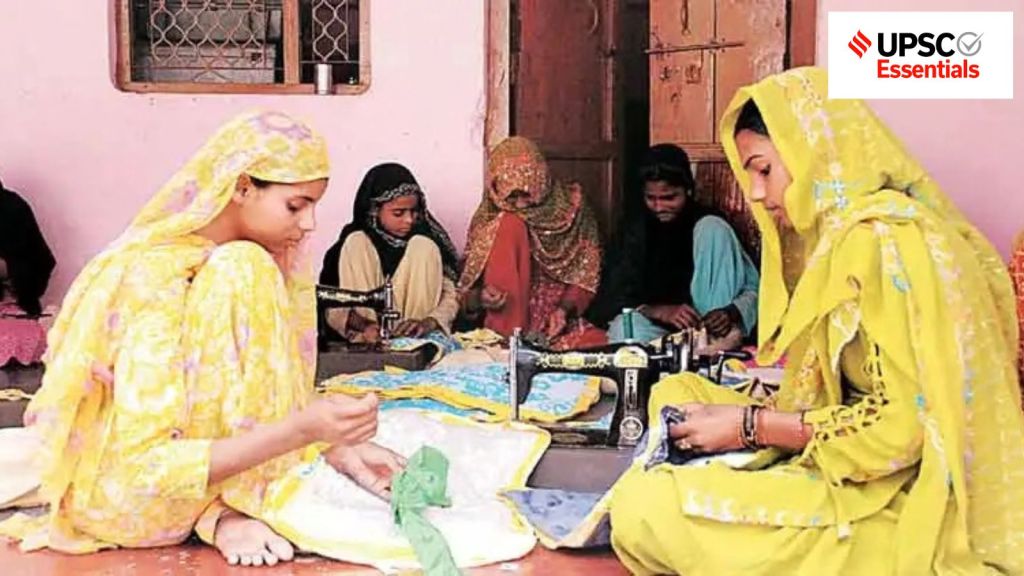 Employment creation, education, vocational education, and infrastructure may need to complement access to microloans to fully exploit their developmental potential. (Representational image)
— Ritwika Patgiri
Women account for barely 5.5% of enrolment in engineering trades such as electrician, fitter, welder, etc. across Industrial Training Institutes (ITIs) between 2019 and 2024, according to a new working paper by NITI Aayog.

The limited participation of women in core technical trades points to the gendered patterns in education, skills, and occupational choices, and, by extension, constrains their access to skilled employment and economic opportunities.
In addition to skills and employment, access to finance is equally important for women’s economic empowerment. In this broader context of development and economic empowerment of women, microfinance has assumed vital significance. It is seen as a way towards entrepreneurship, economic freedom, and rural development.
It has been nearly five decades since the economist Muhammad Yunus pioneered the microcredit model in 1976 and founded the Grameen Bank of Bangladesh in 1983. In this model, women borrowers are organised into Self-Help Groups (SHGs), which are entitled to borrow as per their individual or group requirement from the lending institutions.
However, concerns regarding the effectiveness of microfinance programmes, their impact on rural women’s indebtedness, and evolving ideas of empowerment have led to questions on the socio-economic and political role of microfinance.
India's microfinance model: how it works, how far it has grown, and why loans alone may not empower women
What is microfinance?
Both the Reserve Bank of India (RBI) and the National Bank for Agriculture and Rural Development (NABARD) define microfinance as “the provision of thrift, credit, and other financial services and products of very small amounts to the poor in rural, semi-urban or urban areas for enabling them to raise their income levels and improve their living standards.”
The microfinance model seeks to target women borrowers, provide small amounts of loans, and focus on social collateral (intangible assets like a person’s reputation) rather than physical collateral (tangible assets). In doing so, it aims at addressing three challenges that the rural poor face in the credit market: the difficulties in targeting or identifying borrowers, screening of borrowers, and enforcement of credit contracts.
Notably, in many countries, microfinance developed through the networks of Non-Government Organisations (NGOs), which were often aided fully or partially by foreign donors for lending. India’s experience in microfinance, however, is different.
India’s unique microfinance model
First, India involved a commercial banking network to provide microloans. A linkage was established among SHGs, NGOs, and banks, whereby NGOs support the establishment of SHGs, which become entitled for credit after a certain level of maturity in internal thrift (savings) and credit operations. This model is unique to India.
Second, India’s microfinance experiment saw thrift as the basis and not credit. SHGs were encouraged to inculcate the habit of saving within the group, manage finances, and give loans internally. Their savings can be deposited in a bank, which connects SHGs to the banking network and enables them to negotiate for credit. This SHG-Bank linkage dates back to 1992, when NABARD initiated a pilot of 500 SHGs.
Another model of microfinance is known as the Microfinance Institution-led Joint Liability Group (JLB) model, which has become the dominant model of microfinance. The SHG-led model has expanded significantly in India. As of December 2025, 10.05 crore households in India have been mobilised into 90.91 lakh SHGs under the Deendayal Antyodaya Yojana – National Rural Livelihood Missions (DAY – NRLM).
At the same time, the number of borrowers and the gross loan portfolio of MFIs grew exponentially. The number of active borrowers of microloans has gone up from 330 lakh in FY 2014 to 627 lakh in FY 2025, according to the Economic Survey of India 2025-26. During the same decade, the gross loan portfolio of microfinance institutions increased from Rs 33,517 crore to Rs 2,38,198 crore, with branch networks expanding from 11,687 branches to 37,380 branches.
Evolution of institutional credit in India
The history of the Indian development trajectory shows that institutional lending has been seen as an effective way of poverty alleviation. However, there were concerns over large informal money lending with high interest rates. For instance, the All-India Rural Credit Survey (ALRCS) of 1954 found that formal credit institutions provided less than 9% of the total rural credit needs while moneylenders, traders, and rich landlords accounted for more than 75% of the total rural credit.
In the 1950s and 60s, rural branches of commercial banks were few in number. This was despite an RBI directive in 1954 that mandated banks to open at least one branch in every rural and semi-rural area for every branch opened in previously banked areas. However, till the early 1970s, the share of banks in rural credit was around 2.4%.
On July 20, 1969, India nationalised 14 commercial banks with the intention to take banking to the rural areas, make credit accessible for agriculture and small industries, and promote entrepreneurial pursuits. Consequently, domestic commercial banks were instructed to allocate 40% of their loanable funds to priority sectors, including agriculture and rural development.
From SEWA to NABARD
Soon after, a cooperative bank under the RBI and the government of Gujarat was registered under the name of SEWA (Self-Employed Women’s Association) Bank in 1974. This bank emerged as a model of financial inclusion for rural poor and self-employed women. In 1975, Regional Rural Banks (RRBs) were set up to provide credit to the rural poor in low-credit regions.
The All-India Debt and Investment Survey of 1981 found that India’s formal financial sector’s share in aggregate credit was more than 60%. Subsequently, the government focused more on expanding institutional credit as part of rural development. The establishment of NABARD in 1982 helped poor and self-employed people get access to subsidised credit via banks.
From 1987 to 1992, for instance, NABARD conducted studies on SHGs and financially assisted an NGO in supporting the SHGs. Around the same time, Bangladesh was experimenting with a different approach to provide credit to the rural poor.
The case of Bangladesh
Bangladesh is often cited as the most successful example of microfinance and its role in socio-economic development. In the 1980s, the country saw the growth of many NGOs, which experimented with different rural credit models. However, by the 1990s, research pointed out that the Grameen model of microfinance was not sufficient to meet the needs of the rural poor.
As a result, the NGOs and MFIs started providing a range of services, including life insurance products, input supply, skill training, scholarship programmes for female students, community health programmes, legal literacy programmes, etc., along with microcredit. Studies on the impact of microfinance in Bangladesh have highlighted its role in helping women acquire assets of their own, exercise power in decision-making, and lead to a long-term increase in household consumption.
A 2005 study supported by the World Bank found that microfinance in Bangladesh has the potential to lift 1% of the population from poverty by reaching a quarter of the population. But concerns have been raised over the NGO-led development model of the country.
Nayma Qayum, in Village Ties: Women, NGOs, and Informal Institutions in Rural Bangladesh (2021), argues that NGOs have played a complicated role in the development process of the country. While NGOs can work as agents of the neoliberal State, they can also provide vital services in the absence of the state. But the growing role of the NGOs also led to a shift in the development narrative of the country from “collective mobilisation” to “service delivery”, where women are largely perceived as only welfare recipients.
Microfinance and women’s empowerment
Nonetheless, such narratives do not change the gendered and structural realities of women. Some studies found that participation in microfinance can also lead to an increase in domestic violence against women, as it challenges the traditional gender roles. Feminist economist Naila Kabeer argued that access to microfinance does not automatically “empower” women.
While microfinance has a positive impact on children’s education, food distribution at home, and less malnutrition among girl children, its contribution to women’s increased participation in household decision-making is more complex. Thus, microfinance, like other policies such as education, access to political quota, and access to waged work, can be seen as one of the potential pathways through which women may improve their bargaining power and agency.
Recent critiques on microfinance also point out the increasing debt of poor women. In their book The Indebted Woman: Kinship, Sexuality, and Capitalism (2023), Isabelle Guérin et al. explain the gendered nature of debt in South Arcot, Tamil Nadu.
They find that while mainstream development programmes and microcredit institutions often view women borrowers as impulsive or ignorant, low-income women are neither passive nor foolish victims of finance. But in the context of wider social perception, female debt is usually seen as both a form of obedience and exploitation.
Why microloans alone may not work
However, it is difficult to measure poor women’s indebtedness for a number of reasons. First, debt is usually organised at the household level, which makes it difficult to isolate women’s individual indebtedness. Second, development policies often focus on financial exclusion and not on indebtedness. And finally, data unreliability is another key issue in debt measurement.
The empirical evidence from South Arcot found that 99% of the households in the area are indebted. Recent studies and surveys have also documented instances in which women experience several forms of harassment in the course of loan collection.
These critiques draw attention to the assumptions underlying microfinance experiments in India and in the Global South. One common criticism is that microfinance programmes implicitly assume that rural households and women are all potential entrepreneurs, who primarily lack capital but have viable investment opportunities.
However, rural economies in India are largely marked by small and labour-intensive businesses. Loans without the creation of more customers and markets may not have the desired impact of microfinance. Non-farm self-employment is often distress-driven and are forms of and may involve survival-oriented strategies. Hence, employment creation, education, vocational education, and infrastructure may need to complement access to microloans to fully exploit their developmental potential.
Post read questions
1. Access to credit is a necessary but not sufficient condition for women’s economic empowerment. Discuss in the context of Self-Help Groups (SHGs) and microfinance in India.
2. To what extent can SHGs address the structural constraints faced by rural women in accessing employment, skills and productive assets?
3. Trace the evolution of institutional rural credit in India from the dominance of informal lenders to the emergence of SHG-based microfinance. What explains this transformation?
4. What are the distinctive features of the Indian microfinance model? How does the SHG–Bank Linkage model differ from the MFI-led Joint Liability Group model?
(Ritwika Patgiri is a doctoral candidate at the Faculty of Economics, South Asian University.)
Share your thoughts and ideas on UPSC Special articles with ashiya.parveen@indianexpress.com.
Click Here to read the UPSC Essentials magazine for September 2026. Subscribe to our UPSC newsletter and stay updated with the news cues from the past week.
Stay updated with the latest UPSC articles by joining our Telegram channel – IndianExpress UPSC Hub, and follow us on Instagram and X.

 Share


