
— Pushpendra Singh and Archana Singh
What might a richer coastline look like? It could mean more ports, bigger ships, and higher seafood exports. It could also mean higher income for fishing families, clean waters, and better protection for coastal villages from storms.

An integrated approach that balances these objectives will be crucial to making India’s Blue Economy inclusive and sustainable. As the Blue Revolution is set to be another success story, let’s understand how India seeks to harness its marine wealth.
Ocean as the engine of growth
For decades, India’s infrastructure story was written largely on land. Roads connected markets, railways moved freight, and industrial corridors attracted investment. The sea entered this story mainly through ports and trade. Now, India is looking at the ocean as a wider economic space for fisheries, tourism, energy, research, and new industries.
India’s blue economy ambitions are complemented by its 11,098 km of coastline. The blue economy refers to the sustainable use of ocean and coastal resources to support economic growth, jobs and livelihoods, while protecting marine ecosystems. Its scope extends beyond fishing and shipping to emerging fields like marine biotechnology and ocean energy.
India’s maritime activity is already growing. The country’s major ports handled 915.17 million tonnes (MT) of cargo during FY 2025–26, marking a year-on-year growth of 7.06%. This underscores the growing efficiency of India’s maritime sector.
India's blue economy: the coastline, the capital and the lessons from abroad
Building India’s blue economy
Alongside its extensive coastline, India’s maritime infrastructure supports around 95% of the country’s trade by volume. As the government aims to increase the maritime sector’s contribution to GDP significantly by expanding maritime infrastructure, Sagarmala has played a crucial role in this. The ambitious port-led infrastructure development programme, launched in 2015, has supported port-led development through various initiatives.
Around 845 projects, estimated at Rs 6.06 lakh crore, have been taken up under the Sagarmala programme, according to an assessment by the government. As of March 24, 2026, around 315 projects worth Rs 1.57 lakh crore have been completed, while 210 projects are currently under implementation, and 320 projects are in the planning stage.
Better links between waterways, ports, roads and railways can improve freight movement, reduce transport costs and strengthen the competitiveness of Indian businesses. But the blue economy is not merely about transport. It also encompasses food security, energy, livelihoods and the scientific knowledge needed to manage ocean resources sustainably.
Fisheries, economy, and livelihoods
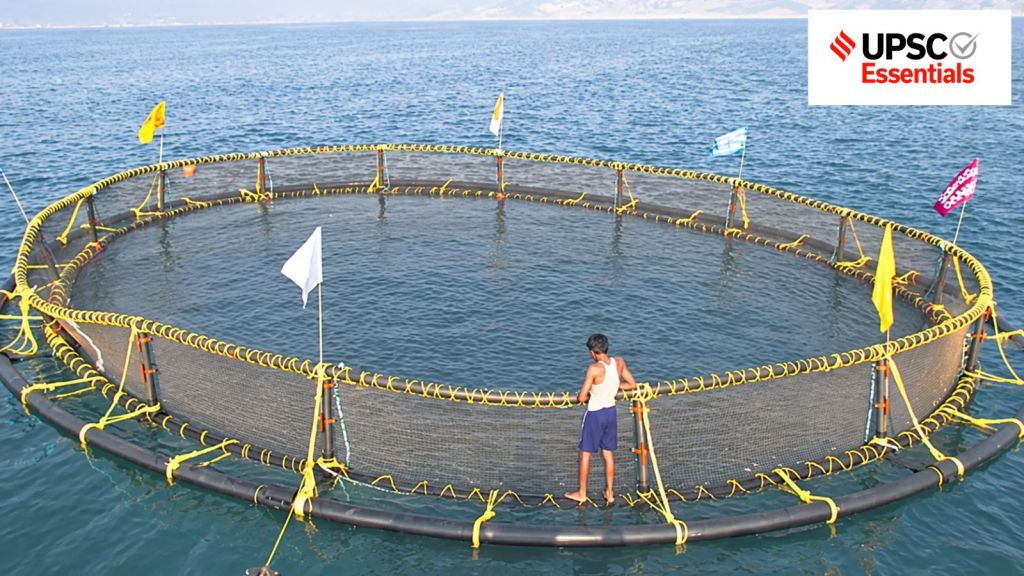
Fisheries show how closely economic opportunity is linked with everyday life. The sector supports nearly 30 million livelihoods through inland fisheries and aquaculture, not just marine fishing. This distinction matters when discussing coastal development.
The fisheries sector has evolved into a commercially significant sector over the past decade. India is now the second largest fish-producing country and accounts for about 8% of global fish production. Its seafood exports span a wide and diversified basket, with over 350 varieties of products shipped to nearly 130 global markets.
Seafood export earnings registered a strong growth, rising from Rs 62,408 crore in 2024-25 to Rs 73,890 crore in FY 2025-26 (an increase of about 18.4%). While the growth underscores the sector’s economic potential, translating this into returns for producers and workers remains important.
For fishing families, this requires safe landing facilities, ice plants, cold storage, affordable credit and access to markets. Better processing can reduce losses and raise earnings without putting additional pressure on fish stocks. Cooperatives can improve bargaining power, while women in processing and marketing may also need stronger support.
Investing in new ocean opportunities
Further offshore, India is exploring new possibilities. A 7,453-crore government scheme supports the development of one gigawatt of offshore wind capacity – 500 MW each off the coast of Gujarat and Tamil Nadu – along with port upgrades. These are planned investments, rather than operating capacity.
The 4,077-crore Deep Ocean Mission covers underwater technologies, biodiversity, ocean observation and deep-sea exploration. The research into seabed resources may widen future opportunities, but exploration does not establish that commercial extraction is ready or environmentally sound.
However, these activities show why maritime development needs different kinds of finance. Ports require large investments with long repayment periods. Fishing enterprises need smaller loans and insurance. The research and conservation often require public funding, as their benefits far outweigh commercial returns.
Blue bonds and the maritime financing gap
How can India bring long-term capital into this expanding economy? Blue bonds offer a route. A blue bond is a borrowing instrument whose proceeds are reserved for sustainable water and ocean-related projects. Like a conventional bond, it must be repaid with interest. Its distinguishing feature is the specified use of funds and environmental reporting.
Market regulator Securities and Exchange Board of India (SEBI) recognises the potential of blue bonds for the country’s blue economy. Its 2023 framework introduced blue bonds within debt securities. Their scope includes clean water, recycling, sustainable shipping and fishing, traceable seafood, ocean energy and ocean mapping. However, a project’s location beside the sea does not automatically make it eligible for blue financing.
For maritime infrastructure, long-term bonds can help match borrowing periods with the years projects need to generate income. They can also attract institutional investors seeking long-duration investment opportunities. But a blue bond remains a debt instrument and needs a credible repayment plan. India’s first proposed blue bond, under the Sagarmala programme, offers a case in point.
Sagarmala Finance Corporation planned to raise Rs 600 crores through 10-year bonds but withdrew the issue on September 28 after investors sought higher interest rates than it was willing to offer. Bids totaled 525 crores. However, the setback does not remove the case for blue finance. It shows that a sustainability label alone cannot guarantee lower borrowing costs. Affordable borrowing requires sound projects, reliable income and a financial structure that addresses risk. Environmental objectives, therefore, need to be backed by financial credibility.
What global experiences show
Other countries offer useful lessons. Seychelles issued the world’s first sovereign blue bond in 2018, raising USD 15 million. A USD 5 million World Bank guarantee and USD 5 million in concessional financing from the Global Environment Facility helped support the transaction.
However, Belize followed a different approach. Its USD 364 million debt conversion in 2021 refinanced sovereign debt while creating funding for marine conservation and supporting a commitment to protect 30 per cent of its ocean. This was a debt-for-conservation arrangement, rather than simply a bond financing new infrastructure.
India’s scale and financing needs are different, but these examples offer useful insights: blue finance works better when financial support is clearly linked to environmental results. Guarantees or concessional funding should serve measurable public benefits, with their costs disclosed.
Growth without bluewashing
Finance alone cannot make maritime growth sustainable. A port can increase trade while damaging mangroves. Tourism can create jobs while adding waste. Bigger fishing fleets can raise catches in the short-term but can reduce stocks over time.
India needs clear standards to prevent bluewashing – attaching a blue label to projects without convincing environmental benefits. Independent review, transparent use of funds, and regular reporting can help establish what investments have achieved. This could include measures such as reductions in pollution, protection of marine habitats, and improvements in the livelihoods of coastal communities.
India’s blue economy will, therefore, need to effectively connect growth, finance, livelihoods, and conservation from the outset. Coastal communities need a meaningful voice. The goal is to make the ocean more productive without undermining the ecosystems. That balance will determine whether maritime expansion becomes a lasting source of prosperity.
Post read questions
1. India’s Blue Economy represents a shift from a port-centric maritime strategy towards a broader economic engagement with ocean resources. Discuss the opportunities and challenges associated with this transition.
2. The success of India’s Blue Economy will depend not merely on expanding maritime infrastructure, but on balancing economic growth with ecological sustainability and coastal livelihoods. Discuss.
3. Fisheries illustrate the dual character of India’s Blue Economy—as a source of economic growth and as a foundation for millions of livelihoods. Discuss the measures required to make fisheries growth more inclusive and sustainable.
4. Sagarmala reflects India’s attempt to leverage its coastline for port-led development. Assess its potential to reduce logistics costs and improve competitiveness while examining the limitations of a predominantly infrastructure-led approach to the Blue Economy.
5. What are blue bonds? How can they help finance India’s maritime and ocean-related development? Discuss the challenges involved in making blue finance both affordable and environmentally credible.
(Pushpendra Singh is an Assistant Professor of Economics at Somaiya Vidyavihar University, Mumbai, and Archana Singh is an Assistant Professor of Gender and Economics at the International Institute for Population Sciences, Mumbai.)
Share your thoughts and ideas on UPSC Special articles with ashiya.parveen@indianexpress.com.
Click Here to read the UPSC Essentials magazine for September 2026. Subscribe to our UPSC newsletter and stay updated with the news cues from the past week.
Stay updated with the latest UPSC articles by joining our Telegram channel – IndianExpress UPSC Hub, and follow us on Instagram and X.

 Share


