5 min readNew DelhiSep 5, 2026 01:30 PM IST
First published on: Sep 4, 2026 at 05:12 PM IST
The 26th summit of the Shanghai Cooperation Organisation (SCO) in Bishkek, Kyrgyzstan, has drawn global attention, especially in the context of the growing competition between Russia, China, and the US in the Central Asian region.
The region has once been the primary theatre of the Great Game between the British and Russian empires. How is the strategic competition between great powers in the region akin to yet another Great Game? Will countries like India shape this competition?

The complex origin of the Great Game
The idea of the Great Game is used to describe a competition for power, influence, hegemony and economic riches. The most familiar use of the term is made with reference to the competition between the British and the Russian empires in the nineteenth century over access to strategically and economically valuable territory in Central Asia.
In his article, The Legend of the Great Game (2002), Malcolm Yapp attributes the first use of the term in the context of British concerns in India to Colonel Arthur Wellesley. Writing to the commander of the East India Company’s forces in the Gujarat region in 1804, Wellesley referred to possible action against the neighbouring Maratha Confederacy: “You have now a great game on your hands.”
But it was British intelligence officer Captain Arthur Conolly who is said to have used the term first in the context of Central Asia in 1840. John William Kaye, author of History of the War in Afghanistan (1851), discovered it in Conolly’s papers. In the latter half of the 20th century, the understanding of the term was shaped by Peter Hopkirk, noted writer on Anglo-Russian rivalry in 19th-century Central Asia.
In his book The Great Game: On Secret Service in High Asia (1990), Hopkirk defined the term Great Game as a “shadowy struggle for political ascendancy” stretching from the Caucasus through Central Asia to Chinese Turkestan and Tibet, with British India seen in London and Calcutta as the ultimate prize that ambitious Russian officers hoped to threaten. Interestingly, this definition owes to Rudyard Kipling’s novel Kim (1901).
Why Central Asia matters again
Matthew Edwards, in his article The New Great Game and the new great gamers: disciples of Kipling and Mackinder (2003), explains the Great Game in three phases. The first phase was marked by Russian expansion into the Caucasus and Central Asia during the late 18th and early 19th centuries. Alarmed by this, the East India Company, de facto power in India, responded by deploying both covert (secret agents) and overt (military action) tools to counter Russian advances.
The second phase is identified with Wilhelmine Germany’s Drang nach Osten (“drive to the east”). The third phase began after the 1917 Russian Revolution when the Bolsheviks under Lenin set out, ‘by means of armed uprisings, to liberate the whole of Asia from imperialist domination’. The phase ended with the consolidation of Bolshevik power over the old Tsarist domains.
In addition to territorial ambition, the Great Game is characterised by competition for natural resources and geopolitical and strategic ambitions. Vast natural resources, including rare earths and critical minerals, as well as its geopolitical significance are among the major factors that made Central Asia the theatre of the New Great Game in the 21st century.
The New Great Game
The region appears to have acquired the centre stage in the context of the growing strategic competition between the US and China, particularly as artificial intelligence and semiconductors have emerged as points of contention.
The US has placed higher emphasis on the region through the “C5+1” framework, referring to the Central Asian countries and the US. China is deepening its economic presence in the region, with trade between the two sides crossing $100 billion in 2025. Alongside the US and China, Russia and the European Union are equally vying for influence and resources in the region.
However, the Great Game is not confined to the Central Asian region. The Arctic has emerged as yet another theatre of strategic competition, and a similar contest is taking shape across the Indo-Pacific. The larger question, therefore, remains: how will countries like India shape this competition?
Send your comments to ashiya.parveen@indianexpress.com.
Click Here to read the UPSC Essentials magazine for August 2026. Subscribe to our UPSC newsletter and stay updated with the news cues from the past week.
Stay updated with the latest UPSC articles by joining our Telegram channel – IndianExpress UPSC Hub, and follow us on Instagram and X.

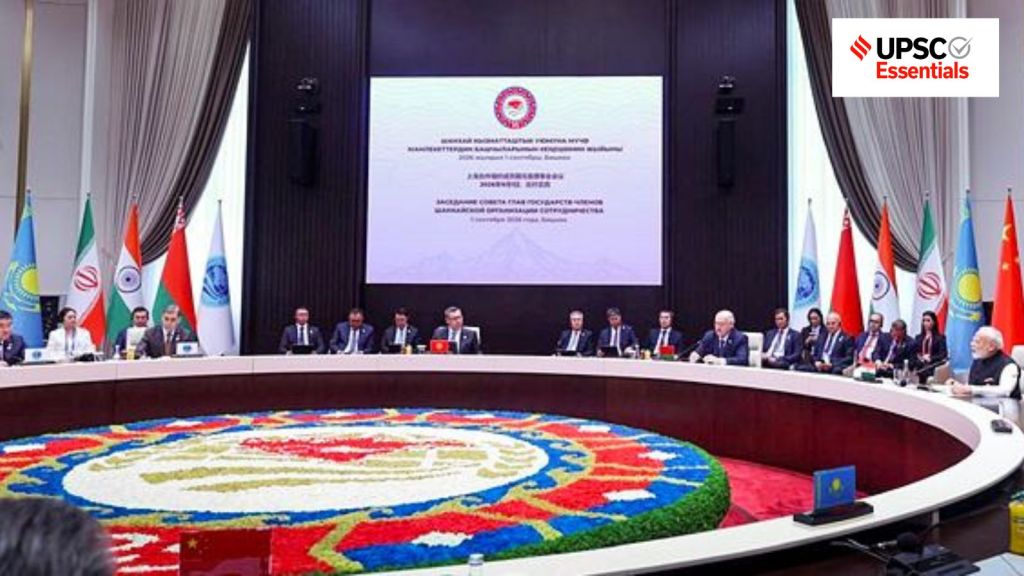 Prime Minister Narendra Modi and world leaders at the Shanghai Cooperation Organization (SCO) Council of Heads of State Meeting, in Bishkek, Kyrgyzstan. (MEA India/X via PTI Photo)



 Share


