
As nuclear power moves into space, how can it be made safe and responsible?
As countries explore nuclear power options for deep-space missions, an important question arises: how can nuclear power be used safely and responsibly, and are existing international space laws adequate to govern its use? See infographics.
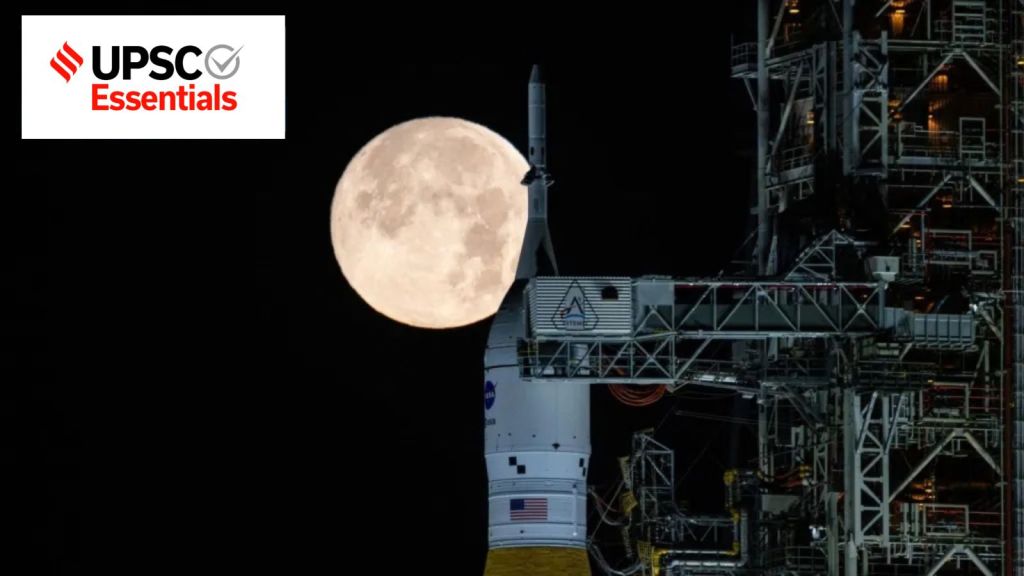 A full Moon is seen shining over NASA’s Space Launch System and Orion spacecraft, atop the mobile launcher in the early hours of February 1, 2026. Photo: NASA/Sam Lott
— Renuka
As space exploration moves from short-term missions towards sustained activities on the Moon, Mars and beyond, reliable energy is becoming increasingly important. Solar power remains the main source of energy for most spacecraft, but its effectiveness falls with increasing distance from the Sun and is limited in permanently shadowed regions and during long lunar nights. Extreme temperatures and radiation also pose challenges for solar panels.

Nuclear energy offers an alternative because it can provide compact and continuous power without depending on sunlight. Radioisotope power systems have supported space missions since 1961, while fission reactors are now being developed for higher-power applications and propulsion. As the US, China, Russia, and India expand their ambitions in lunar and deep-space exploration, nuclear power raises an important question: how can it be deployed safely and responsibly, and what international rules should govern its use?
Nuclear energy in space
Nuclear energy is used in space in two broad ways: through radioisotope systems and through fission systems.
Radioisotope power systems
Radioisotope thermoelectric generators (RTGs) convert the heat released by the natural decay of radioactive material, usually plutonium-238, into electricity. They have no moving parts and can supply useful power and heat for decades. A related device is the Radioisotope Heater Unit (RHU), which produces no electricity but only supplies heat, which keeps instruments and batteries from freezing in extreme cold.
Different types of RTGs have powered various space missions of NASA, including Voyager space probes, and Curiosity and Perseverance rovers. Voyager 1 and 2 were launched in 1977 on missions originally expected to last only five years, but have continued operating for nearly half a century.
India has also begun exploring the use of nuclear power in its space missions. In 2021, ISRO invited proposals to develop a 100-watt RTG, which could provide a reliable source of power for future deep-space missions. India also has ambitious plans for human spaceflight missions, setting up a space station, and even landing humans on the Moon.
Nuclear power in space: where it runs, who is racing for the Moon, and where the rules fall short
Fission systems
Fission reactors work differently from RTGs. Instead of producing energy from the natural decay of radioactive material, they generate heat through a controlled nuclear chain reaction. This heat can then be converted into electricity.
Their main advantage is a relatively much higher power output. This makes fission reactors suitable for missions that require large amounts of electricity, such as future bases or long-duration missions on the Moon and Mars, where power would be needed for habitats, life support, communications, etc.
Nuclear energy can also move spacecraft. Nuclear thermal propulsion (NTP) uses a reactor to heat a propellant such as liquid hydrogen and expels it through a nozzle, giving roughly twice the propellant efficiency of the best chemical rockets. Nuclear electric propulsion (NEP) converts reactor heat into electricity, which is then used to accelerate an ionised propellant. Its thrust is low, but its very high efficiency makes it attractive for long deep-space journeys.
From deep-space missions to lunar bases
These technologies provide reliable energy for spacecraft operating deep in space, enabling them to continue sending unique scientific data back to Earth. Some of the most established use of nuclear power is in deep-space missions, lunar exploration, and long-duration missions.
Deep-space missions
The most established uses of nuclear power are in deep space. Beyond Mars, sunlight becomes too weak for high-energy missions. Nuclear systems work continuously and do not need to be pointed at the Sun, which makes them especially useful in dark or cold environments.
The Voyager spacecraft, now more than 20 billion km from Earth, has run on radioisotope power for nearly five decades. NASA’s Dragonfly rotorcraft, scheduled to launch to Saturn’s Moon Titan in July 2028, will also be powered by a radioisotope generator.
Lunar exploration
The permanently shadowed regions at the lunar south pole may hold water ice, but they receive little or no sunlight. In August 2025, NASA announced plans to fast-track the development of a fission surface power system of at least 100 kilowatts, with the goal of placing a nuclear reactor on the Moon by the first quarter of fiscal year 2030.
In April 2026, a White House memorandum targeted 20-kilowatt reactors in orbit by 2028 and on the Moon by 2030, with higher-power systems in the 2030s. NASA has also invited the Indian Space Research Organisation (ISRO) to join its Moon Base programme. Meanwhile, China and Russia have announced a joint plan to place a reactor on the Moon by the mid-2030s for their International Lunar Research Station.
Long-duration missions
Nuclear propulsion could transform how far and how fast we travel. Shorter transits to Mars would reduce astronauts’ exposure to space radiation and allow spacecraft to carry more cargo.
Future space infrastructure
Reactors could power lunar habitats, life-support systems and communications, and help extract water and oxygen from lunar soil. Over time, reliable nuclear power could anchor permanent bases on the Moon and Mars, and the wider infrastructure a sustained space economy requires.
Governing nuclear power in space
The deployment of nuclear technology in outer space gives rise to distinct safety concerns. The foremost is the risk of safe launch and re-entry. A nuclear source on a rocket must be designed to survive a launch failure or an accidental fall back to Earth.
In 1978, the Soviet satellite Cosmos 954 re-entered over northern Canada and scattered radioactive debris from its onboard reactor. Canada claimed compensation, and the matter was settled in 1981 for C$3 million.
Notably, deep-space missions already expose astronauts and spacecraft to cosmic rays and solar particles. And the reactor itself needs careful shielding and operational controls. International space law provides a foundation, but not a complete regime.
The Outer Space Treaty, 1967
It requires states to carry out space activities in line with international law and bans placing nuclear weapons and other weapons of mass destruction in orbit or on celestial bodies. The Treaty makes states internationally responsible for national space activities, including those of private companies.
It also requires states to avoid harmful contamination of outer space and celestial bodies. The Convention on International Liability for Damage Caused by Space Objects, 1972, makes a launching state absolutely liable for damage its space object causes on Earth or to aircraft in flight.
Principles relevant to the Use of Nuclear Power Sources in Outer Space
Adopted by the United Nations General Assembly in 1992, it set rules on safety assessment, radiation protection and notification when a nuclear-powered object is about to re-enter the atmosphere. However, they apply only to nuclear sources that generate electricity for non-propulsive purposes.
Safety Framework for Nuclear Power Source Applications in Outer Space
The 2009 safety framework was developed jointly by the UN Committee on the Peaceful Uses of Outer Space (COPUOS) and the International Atomic Energy Agency (IAEA). It provides guidance on safety during launch, operation and the end of a mission.
Technical and safety challenges
Several challenges need to be addressed before nuclear technology can be used more widely in space. Nuclear propulsion is still at an early stage of development and requires further testing before it can be used regularly.
Another challenge is the limited availability of plutonium-238, which is used in radioisotope power systems. The US restarted its production in 2015 after a gap of nearly 3 decades, showing the difficulty of maintaining a reliable supply.
Yet another key concern is safety. The nuclear systems used in space have to be designed so that they can endure launch accidents and other kinds of failure. They also require specialised materials, extensive testing, and careful safety procedures.
Since an increasing number of countries are planning to use nuclear power for missions to the Moon and for deep-space missions, common safety standards and more international cooperation will become ever more important.
Need to strengthen international regulations
The way forward should, therefore, involve combining technological development with stronger international regulation. Countries should work towards common safety standards covering the design, launch, operation and disposal of nuclear systems in space.
The United Nations could consider whether the existing principles on nuclear power sources in space need to be updated to address newer technologies such as high-power reactors and nuclear propulsion. While pursuing its ambitious space missions, India can contribute to international discussions on the safe and responsible use of nuclear technology.
As the use of nuclear power in space expands, its success will depend not only on technological development but also on strong safety standards, international cooperation and responsible regulation.
Post read questions
1. The growing use of nuclear technology in space reflects the transition from short-duration exploration to sustained space activities. Discuss.
2. Examine the technological and operational challenges involved in radioisotope power systems and fission reactors in deep-space exploration.
3. What are the principal safety, technological, environmental and geopolitical concerns associated with the deployment of nuclear systems in outer space? Suggest measures to address them.
4. With multiple countries planning lunar bases and deep-space missions, common international safety standards for space nuclear systems are becoming increasingly important. Discuss.
5. How adequate are existing international mechanisms for ensuring the safe and responsible use of nuclear power sources in outer space? How can India contribute to the international governance of nuclear technology in space?
(Dr. Renuka holds a PhD in environmental law from Himachal Pradesh National Law University, Shimla.)
Share your thoughts and ideas on UPSC Special articles with ashiya.parveen@indianexpress.com.
Click Here to read the UPSC Essentials magazine for September 2026. Subscribe to our UPSC newsletter and stay updated with the news cues from the past week.
Stay updated with the latest UPSC articles by joining our Telegram channel – IndianExpress UPSC Hub, and follow us on Instagram and X.

 Share


