
Now if I ask what is the national tree of India, the answer is simple: the Banyan tree. It is a sacred tree in Hinduism, Buddhism (linked to Kashyapa Buddha, not Gautama Buddha) and Jainism (linked to Neminatha, the 22nd Tirthankara). And this national tree is also the state tree of Gujarat and Madhya Pradesh.
But in Haryana, Bihar, and Odisha, the state tree is the Pipal tree under which the Gautama Buddha attained enlightenment as did the 23rd Tirthankara Parshvanath, who lived before Mahavira.
Image design: Angshuman Maity
Sacred Sal, Ashoka and Shami
In Chhattisgarh and Jharkhand, it is the Sal tree. In Kishkindha Kanda of the Ramayana, Ram shoots an arrow through seven Sal trees. The Sal tree is also linked to Buddhism. The Buddha was born when his mother was holding a branch of the Sal tree. Also, the Buddha died between two Sal trees. Munisuvrata, the 20th Tirthankara, who lived during the time of Ram, is linked to the Sal tree.
The Ashoka tree is the state tree of Uttar Pradesh, while the Ashoka flower is the state flower of Odisha. The tree with its orange flowers is also linked to the Ramayana as Sita was kept in the Ashoka garden or Ashok Vatika of Lanka.
The Khejri tree, also known as the Shami tree, is the state tree of Telangana and Rajasthan. It grows in arid regions and is linked with warrior communities. The Khejri tree is also found on the Harappan seals. It is slightly thorny and venerated by royal families during Dussehra festivals. The Mahabharata says that during exile, the Pandavas hid their weapons in this tree.
The mango tree, whose leaves are used in religious ceremonies and as decorations at the entrances of homes during festivals, is the state tree of Maharashtra and Chandigarh. Interestingly, the Gulmohar Tree – although introduced to India less than 200 years ago – is presumed to be the state tree of the National Capital Territory of Delhi. For Christians of Kerala, the red flowers of the Gulmohar are the blood of Jesus that fell on the tree when he was crucified. They refer to the tree as “Kaalvarippoo” (Calvary flower).
State trees in the south
As we go south, we notice that the Neem tree, which is sacred to the goddess, is the state tree of Andhra Pradesh. The Bael or Bilva tree, sacred to Shiva, is the state tree of Puducherry. The toddy palm, which is sacred to Balaram, is the state tree of Tamil Nadu. The coconut tree, revered in most Hindu rituals, is the state tree of both Goa and Kerala. Sandalwood is the state tree of Karnataka. Sandalwood paste is sacred to Vishnu and is used in Vishnu temples.
The state trees of Himachal Pradesh, Jammu & Kashmir, and Ladakh are conifer trees (a group of cone-bearing evergreen trees). Deodar, linked to Shiva, is the state tree of Himachal Pradesh; Chinara, sacred to Sufis, is the state tree of Jammu & Kashmir, and Juniper, associated with Tibetan Buddhists, is the state tree of Ladakh.
In Sikkim and Uttarakhand, the Rhododendron tree is the state tree. Its bright red flowers are offered to the goddess Nandadevi.
Timber trees and tribal traditions
If we go towards the Northeast, we see that many state trees are mostly timber trees venerated by local tribes – like Hollong in Assam and Arunachal Pradesh, Alder in Nagaland, the Wood King in Manipur, White Teak in Meghalaya, and the Redwood in Andaman.
The iron tree of Mizoram is a sacred tree in Buddhism and is linked to many future Buddhas. It is also the national tree of Sri Lanka. Tripura’s state tree is the fragrant Agar, which is used to make scent. In West Bengal, the sacred tree is Saptaparni, whose bark is used to make school blackboards. Graduates of Santiniketan’s Vishwa-Bharati University carry a sprig of this tree during their graduation ceremony.
The Breadfruit tree of Lakshadweep is a reminder of the great Polynesian seafarers who travelled to this island thousands of years ago from the Pacific and introduced this plant. Thus, a study of state trees tells us a lot about Indian culture.
Post Read Questions
Why is the Banyan tree considered significant in the Indian cultural and religious context? Which states have the Pipal tree as their state tree, and what is its religious significance?
How is the Sal tree linked to both Hinduism and Buddhism? What is the mythological relevance of the Ashoka tree?
Which states consider the Khejri or Shami tree as their state tree, and what is its association with Mahabharata?
Which trees are considered sacred in the southern states, and what deities are they associated with?
What role do timber trees play in the cultural traditions of Northeast states?
(Devdutt Pattanaik is a renowned mythologist who writes on art, culture and heritage.)
Share your thoughts and ideas on UPSC Special articles with ashiya.parveen@indianexpress.com.
Subscribe to our UPSC newsletter and stay updated with the news cues from the past week.
Stay updated with the latest UPSC articles by joining our Telegram channel – IndianExpress UPSC Hub, and follow us on Instagram and X.

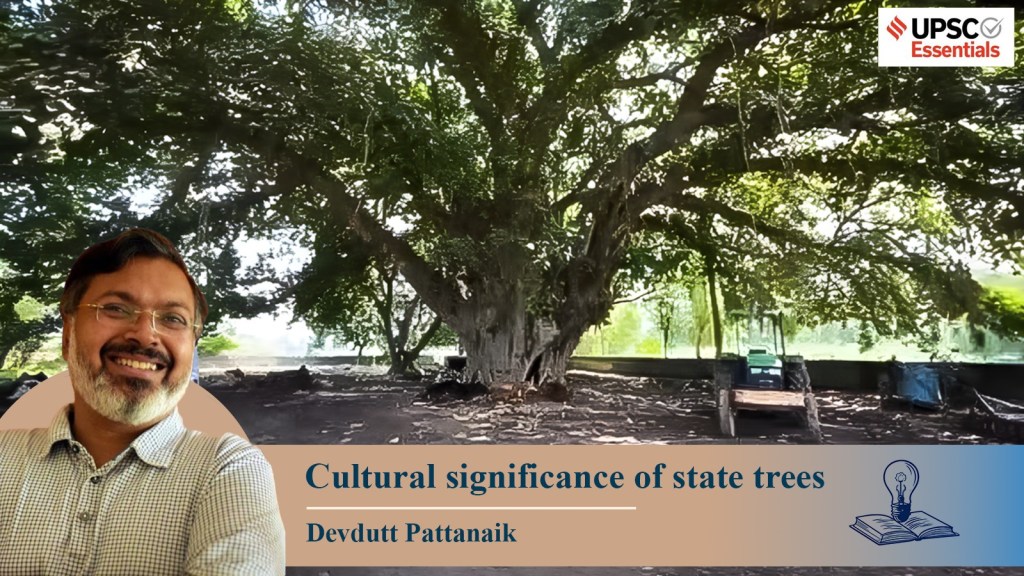

 Image design: Angshuman Maity

 Share


