


Journalism of Courage
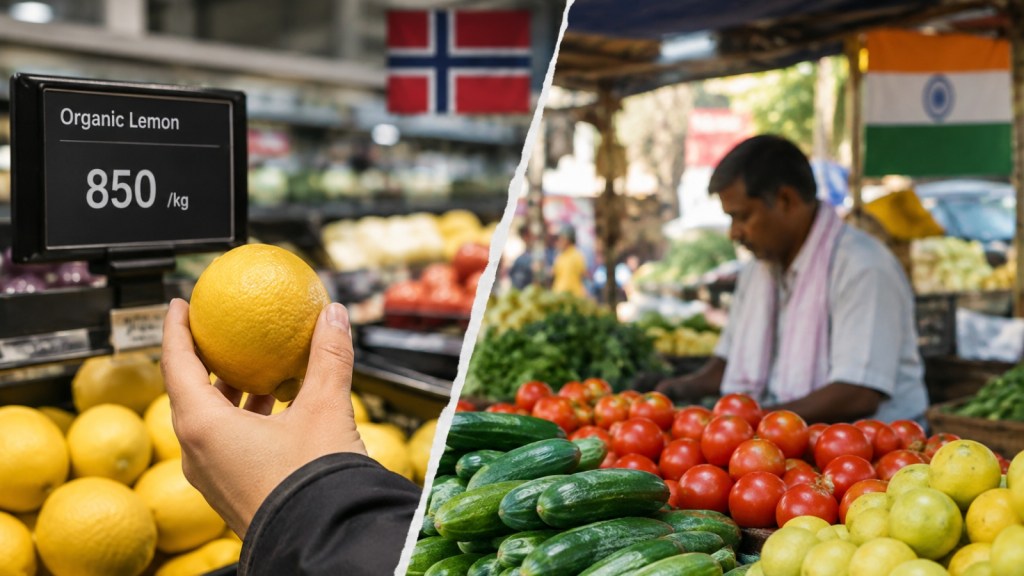 The post sparked a discussion, with users pointing to everything from transportation and wastage to purchasing power as possible reasons for the difference.
An Indian living in Norway has drawn attention online after sharing how much everyday vegetables cost in the European country compared with prices in India, with the price gap prompting a wider discussion about what farmers earn for their produce.
In a post on X, a man identified as Vinod shared a video from a Norwegian grocery store, showing the prices of vegetables including lemons, tomatoes, and cucumbers. “Even after living in Norway for years, it still surprises me every time I visit the butikk,” he wrote.
According to him, organic lemons were priced at Rs 850 per kg, tomatoes at Rs 680 per kg, while a single cucumber cost Rs 300.
He then put those figures against what consumers in Indian metros typically pay. Lemons, he said, cost around Rs 90-Rs 110 per kg, tomatoes Rs 60-Rs 80 per kg, and cucumbers Rs 20-Rs 30 each, depending on their quality.
“It’s 8 times cheaper than Norway, but salaries aren’t 8 times higher in Norway – not even close. Still, we complain as always,” he wrote.
But the comparison was not simply about how expensive groceries are in Norway. Vinod said the difference also made him question how much Indian farmers actually earn from the produce they grow.
“It’s not about Norway’s cost structure, salaries, imports and so on… it just makes me wonder if we’re paying our farmers fair price, enough for their hard work in India,” he wrote, asking whether India is “failing our farmers”.
Even after living in Norway for years, it still surprises me every time I visit the butikk 😊🇳🇴
These are the daily prices of groceries:
Organic lemon: ₹850/kg, tomato: ₹680/kg, cucumber: ₹300 each 😳
In India’s metros, lemons can cost around ₹90–₹110/kg, tomatoes… pic.twitter.com/JeLxob8dkK
— Vinod (@turiyatman) September 29, 2026
The post sparked a discussion, with users pointing to everything from transportation and wastage to purchasing power and the role of middlemen as possible reasons for the difference.
“In India, tomato farmers often get only about a third of what we pay at the mandi/store and the rest goes to transport, wastage, and middlemen,” an X user commented.
Another argued that the difference should be viewed in the context of living standards, writing, “Your are living in the best country in terms of living standard and quality of life. Govt makes you spend at least a standard amount to ensure your quality of living. Its not in India.”
A third user brought the value of currencies into the discussion, writing, “Have you heard of something called Purchase Power Parity? Is almost 4 times than Indians. Now 80% population BPL in India.”
The contrasting responses shifted the conversation from a simple India-Norway price comparison to a broader debate over food prices, farmers’ earnings, and factors that determine what consumers ultimately pay.


